
UK peregrine habitat could grow by 73.5%, but climate suitability is not occupancy
The projections span 16 breeding raptors, but prey supply, nesting sites and human pressures remain outside the map.
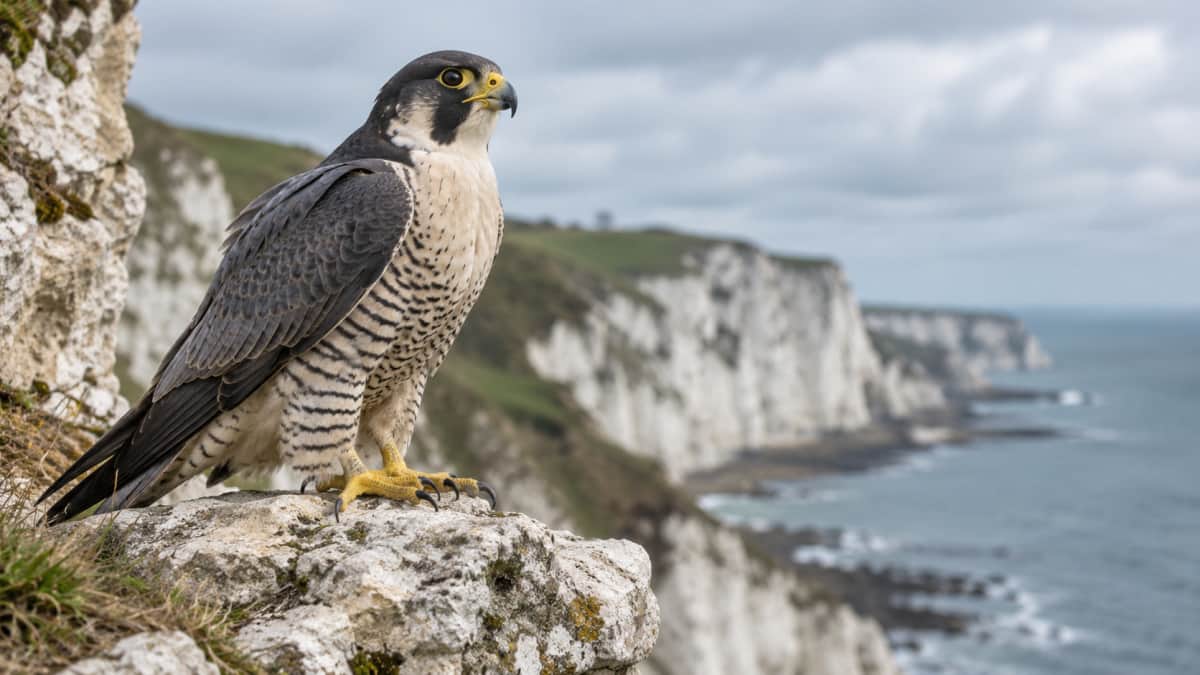
Why it matters: Climate-driven shifts in suitable range could change where raptors can live, but the models do not show whether populations can establish there.
110,257 sq km — current modelled area suitable for peregrine falcons in the UK
155,000 sq km — projected area under SSP2-4.5 for 2041–2060, a 40.6% increase
191,319 sq km — projected area under SSP5-8.5 for 2061–2080, a 73.5% increase
97.2% — projected loss of suitable area for white-tailed eagles under the higher-emissions scenario
A study by Connor T. Panter of the University of Nottingham projects that climate-suitable territory for peregrine falcons in the United Kingdom could expand by 73.5% by 2061–2080 under a high-emissions scenario. The modelling also points to substantial losses for some other breeding raptors, showing that warming could shift the balance of suitable environments across species.
Peregrine range expands in both scenarios
The model estimates about 110,257 square kilometres of currently suitable environmental conditions for peregrines. Under the intermediate SSP2-4.5 pathway, that area could reach 155,000 square kilometres in 2041–2060, a 40.6% increase. Under SSP5-8.5, the projected average rises to 191,319 square kilometres in 2061–2080—about 81,000 square kilometres more than the baseline.
All five climate models used in the study project an expansion for the species, although they differ on its size. The result describes environmental suitability, not a forecast that peregrines will occupy every additional area or reproduce there.
The species uses varied settings, including coastal cliffs, mountains and urban structures that provide nesting sites. Its diet depends mainly on other birds, so prey availability is also relevant. Changes in nesting opportunities, prey populations and human activity could affect whether newly suitable areas support breeding populations.
Climate gains are not shared across raptors
The projections vary sharply among the 16 species assessed. Under the higher-emissions scenario, suitable area for the hen harrier could increase by 41%, while the short-eared owl could lose 67.6% of its suitable range. The study also projects declines for the red kite, merlin and goshawk.
The most severe modelled reduction is for the white-tailed eagle: suitable area falls from about 2,306 square kilometres to 65 square kilometres, a 97.2% decline. The study cautions that the species already has a small area classified as suitable and that the projections carry uncertainty. A reduction in suitable range does not by itself mean that a species will disappear.
Models map climate, not future populations
The research used MaxEnt species-distribution models, matching recorded locations with environmental conditions. It considered 14 variables, including temperature, rainfall, altitude, slope and land cover, alongside five global climate models and two emissions pathways for 2041–2060 and 2061–2080.
The models kept current land-cover characteristics constant, so they did not account for future changes from urbanisation, agriculture or ecosystem modification. Their ability to distinguish suitable from less suitable areas was also relatively low for several species, including the peregrine falcon.
The projections are therefore scenarios of environmental suitability rather than exact maps of future distribution. Monitoring whether populations move into newly suitable areas—and whether prey and nesting conditions support breeding—will be needed to test the modelled changes.
More in Resources
Iraq pushes for a larger OPEC+ oil quota as capacity estimates diverge
Baghdad wants future allocations based on a higher benchmark, while a technical review points to a lower sustainable ceiling.

Diesel supply risk in 2027 puts Chile's copper miners' costs in focus
Open-pit fleets depend on a fuel market where crude availability and refinery output are diverging.

Gazprom’s 400 MW gas-station plan faces a test: compressor capacity is not power output
Russia’s data-centre expansion is colliding with regional power gaps, while Gazprom’s candidate assets were built to move gas.