
Selenium Isotopes Trace Subducted Material Into New Oceanic Crust
The trench-to-ridge connection spans deep mantle processes, and rocks formed at its far end may hold the evidence.
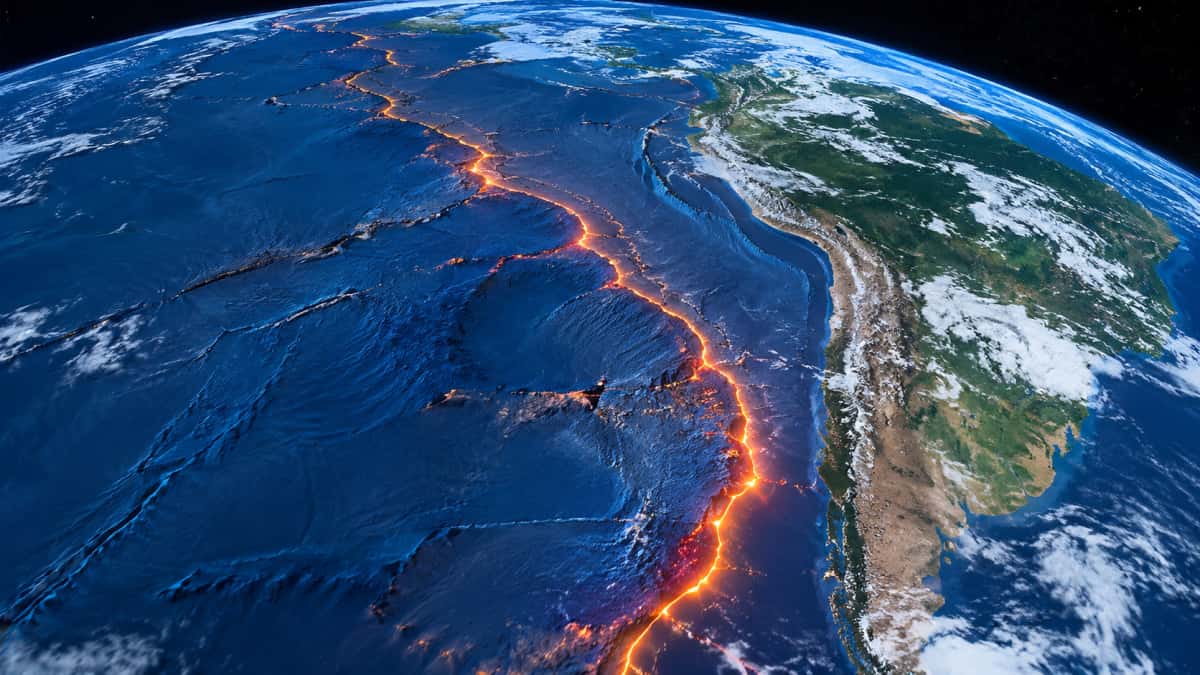
Why it matters: Tracing how elements move through the mantle could refine geological models used to understand magmatism and mineral formation.
Hundreds of millions of years — the timescale over which the geological processes studied may unfold.
November 25, 2026 — the date the research was reported and published in Science Advances.
An international research team used selenium isotopes to trace how material carried into the mantle by subduction can reappear in magma that forms new oceanic crust. The study, involving the University of Chile and institutions in Spain and France, combines geochemical indicators with thermodynamic models to connect processes deep inside Earth with volcanism at ocean ridges.
The findings suggest that even small proportions of recycled material can leave a detectable chemical signal in those magmas. The work does not identify a mineral deposit, but it offers a way to investigate how Earth’s internal recycling shapes the composition of newly formed rocks.
From subduction zones to the mantle
At a subduction zone, one oceanic plate descends beneath another. As the rocks sink, increasing pressure and temperature alter their mineralogy and chemistry. Some of their components interact with the surrounding mantle, changing the composition of material at depth.
What happens to those components after they enter the mantle is a central question in deep-Earth geology. The researchers examined differences among selenium isotopes—variants of the same element with different atomic masses—as indicators of processes that can alter the relative distribution of elements in rocks.
The isotope evidence was assessed alongside thermodynamic modelling to reconstruct transformations experienced by subducted material. The study links that deep geological history to magmas that later rise and contribute to oceanic crust, though the reported findings do not specify a single route or timescale for every recycled component.
A chemical record in ridge magmas
Ocean ridges form where tectonic plates move apart. Mantle material can partially melt in these regions and rise; as magma cools, it forms rocks that become part of the ocean floor. The research indicates that this process need not draw on chemically uniform mantle material: recycled components may be incorporated and preserve a signal of earlier geological events.
That signal matters because the rocks at a ridge can record processes that began far away and much earlier. The study’s approach provides a geochemical means of testing for such recycled material, rather than treating the composition of new oceanic crust as evidence only of the mantle’s present state.
Relevance to mineral-system models
The research does not report new mineralization or directly locate deposits. Its potential application is in improving models of how elements move through Earth, including during melting, rock interaction and fluid circulation. Those processes can influence the distribution of metals and other chemical components.
The connection is relevant to Chile, where subduction, magmatism and mineralization have shaped the Andes and are associated with major porphyry copper systems. The study addresses oceanic crust formation, not a specific Andean deposit, so its contribution is foundational: better constraints on deep-Earth recycling may help researchers refine broader models of crustal and mantle evolution.
The authors’ approach uses selenium isotope indicators together with thermodynamic models; applying and refining those tools will be necessary to investigate the origin and movement of geological materials in greater detail.
More in Resources
US data centers generated 25.7Mt of power-linked CO₂, but grid mix matters
A Harvard assessment of 403 large facilities shows why the climate cost of digital infrastructure cannot be judged by electricity use alone.

Gold falls below US$3,500 as 2027 mine budgets face a price test
Companies are setting exploration and investment plans while US inflation data challenges the price assumptions behind project economics.
China connects Qiongjie’s first turbines, while the 500 MW target remains ahead
At roughly 5,100 metres, thinner air affects energy capture and cooling, while cold and logistics add operational constraints.