
Minesto’s T-Dragon targets shallow tidal sites, but Chile’s site case is unresolved
Chacao’s fast flows fit the system’s stated range on paper, while local depth, ecology and grid access still require assessment.
Why it matters: A system designed for shallower, faster currents could expand the locations considered for tidal power, but its commercial and local viability remains to be established.
25–30 metres — designed operating depth for T-Dragon.
5 metres per second — maximum current speed in the stated operating range.
650 GW — Minesto’s estimate of global marine-energy resource potential, not installed capacity.
1.2 MW — Dragon 12’s nominal capacity when connected to the Faroe Islands grid in 2024.
Minesto unveiled its T-Dragon configuration on November 26, 2026, aiming to operate in water 25 to 30 metres deep and in currents of up to five metres per second. The Swedish company says the design could make some sites more accessible where conventional fixed tidal turbines face technical or economic constraints. Chile’s Chacao Channel has currents that may be relevant, but no T-Dragon installation there has been confirmed.
A moving turbine beneath the surface
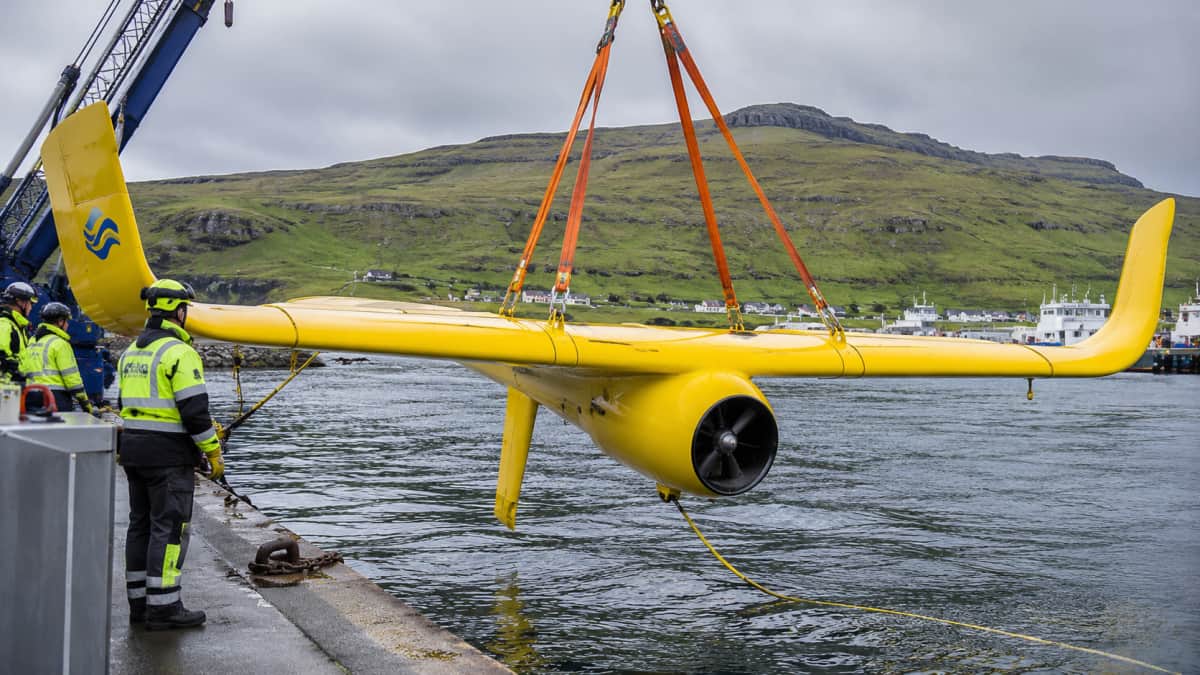
T-Dragon uses a tethered underwater device with a hydrodynamic structure, turbine, generator and control system. The current drives it along a controlled figure-eight path, increasing the water’s speed relative to the turbine beyond the natural flow speed. The turbine converts part of that kinetic energy into electricity, which is carried by cable to a seabed base and then toward distribution infrastructure.
Unlike a fixed turbine, the device moves through a larger area of water. The available power in a flow rises approximately with the cube of its speed, although the electricity delivered depends on system efficiency and losses. Minesto has identified 650 GW of marine-energy resource potential worldwide; that estimate is not installed capacity, approved projects or guaranteed commercial generation.
Earlier Minesto devices have generated power
The company’s technology has operated in real marine conditions. In February 2024, its Dragon 12 device, with a nominal capacity of 1.2 MW, was connected to the grid in the Faroe Islands’ Vestmannasund strait. The unit has a 12-metre wingspan. In March 2026, the smaller Dragon 4 began generating electricity at a nominal capacity of 100 kW as part of development work for microgrids.
Those deployments provide operating experience for the technology family, but Minesto has not publicly detailed T-Dragon’s nominal capacity or a definitive commercial deployment schedule. The new configuration is intended to extend the operating range; its performance at a particular site would still need to be assessed.
Chacao offers a potential site, not a project
Hydrodynamic studies in the Chacao Channel, in Chile’s Los Lagos Region, have identified currents approaching four metres per second during periods of stronger tidal flow. That is within T-Dragon’s stated maximum speed, but speed alone does not establish a viable location. Water depth, bathymetry, biodiversity and electrical infrastructure would also require site-specific assessment. Chile’s more than 4,000 kilometres of continental coastline and research activity through the Marine Energy Research and Innovation Center provide a basis for evaluating ocean-energy technologies, but they do not amount to a confirmed Minesto project.
Tidal flows are predictable, though they weaken during parts of the tidal cycle and can become slow as flow direction changes. Installation, maintenance, grid connections and device recovery can add costs, while environmental assessments must consider marine life, fisheries and navigation. For Chile, the next step would be site-specific technical and environmental studies; Minesto has not announced a T-Dragon installation in the country.
More in Resources
Iraq pushes for a larger OPEC+ oil quota as capacity estimates diverge
Baghdad wants future allocations based on a higher benchmark, while a technical review points to a lower sustainable ceiling.

Diesel supply risk in 2027 puts Chile's copper miners' costs in focus
Open-pit fleets depend on a fuel market where crude availability and refinery output are diverging.

Gazprom’s 400 MW gas-station plan faces a test: compressor capacity is not power output
Russia’s data-centre expansion is colliding with regional power gaps, while Gazprom’s candidate assets were built to move gas.