
Copper prices can swing sharply even when mine output barely moves
Chile's export and fiscal exposure is tied to a benchmark that can move before physical supply and consumption do.
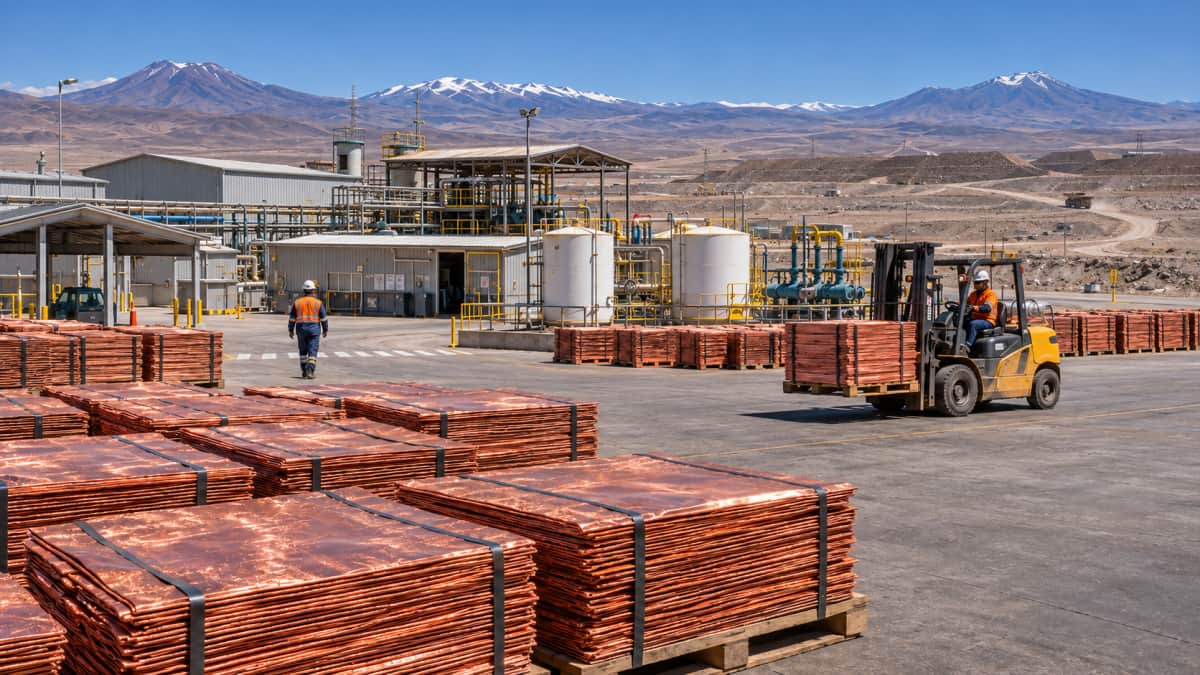
Why it matters: Copper's price can shift Chile's export values and fiscal outlook without a matching change in mine production.
58% — China's approximate share of refined copper consumption in 2026.
24.8% — increase in Cochilco's 2026 average-price projection between February and October 2026.
US$1,102 million — theoretical annual value change for each US$0.10/lb price move, assuming constant Chilean production of five million tonnes.
Copper prices can move sharply even when mines and consumers have not materially changed their activity because the market trades on expectations as well as physical supply and demand. Chinese economic signals, exchange inventories, the US dollar, mine disruptions and investment flows can all shift the expected balance—and the price—before the underlying metal flows adjust.
For Chile, the swings reach beyond mining companies. Copper prices affect export values, tax receipts, the exchange rate, investment and activity in mining regions. A change in the benchmark can therefore alter economic and budget assumptions even when production remains steady.
China’s demand signals shape expectations
China accounted for approximately 58% of global refined copper consumption in 2026, according to the figures cited in the market analysis. Its manufacturing sector, infrastructure investment, property construction, power networks, vehicle production and machinery demand make the country a central influence on copper expectations.
Signs of stronger Chinese growth can support prices as traders anticipate higher consumption. Policy announcements may also move prices before any resulting stimulus translates into actual metal consumption.
The US dollar and interest rates add another layer. Because copper is priced internationally in US dollars, a stronger dollar can make it more expensive for buyers using other currencies, potentially weighing on demand. Higher US interest rates can also increase financing costs and make some financial assets more attractive. These relationships are not automatic: a significant supply disruption can support copper even as the dollar strengthens.
Inventories and mine disruptions tighten the balance
Stocks reported at the London Metal Exchange (LME), COMEX and Shanghai Futures Exchange (SHFE) are closely watched as indicators of available exchange-held metal. Falling inventories alongside firm consumption can reinforce perceptions of scarcity; sustained stock accumulation can suggest weaker demand or supply exceeding immediate needs.
Location matters, too. Metal accumulating in the United States can coexist with tighter availability in Europe or Asia, contributing to differences among markets. Exchange stocks also exclude copper held in industrial and commercial facilities outside those systems, so they do not capture all global inventories.
Supply can be slow to respond when a large mine is disrupted. Strikes, accidents, geotechnical or metallurgical problems, water and power constraints, social conflict and project delays can all affect output. While a stoppage can alter supply expectations within days, developing a new mine may take more than a decade.
That limited short-term flexibility helps explain why relatively small deficits can move prices. In a hypothetical 28-million-tonne market, a 250,000-tonne deficit would equal 0.89% of annual volume. With available inventories low, even a sub-1% imbalance may have an outsized effect because neither supply nor demand can adjust quickly.
Financial flows meet longer-term demand pressures
Funds, banks and other investors trade copper futures based on expectations for growth, interest rates and risk. Their buying or selling can amplify moves linked to physical conditions; simultaneous position liquidation can also drive a sharp decline without an equivalent change in industrial consumption.
Cochilco’s projections illustrate how quickly market expectations shifted during 2026. Its average-price estimate for that year rose from US$4.95/lb in February to US$6.18/lb in October, an increase of approximately 24.8%. These were annual forecasts, not recorded prices for a particular trading day. The agency’s 2027 projection also changed, from US$5.00/lb in February to US$5.95/lb in October.
Longer-term demand from transport electrification, renewable energy, data centres and grid upgrades is developing alongside constraints that include declining ore grades, rising investment costs and a limited pipeline of major discoveries. Those structural pressures do not prevent short-term corrections when financial conditions or growth expectations shift.
The Chilean value calculation is also illustrative rather than a measure of revenue: it assumes five million tonnes of production and values all metal at the stated price change. It does not represent tax receipts, mining profits or realized exports.
More in Resources
Chile's molybdenum output rebounds, but copper mines still set the supply pace
Steelmaking accounts for roughly four-fifths of demand, while the metal also serves energy, aerospace and chemical industries.
Chile’s 839 tailings deposits offer a supply option, but economics vary by site
Abandoned and inactive sites make up most of the registry, but metal content and remediation costs differ from one deposit to the next.
El Teniente’s Andes Norte pause puts Chile’s deep-copper push to the test
As surface deposits mature, Chile’s major operations must reach deeper ore while managing increasingly complex rock conditions.