
Chile's molybdenum output rebounds, but copper mines still set the supply pace
Steelmaking accounts for roughly four-fifths of demand, while the metal also serves energy, aerospace and chemical industries.
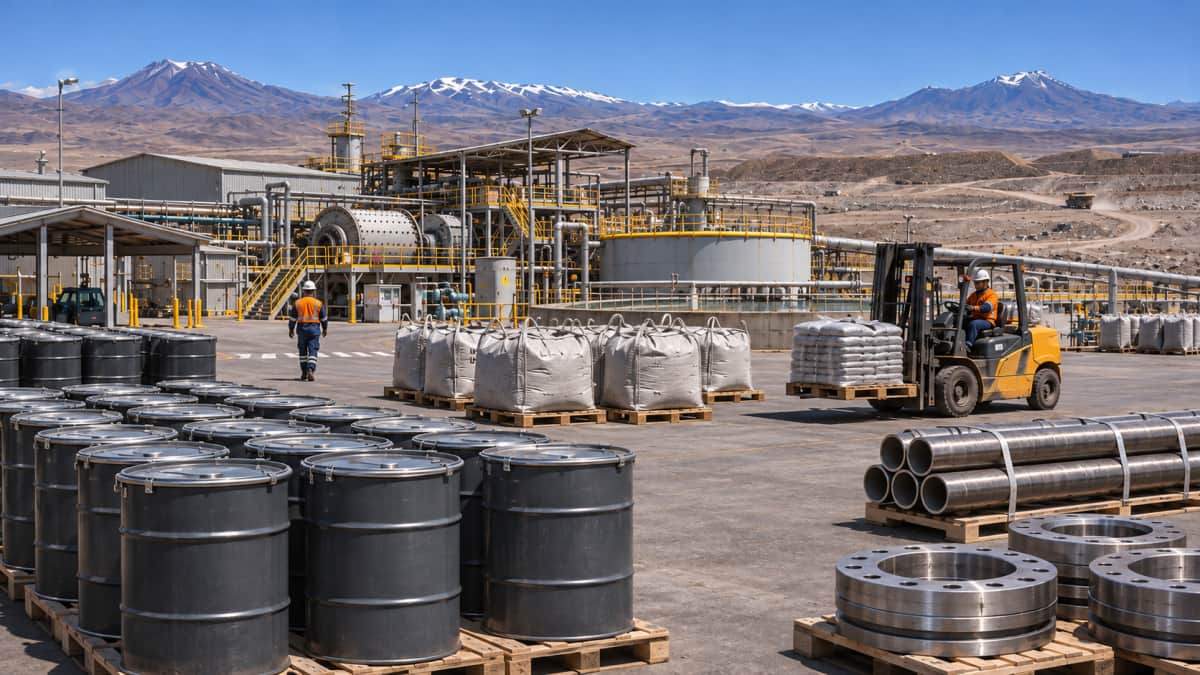
Why it matters: Molybdenum adds revenue to copper operations while supplying alloys used in equipment built for heat, pressure and corrosion.
260,000 tonnes — estimated global mine production of contained molybdenum in 2025
43,400 tonnes — Chile's estimated production in 2025, about 17% of the global total
About 80% — share of molybdenum use going to steel and iron products
2.6 million tonnes — estimated Chilean molybdenum reserves
Chile produced an estimated 43,400 tonnes of molybdenum in 2025, up 12.7% from 38,500 tonnes in 2024, according to the figures provided. The country was the world's second-largest producer after China, with output largely linked to molybdenum recovered as a by-product of copper mining.
That connection gives copper operators an additional revenue stream, but also means molybdenum supply is influenced by copper mine plans and the grades of molybdenite encountered. The metal's industrial importance, meanwhile, extends well beyond the mines that produce it.
Steelmaking anchors demand, with uses across industry
Molybdenum, or Mo, has a melting point of about 2,623°C. Added in relatively small quantities, it can improve the strength, hardness, heat stability and corrosion resistance of steel and other alloys. The source material estimates that about 80% of molybdenum use goes to steel and iron products.
Those properties are used in mining equipment, oil and gas pipelines and valves, power-generation facilities, nuclear installations and aerospace turbine components. Molybdenum also has applications in automotive steels, chemical-processing equipment and electronics. In some uses, replacing it can be technically difficult or reduce material performance.
Demand is not limited to established heavy industries. Nuclear and geothermal facilities, electricity infrastructure and some equipment used in hydrogen production require materials that can withstand high temperatures, pressures or corrosive conditions. Molybdenum compounds are also being studied as catalysts, while molybdenum disulfide has semiconductor properties being investigated for advanced electronics. These emerging uses remain small compared with steelmaking.
Copper operations underpin Chile's position
Global mine production was estimated at 260,000 tonnes of contained molybdenum in 2025. China, Chile, the United States, Peru and Mexico together accounted for about 90% of output, according to the figures provided. Chile's production was 45,600 tonnes in 2022 and 44,100 tonnes in 2023 before falling to 38,500 tonnes in 2024 and recovering the following year. Its estimated reserves stand at 2.6 million tonnes.
Molybdenite, the principal molybdenum mineral, occurs in many Andean copper porphyry deposits. It can be separated through selective flotation, and Chilean operations associated with molybdenum recovery include Chuquicamata, El Teniente, Los Pelambres, Collahuasi and Los Bronces. Sales can help offset some copper-production costs, though realised value depends on concentrate quality, treatment charges, contract terms and recovery costs.
An illustrative calculation in the material puts the gross annual value of 5,000 tonnes of contained molybdenum at between US$165.3 million and US$330.7 million under assumed prices of US$15 to US$30 per pound. Those figures are not current quotations or net revenue.
By-product supply adds a constraint
Because a substantial part of supply comes from copper mines, a change in copper output, mine sequencing or molybdenite grades can also affect molybdenum production. That limits the speed at which supply can respond to stronger demand, even when market prices support additional recovery.
Reported global production in the second quarter of 2026 was 167.2 million pounds, down 3% from the same period in 2025. The dependence on copper operations means disruptions or production changes at large mines can affect supply to steel and alloy makers as well as copper markets.
Chile also has downstream processing capacity. Molymet processes molybdenum concentrates through roasting and purification and produces products including molybdenum oxides, ferromolybdenum and specialised chemicals. Further recovery from mine tailings could add to supply, but its viability depends on mineralogy and whether processing costs can be justified.
More in Resources
Copper prices can swing sharply even when mine output barely moves
Chile's export and fiscal exposure is tied to a benchmark that can move before physical supply and consumption do.
Chile’s 839 tailings deposits offer a supply option, but economics vary by site
Abandoned and inactive sites make up most of the registry, but metal content and remediation costs differ from one deposit to the next.
El Teniente’s Andes Norte pause puts Chile’s deep-copper push to the test
As surface deposits mature, Chile’s major operations must reach deeper ore while managing increasingly complex rock conditions.