
Voyager 1 reaches a one-light-day distance as NASA loses its engineering data
The probe still emits a carrier signal, but the telemetry gap complicates efforts to diagnose its latest fault.
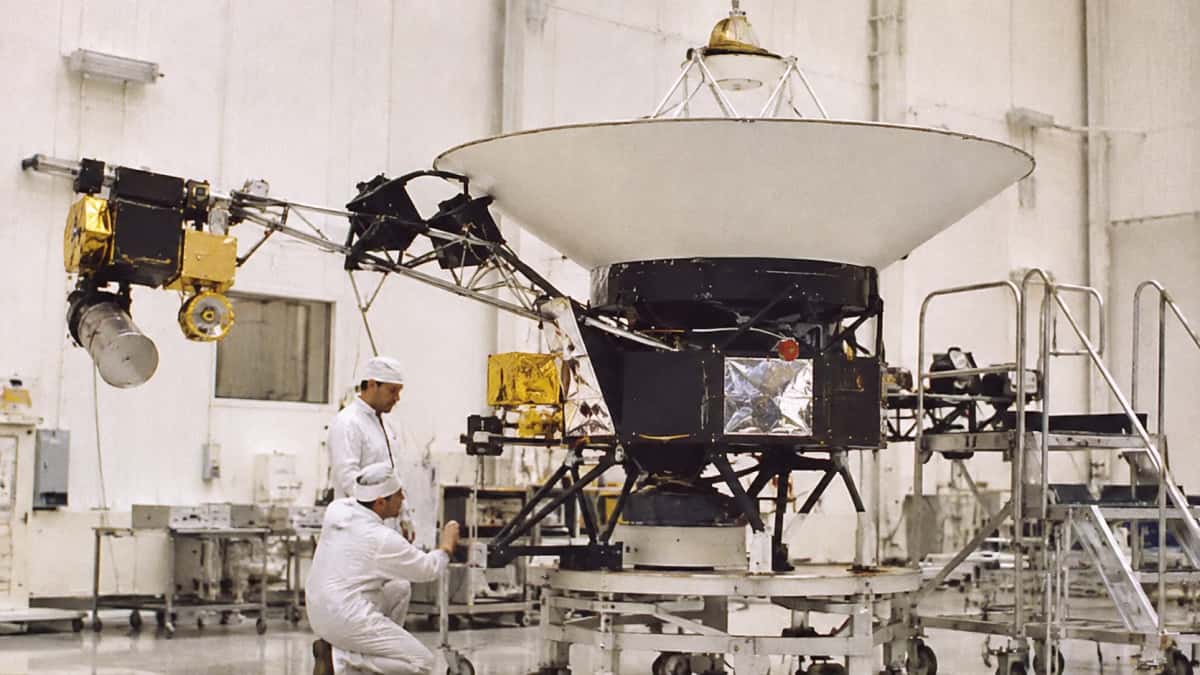
Why it matters: Voyager 1's growing distance turns a technical fault into a slow-moving operations challenge, with each exchange taking about two days.
25.902 billion kilometres — Voyager 1's distance from Earth on November 18, 2026.
About 48 hours — the approximate time for a radio exchange to travel to the probe and back.
Two instruments — the science payloads still active on Voyager 1.
NASA's Voyager 1 became the first human-made spacecraft to reach a distance of one light-day from Earth on November 18, at approximately 25.902 billion kilometres. The milestone comes as the probe continues to transmit a radio carrier signal but has stopped returning science and engineering data, leaving its operators without the information needed to diagnose its condition.
The Jet Propulsion Laboratory in California confirmed the distance on November 19, after receiving a signal sent from the spacecraft a day earlier. A command sent from Earth now takes about 24 hours to reach Voyager 1; a reply takes roughly another 24 hours. The resulting 48-hour round trip slows troubleshooting, although the carrier signal confirms that some communications systems remain operational.
A distance record, not a new boundary in space
Voyager 1 crossed the one-light-day mark at 05:16:07 Eastern time on November 18. A light-day is the distance light travels in 24 hours, not the duration of the spacecraft's journey. Voyager 1 took 49 years, two months and 11 days after launch to reach that separation, travelling outward at about 61,000 kilometres per hour.
The milestone marks a communications threshold rather than a sudden change in the spacecraft's surroundings. Radio signals from the Moon take about 1.3 seconds to reach Earth; sunlight takes roughly eight minutes and 20 seconds, while signals from Mars can take between three and 22 minutes, depending on the planets' positions. Voyager 1's signal now takes a full day.
The spacecraft entered interstellar space after crossing the heliopause on August 25, 2012, moving beyond the region dominated by the solar wind. That does not mean it has left the solar system under every astronomical definition: the distant Oort cloud lies much farther out.
Data outage complicates efforts to diagnose the probe
Since November 14, Voyager 1 has not sent usable science or engineering data, although it continues to emit a carrier signal. Engineers suspect a problem with the computer system that gathers and prepares data for transmission, but the cause has not been confirmed. The spacecraft also experienced a temporary communications interruption in October, when its signal was undetected for about 48 hours before contact resumed.
Voyager 1's power supply is another constraint. Its radioisotope thermoelectric generators convert heat from plutonium decay into electricity, but the available power declines over time. The Voyager spacecraft lose about four watts of electrical power each year, prompting engineers to turn off instruments and auxiliary systems.
A low-energy charged-particle instrument was shut down in April 2026. Two science instruments remain active: one studies plasma waves and the other measures magnetic fields. In September, engineers completed another power-saving manoeuvre by replacing three devices with lower-consumption alternatives. NASA is aiming to keep the science capability operating at least until the mission's 50th launch anniversary in September 2027, though the current data interruption remains unresolved.
A 1977 mission operating on a shrinking power budget
Launched from Cape Canaveral, Florida, on September 5, 1977, Voyager 1 was initially sent to study Jupiter and Saturn. Its observations included volcanic activity on Jupiter's moon Io and measurements of Saturn's moon Titan. The Deep Space Network, with large antennas in the United States, Spain and Australia, supports communication with the probe as its signals grow weaker and travel times increase.
Voyager 1 carries a gold-coated copper record containing sounds, images and cultural material selected to represent life on Earth. Its continued journey will outlast its eventual ability to communicate: the spacecraft is on course to pass within about 1.7 light-years of the star Gliese 445 in roughly 40,000 years. For now, engineers are working to restore data transmission while managing the probe's remaining power and the long delay between commands and replies.
More in Frontier Mining

UN gives autonomous-weapons talks two more years, but a binding treaty is uncertain
The Geneva review exposed a split between states seeking bans and military powers defending room for national rules.
BepiColombo reaches Mercury orbit, but its iron-rich interior remains a mystery
Two orbiters will examine the planet’s surface and magnetic environment, but deployment and instrument checks remain before routine observations.

Anthropic Mathematician’s Riemann Proof Faces a Test Beyond Formal Verification
The proof’s scale shifts scrutiny from machine-checking to whether specialists can reconstruct the mathematical ideas behind it.