
BepiColombo reaches Mercury orbit, but its iron-rich interior remains a mystery
Two orbiters will examine the planet’s surface and magnetic environment, but deployment and instrument checks remain before routine observations.
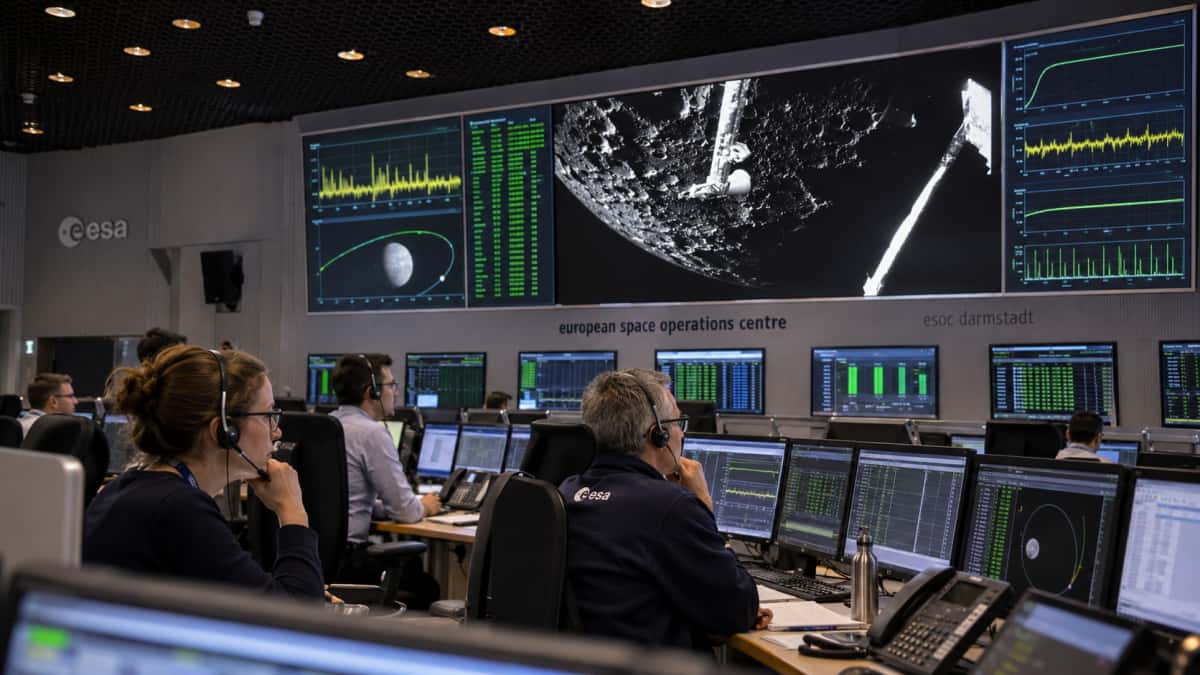
Why it matters: Mercury’s unusually large metallic core could help scientists test how rocky planets formed and evolved.
37 minutes — duration of the orbit-insertion braking manoeuvre
635 kilometres — closest approach to Mercury’s surface during the manoeuvre
Nine flybys — gravity assists used on the route to Mercury
6 April 2027 — planned start of scientific operations
BepiColombo entered orbit around Mercury on 21 November 2026 after an eight-year journey, completing a braking manoeuvre that allowed the planet’s gravity to capture the spacecraft. The joint European Space Agency (ESA) and Japan Aerospace Exploration Agency (JAXA) mission will use two orbiters to investigate Mercury’s geology, composition, internal structure and magnetic environment.
The spacecraft is the second mission to enter orbit around Mercury, following NASA’s MESSENGER, which studied the planet from 2011 to 2015. BepiColombo’s scientific operations are scheduled to begin in 2027, after the orbiters separate and complete further deployment and trajectory work.
Braking manoeuvre secured orbital capture
On 21 November, four chemical thrusters on ESA’s Mercury Planetary Orbiter (MPO) fired for about 37 minutes during the spacecraft’s closest approach, around 635 kilometres above the surface. The burn reduced the vehicle’s speed enough for Mercury’s gravity to hold it in orbit, rather than allowing it to pass by on a flyby trajectory.
Reaching the planet required years of navigation adjustments and gravity assists. Although Mercury is relatively close to Earth, a spacecraft travelling inward toward the Sun must shed substantial orbital energy to avoid passing the planet. BepiColombo launched on 20 October 2018 from the Guiana Space Centre aboard an Ariane 5 rocket, and used electric propulsion powered by solar panels during much of its journey.
Its route included one Earth flyby, two of Venus and six of Mercury. The transfer module separated from the orbiters in September 2026, leaving the European spacecraft to carry out the final approach manoeuvres.
Two orbiters will examine different parts of the system
The European MPO is designed to study Mercury’s geology, surface, chemical composition and internal structure. It carries 11 scientific experiments, including cameras, spectrometers and a laser altimeter. Japan’s Mercury Magnetospheric Orbiter, known as Mio, carries five instruments to investigate the magnetic field, energetic particles and the planet’s interaction with the solar wind.
Operating from different positions, the two spacecraft are intended to provide complementary measurements of the planet and its surrounding space environment. Their observations will address questions about Mercury’s formation and geological evolution, including why the small rocky planet has such a high density.
At about 4,879 kilometres in diameter, Mercury is the smallest planet in the solar system. Its density is associated with a large iron-rich core, but the reasons for its unusual internal structure remain unresolved. BepiColombo will also examine the composition and distribution of surface minerals and investigate how the terrain changed over billions of years.
Deployment comes before planned science operations
The mission’s schedule calls for Mio to separate on 9–10 December 2026, followed by the release of its protective shield on 16 December. The MPO is due to reach its final science orbit on 10 March 2027, with scientific operations planned to start on 6 April. The dates may change depending on operating conditions and technical checks.
Among the targets are permanently shadowed craters near Mercury’s poles, where temperatures may be low enough to preserve ice despite surface temperatures reaching about 450°C in sunlit areas. The orbiters will also study small surface depressions known as hollows, which may be linked to the loss of volatile materials. Instrument checks, orbit adjustments and spacecraft deployment must be completed before the planned science phase begins.
More in Frontier Mining

Anthropic Mathematician’s Riemann Proof Faces a Test Beyond Formal Verification
The proof’s scale shifts scrutiny from machine-checking to whether specialists can reconstruct the mathematical ideas behind it.

Kast visits NTT as Codelco tests whether its network can serve El Teniente
Remote control could move workers away from exposed areas, but El Teniente must establish whether the connection can meet mine-site demands.
Seven water technologies target Chile’s arid north, but scale remains the test
A hydrogel device ran without electricity in Death Valley, while Chile already depends on larger systems to supply desert cities.