
Seven water technologies target Chile’s arid north, but scale remains the test
A hydrogel device ran without electricity in Death Valley, while Chile already depends on larger systems to supply desert cities.
Why it matters: New water sources could help remote communities and mines diversify supply, but technologies must deliver safe water at volumes that justify their cost.
57–161.5 millilitres a day — output from the MIT hydrogel device during a seven-day Death Valley test.
650,000 litres a year — the favourable-condition collection capacity reported for fog nets at Cerro Grande in Coquimbo.
US$130 million — investment in the expansion of Antofagasta’s desalination plant, which entered operation in March 2025.
1,436 litres per second — production capacity of the expanded plant.
Seven technologies could broaden water supply options in Chile’s arid regions, from atmospheric capture to wastewater treatment. The newest prototype, developed by the Massachusetts Institute of Technology (MIT), produced water from air without electricity during a test in California’s Death Valley, but its daily output remains small compared with household or industrial demand.
The device, about the size of a window, uses hydrogel to absorb moisture overnight. Solar energy then helps release the water vapour, which condenses on an interior surface for collection. The test ran for seven days. Researchers’ next steps include improving the material’s efficiency and deploying multiple panels to raise output.
Fog capture has a record in Chile
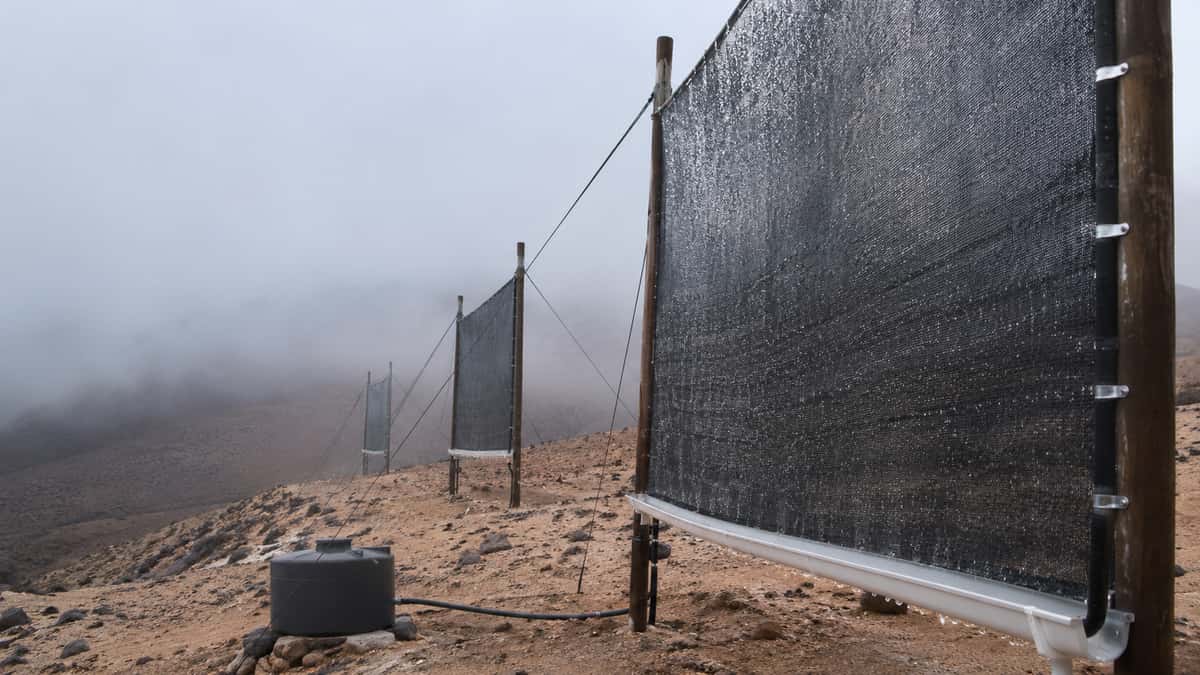
Fog nets, or atrapanieblas, intercept suspended droplets and channel the collected water into storage. Their performance depends on local fog frequency, wind and terrain, but the approach requires little energy and has been used in Chile.
At the Cerro Grande ecological reserve in Peña Blanca, Coquimbo Region, 34 nets cover a combined 306 square metres. Under favourable conditions, they can collect up to 650,000 litres annually for agricultural, ecological restoration and community uses. A separate fog-harvesting system in Morocco’s Aït Baâmrane region supplies more than 400 people across five localities.
Other approaches include dew collectors that condense overnight moisture, rainwater harvesting with storage and treatment, and sand dams that hold water within sediment in seasonal riverbeds. Sand dams can help preserve water through dry periods, but geology and microbial contamination require assessment. Rainwater systems also need suitable storage and treatment, which can include ultraviolet radiation, activated carbon and reverse osmosis.
Treatment systems offer larger-scale options
Reverse osmosis removes much of the dissolved salt from seawater or brackish groundwater, but requires energy and produces concentrated brine that must be managed. Advanced wastewater treatment can also add supply: Scottsdale, Arizona, uses ozone, membrane filtration, reverse osmosis and ultraviolet treatment to recharge aquifers.
Chile has already deployed desalination at urban scale. The expanded North Antofagasta plant entered operation in March 2025 after a US$130 million investment. Its capacity of 1,436 litres per second allows Antofagasta and Mejillones to be supplied entirely with desalinated water. Such infrastructure involves substantial investment in energy, pipelines, distribution and maintenance, while small atmospheric systems may be more relevant to isolated communities beyond established networks.
Mining applications depend on volume and water quality
For mining, desalination, industrial-water recovery and recirculation are established ways to reduce reliance on some continental sources. Atmospheric capture could eventually support remote facilities or camps, but the prototype output reported in Death Valley is far below industrial requirements. Its near-term role, if developed further, would be complementary rather than a substitute for large supply systems.
Across all seven approaches, collection does not automatically make water safe to drink. Systems need testing for microbial and chemical contaminants, as well as evaluation of installation costs, maintenance and performance through prolonged dry periods. For northern Chile, the next step is to assess which combination of local conditions, treatment needs and infrastructure can provide reliable, potable water.
More in Frontier Mining
NASA’s PROMISE rover targets lunar ice where solar power cannot reach
The 18-month mission will reuse Mars-tested hardware, but lunar darkness and cold impose a different operating test.

NASA’s 12 stratospheric dust grains may point to ancient ice beyond Neptune
The particles were recovered near Earth, but the region they may represent is almost impossible to sample directly.

AI-run labs promise faster materials research, but mining poses a different test
From reagent selection to mineral recovery, each change in chemistry can demand another round of trials.