
NASA’s PROMISE rover targets lunar ice where solar power cannot reach
The 18-month mission will reuse Mars-tested hardware, but lunar darkness and cold impose a different operating test.
Why it matters: Finding and characterising polar ice could help determine whether lunar resources can support future human missions, but detection alone would not establish that extraction is viable.
18 months — planned initial surface mission
About 1 metre — maximum subsurface depth for the rover’s drilling system
US$94 million — base value of Blue Origin’s transport contract, with an option of up to US$140 million
Late 2028 — projected launch window
NASA is developing PROMISE, a nuclear-powered robotic rover designed to investigate water ice and other resources at the Moon’s south pole, including in permanently shadowed areas. The mission is projected to launch in late 2028 and conduct an initial 18-month campaign on the lunar surface.
Mars-tested hardware faces lunar conditions
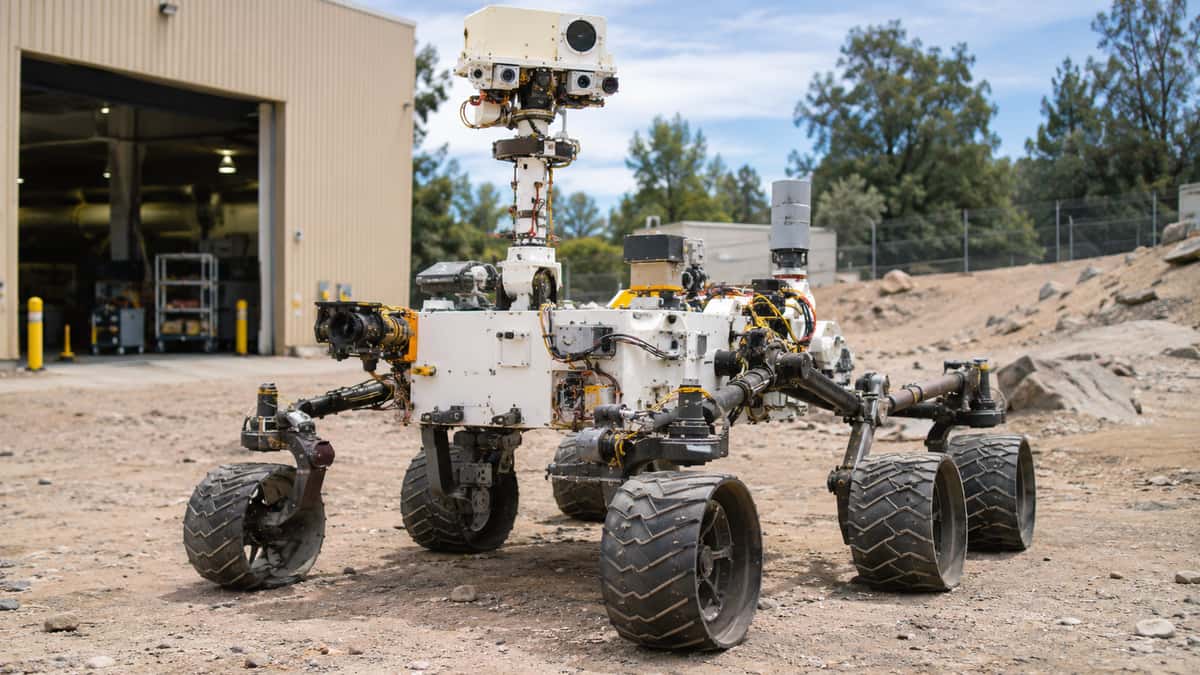
PROMISE — short for Polar Rover for Observation, Mapping, and In-Situ Exploration — is being developed by NASA’s Jet Propulsion Laboratory in California. The six-wheeled vehicle, roughly the size of a sport utility vehicle, is expected to use components, test hardware and spare parts from the Curiosity and Perseverance Mars rover programmes.
Reusing existing systems could reduce development costs and shorten construction timelines, but the rover will need to operate in conditions unlike those on Mars. The Moon’s near-vacuum, extreme temperature swings and abrasive dust pose challenges for mechanical and electronic systems. PROMISE is also intended to test autonomous navigation, sensors and onboard data processing for complex scientific work.
Its power system is central to the mission. A Multi-Mission Radioisotope Thermoelectric Generator (MMRTG) will convert heat from the natural decay of plutonium-238 into electricity. It is not a fission reactor and does not rely on a chain reaction. The generator’s waste heat can also help keep some onboard components at operating temperatures.
That capability is intended to let the rover work in places without direct sunlight. Lunar nights in other regions can last about 14 Earth days, limiting operations for vehicles dependent on solar panels. At the south pole, the power system could allow PROMISE to investigate permanently shadowed craters, where low temperatures and limited illumination make robotic exploration difficult.
Drilling will investigate the subsurface
The rover’s science package is designed to examine lunar soil and search for ice deposits. A drill will sample material to depths of about one metre, while spectrometers will analyse chemical composition. Thermal and radiation sensors, cameras and autonomous navigation systems will help characterise the environment and guide movement across the terrain.
Water ice is of interest because, if deposits can be identified, characterised and processed, they could potentially provide water for astronauts and feed oxygen production. Researchers are also interested in the possibility of obtaining hydrogen and oxygen for energy and spacecraft fuel applications. But finding ice would not, by itself, establish that it can be extracted economically or technically. Its concentration, depth, distribution and processing requirements remain important unknowns.
Blue Origin is contracted to deliver the rover
NASA selected Blue Origin to transport PROMISE to the lunar south pole using its Blue Moon Mark 1 lander. The contract has a base value of US$94 million, with an additional option of up to US$140 million tied to performance objectives. Those amounts cover transportation and deployment services, not the total cost of developing PROMISE.
The late-2028 launch target remains subject to integration, technical testing and readiness of the transportation system. Before launch, the mission must also complete safety checks for the plutonium-fuelled generator and demonstrate that systems developed for Mars can withstand the lunar environment.
Once deployed, PROMISE is intended to survey selected areas and gather geological data relevant to future scientific operations and human activity, including potential landing sites and locations for infrastructure. Its findings could help refine plans for working with lunar resources, but the mission is a reconnaissance effort, not a commercial mining operation. The next milestones are integration and testing of the rover and generator, alongside preparation of Blue Origin’s lander.
More in Frontier Mining
Seven water technologies target Chile’s arid north, but scale remains the test
A hydrogel device ran without electricity in Death Valley, while Chile already depends on larger systems to supply desert cities.
NASA’s 12 stratospheric dust grains may point to ancient ice beyond Neptune
The particles were recovered near Earth, but the region they may represent is almost impossible to sample directly.
AI-run labs promise faster materials research, but mining poses a different test
From reagent selection to mineral recovery, each change in chemistry can demand another round of trials.