
NASA’s 12 stratospheric dust grains may point to ancient ice beyond Neptune
The particles were recovered near Earth, but the region they may represent is almost impossible to sample directly.
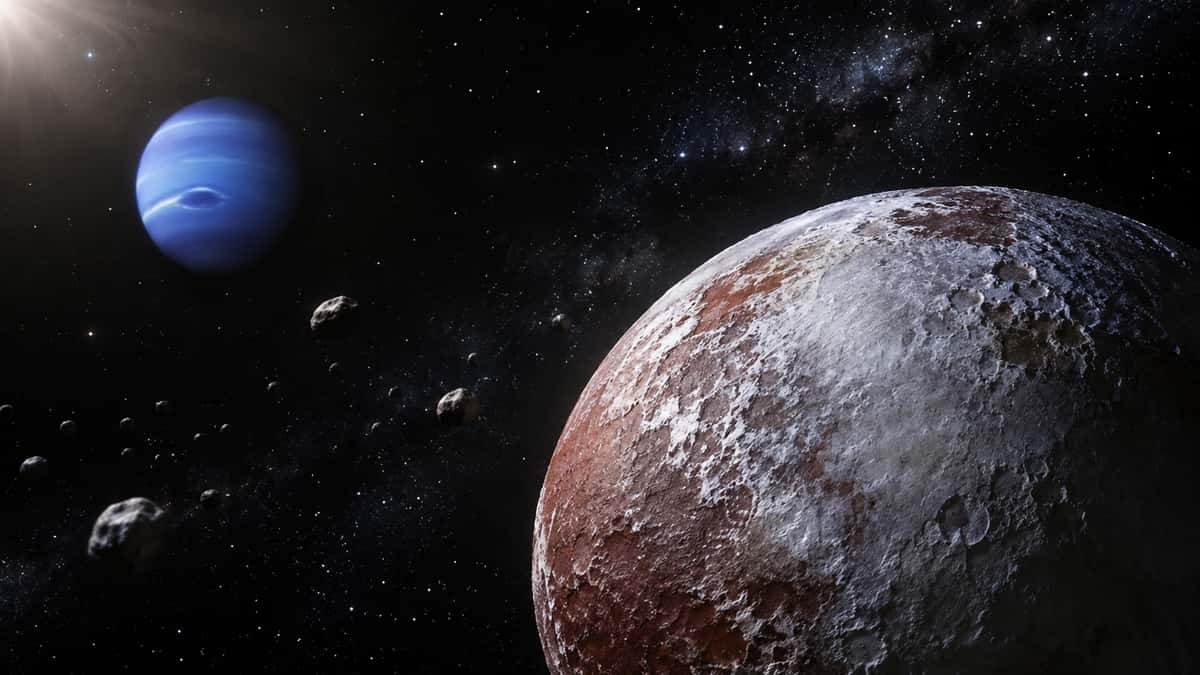
Why it matters: If the particles came from the Kuiper Belt, their minerals could preserve evidence of how water and rock interacted in the outer solar system billions of years ago.
12 particles — interplanetary dust grains examined by the research team
10–30 micrometres — approximate size of each particle
About 100 times — the radiation-track density compared with expected levels in some nearer-solar-system materials
Up to 15% — the modelled increase in the water’s oxygen-18 to oxygen-16 ratio against the reference for Earth’s ocean water
NASA researchers and specialists from the University of California, Los Angeles, report that 12 particles of interplanetary dust collected in Earth’s stratosphere may preserve chemical evidence of an ancient water reservoir in the Kuiper Belt, beyond Neptune. The findings, presented on November 18, 2026, rely on mineral and oxygen-isotope signatures; they are not a direct observation of ice in space.
Radiation damage points to a distant origin
The particles were collected by NASA ER-2 research aircraft flying at high altitude. Researchers examined microscopic radiation damage in their minerals to estimate how long the grains had been exposed to energetic particles from the Sun. Their radiation-track densities were about 100 times higher than expected for material from the main asteroid belt or certain Jupiter-family comets, supporting—but not proving—a more distant origin.
The Kuiper Belt begins roughly 30 astronomical units from the Sun, or about 4.5 billion kilometres. Its icy, rocky bodies include Pluto. Because these objects are difficult to sample directly, interplanetary dust that reaches Earth offers another way to investigate material from the solar system’s outer regions.
Oxygen isotopes preserve a chemical signal
The team identified hydrated minerals including saponite and serpentine, which form through chemical alteration involving water. The researchers focused on oxygen-16, oxygen-17 and oxygen-18: variations in the proportions of these stable isotopes can record the conditions in which minerals formed.
The particles were enriched in the heavier oxygen isotopes. Chemical models suggest the water that reacted with the minerals could have had an oxygen-18 to oxygen-16 ratio up to about 15% higher than the reference used for Earth’s ocean water. That is a model-dependent upper estimate, not a direct measurement of water in the Kuiper Belt. Here, “isotopically heavy” refers to oxygen isotopes, not water enriched in deuterium.
A possible barrier in the early solar system
The isotope differences may indicate that water-bearing materials in the outer solar system were not uniformly mixed with those nearer the Sun. The researchers propose that Saturn’s formation and gravity may have restricted the movement of some material through the young solar system’s gas-and-dust disk. Uranus and Neptune may also have contributed to this separation.
The hydrated minerals may record past episodes when internal heating or impacts melted ice and allowed water to react with rock. They do not demonstrate that liquid water exists today in the bodies from which the grains came. Further samples and observations will be needed to establish how broadly the isotope signature occurs and how the particles travelled to Earth.
More in Frontier Mining
AI-run labs promise faster materials research, but mining poses a different test
From reagent selection to mineral recovery, each change in chemistry can demand another round of trials.

Northwestern wrist sensors top 92% gesture accuracy, but repeat use tests reliability
Camera-free controls could suit rehabilitation and industrial tasks, but researchers have yet to show how the systems perform beyond controlled trials.
Google and Blue Origin target 2029 space data centres, but heat remains a hurdle
A New Glenn launch would test whether distributed orbital computing can move beyond a single-satellite demonstration.