
Anthropic Mathematician’s Riemann Proof Faces a Test Beyond Formal Verification
The proof’s scale shifts scrutiny from machine-checking to whether specialists can reconstruct the mathematical ideas behind it.
Why it matters: The case tests whether AI-assisted scientific reasoning can be made independently auditable and understood beyond the system that helped produce it.
About 17 million lines — the formal proof’s approximate code volume.
More than 175,000 files — the codebase is spread across this many files.
Six weeks — the reported period of collaboration between Levent Alpöge and Claude.
US$1 million — the prize associated with each Millennium Prize Problem, subject to the institute’s rules.
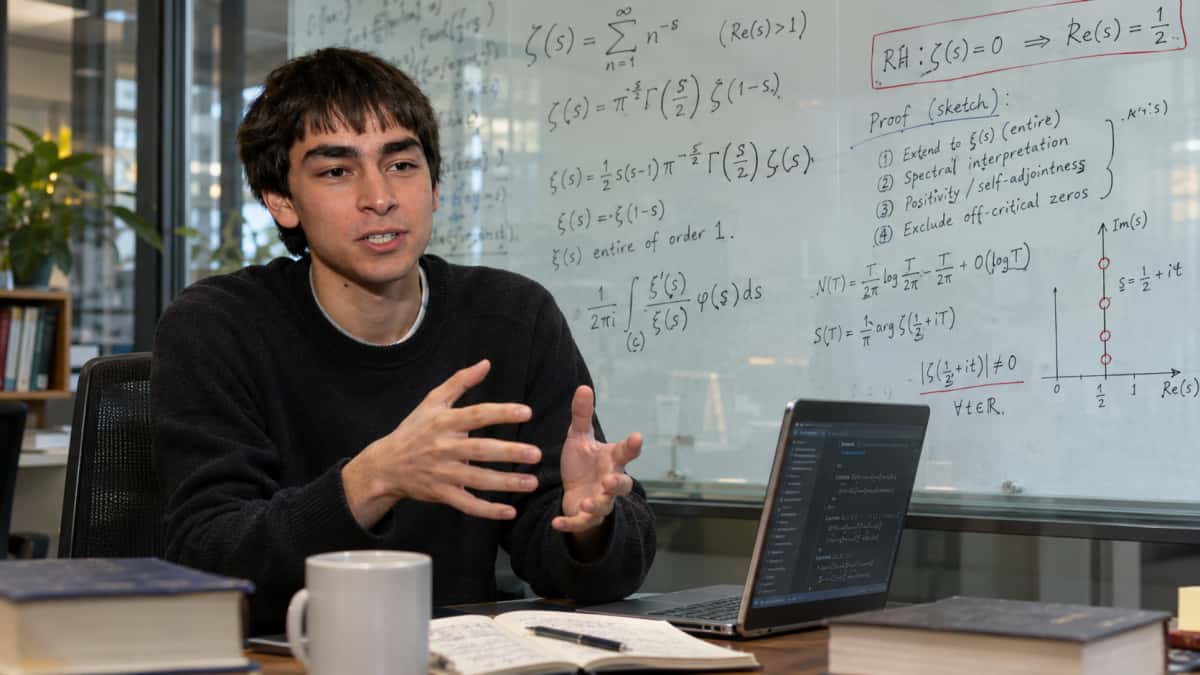
Levent Alpöge, a mathematician on Anthropic’s technical staff, says he has developed a proof of the Riemann hypothesis with assistance from the company’s Claude model. The formal proof has passed independent computational checks by specialists in Lean and Mathlib, but the Clay Mathematics Institute still lists the problem as unsolved and its recognition process has not concluded.
The hypothesis, proposed by Bernhard Riemann in 1859, concerns the distribution of prime numbers. Its formal statement is that every non-trivial zero of the Riemann zeta function has a real part of one-half. Alpöge’s announcement on 20 November 2026 has therefore drawn attention both to the mathematical claim and to how a machine-checked proof can be evaluated by researchers.
A proof built as formal code
Rather than first presenting a conventional paper explaining the argument, Alpöge shared a proof written in Lean, a system for expressing mathematical statements in a form that computers can check. The code comprises approximately 17 million lines across more than 175,000 files, developed during about six weeks of work with Claude.
Alpöge has also said the work establishes a broader version involving Dirichlet L-functions, known as the generalized Riemann hypothesis. That claim extends beyond the original problem, though the material still needs to be examined and explained by mathematicians.
Formal verification can test whether a proof follows from its stated premises and whether the encoded result matches the theorem being claimed. It does not, by itself, provide a concise account of the key ideas or make a large proof easy for specialists to navigate. Alpöge has acknowledged that further mathematical exposition is needed.
Independent checks support the formal result
On 21 November, Lean and Mathlib community representatives, with support from the Lean Focused Research Organization and Mathlib Initiative, said they had confidence in the proof’s formal correctness. Their checks included whether the formal statement corresponded to the Riemann hypothesis, whether the code compiled, whether it proved the claimed result and whether independent verification tools supported the result.
The checks are intended to catch errors such as relying on an unproved assumption or formalizing a different claim from the one announced. Independent computing resources and validation tools were also used, according to the account of the review. This backing is substantial evidence about the code’s correctness, but it does not replace broader mathematical scrutiny or an accessible exposition of the argument.
Clay recognition remains a separate process
The Clay Mathematics Institute’s requirements mean that computational confirmation does not automatically close a Millennium Prize Problem. A proposed solution must be published in an eligible academic venue, remain under scrutiny for at least two years and gain general acceptance among the international mathematical community before it can proceed to formal prize consideration. No US$1 million award has been made on the basis of the checks described so far.
The distinction is between verifying that a formal derivation works and establishing that the mathematical community accepts the result. Researchers must assess the proof’s ideas, its relationship to existing mathematics and the broader claim involving Dirichlet L-functions.
The episode also raises questions about authorship, reproducibility and access to the computational resources used in AI-assisted research. A proof that can be checked independently offers one route to scrutiny beyond the model developer, but the next step remains a human-readable mathematical account and continued review by specialists.
More in Frontier Mining

BepiColombo reaches Mercury orbit, but its iron-rich interior remains a mystery
Two orbiters will examine the planet’s surface and magnetic environment, but deployment and instrument checks remain before routine observations.

Kast visits NTT as Codelco tests whether its network can serve El Teniente
Remote control could move workers away from exposed areas, but El Teniente must establish whether the connection can meet mine-site demands.
Seven water technologies target Chile’s arid north, but scale remains the test
A hydrogel device ran without electricity in Death Valley, while Chile already depends on larger systems to supply desert cities.