
UN gives autonomous-weapons talks two more years, but a binding treaty is uncertain
The Geneva review exposed a split between states seeking bans and military powers defending room for national rules.
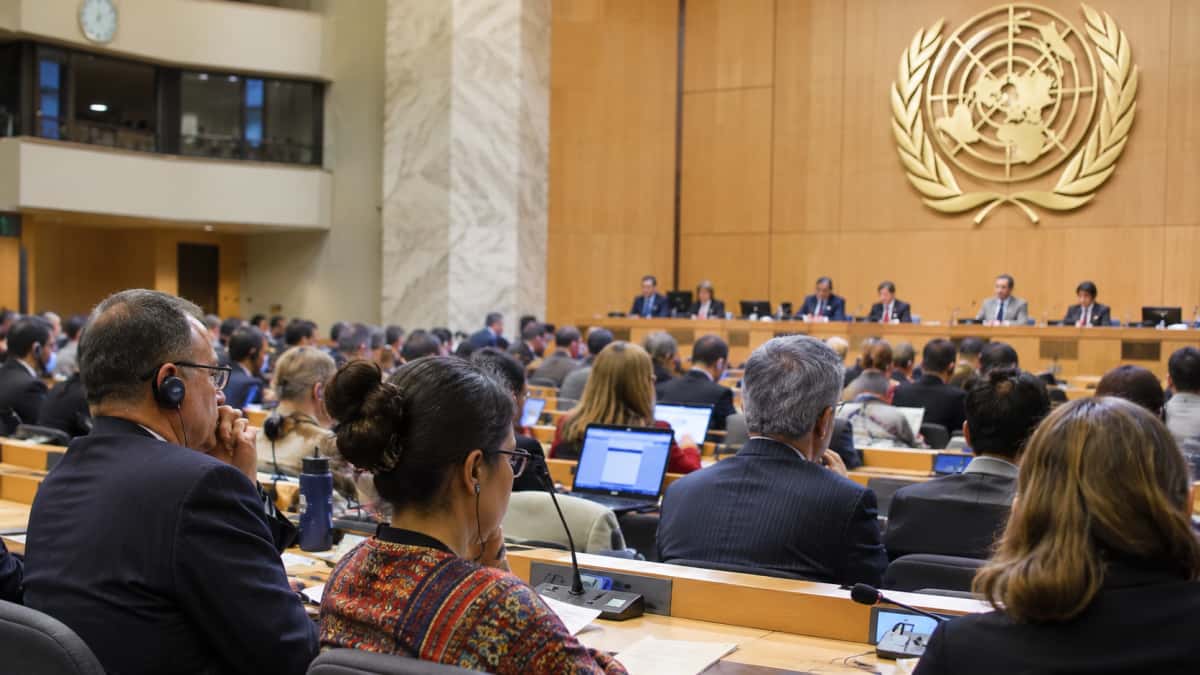
Why it matters: The talks will test whether governments can agree on human controls and legal accountability before autonomous systems gain a wider role in lethal decisions.
128 states — parties to the Convention on Certain Conventional Weapons involved in the debate.
2027 and 2028 — the new period for the Governmental Group of Experts’ work.
163 states — backed a related UN General Assembly First Committee resolution on 29 October 2026.
The UN conference reviewing the Convention on Certain Conventional Weapons agreed to continue discussions on lethal autonomous weapon systems in 2027 and 2028, but did not authorize immediate negotiations on a binding treaty. The decision, reached in Geneva after the review conference ran from 16 to 20 November 2026, keeps the diplomatic process open without guaranteeing that it will produce legally enforceable rules.
The new mandate tasks the Governmental Group of Experts with developing an international instrument addressing international humanitarian law, states’ obligations and possible controls on the technology. Whether that instrument should be a treaty or take another form remains for governments to decide in the next phase.
Consensus keeps treaty negotiations out of the mandate
The outcome reflects a divide between states seeking mandatory restrictions and military powers that oppose committing to new international obligations. The United States, Russia and Israel were among those against an immediate mandate to negotiate a legally binding treaty. Washington has argued that existing international humanitarian law applies to the development and use of these systems, while favouring national guidance and controls.
Around 100 countries supported moving toward stronger international rules. Austria, Belgium, Brazil, Ireland, Mexico, New Zealand and Panama promoted a proposal to begin negotiations on a new legal instrument. But decisions under the Convention require consensus, allowing objections from individual states to block a mandate even when a proposal has wider support.
That procedural barrier shaped the agreement: talks will continue, but states have not agreed that they must culminate in binding obligations. In September 2026, experts advanced elements that could serve as a basis for an eventual instrument. On 29 October, 163 states backed a related resolution in the UN General Assembly’s First Committee, but that support did not settle the mandate at the Geneva review.
The line between automated functions and autonomous attacks
Lethal autonomous weapon systems can use sensors, software and automated mechanisms to identify, select and attack targets. Their capabilities vary: some systems may perform limited functions autonomously, while others can carry out critical steps without an operator authorizing each attack. Not all such weapons use advanced artificial intelligence, and a remotely piloted drone is not necessarily autonomous.
The central concern is whether a system can apply lethal force without sufficient human control, particularly in fast-changing situations where civilians may be present or information is incomplete. International humanitarian law requires parties to distinguish between military targets and protected people and to consider proportionality and precautions. The negotiations must address whether automated systems can meet those obligations reliably, and how decisions and failures can be traced.
Accountability is also unresolved. If an autonomous system causes civilian casualties, investigators need to establish who authorized its use, what safeguards were in place and where responsibility lies among operators, commanders and state authorities. Existing humanitarian law remains applicable, but governments disagree on whether it adequately addresses the specific risks of autonomy.
The next negotiations must define human control
During 2027 and 2028, states are expected to address the meaning of human control, system predictability, responsibility for effects and conditions of use. They will also continue debating whether some categories should be prohibited and others restricted. The International Committee of the Red Cross has called for prohibitions on unpredictable systems and on those designed or used to target people without sufficient human control; these proposals are not agreed international obligations.
The Group of Experts’ recommendations are due in 2028, but the mandate does not predetermine their legal status. The next stage will therefore test whether the states can bridge their differences on both the substance of controls and the form of any resulting instrument.
More in Frontier Mining

Voyager 1 reaches a one-light-day distance as NASA loses its engineering data
The probe still emits a carrier signal, but the telemetry gap complicates efforts to diagnose its latest fault.

BepiColombo reaches Mercury orbit, but its iron-rich interior remains a mystery
Two orbiters will examine the planet’s surface and magnetic environment, but deployment and instrument checks remain before routine observations.

Anthropic Mathematician’s Riemann Proof Faces a Test Beyond Formal Verification
The proof’s scale shifts scrutiny from machine-checking to whether specialists can reconstruct the mathematical ideas behind it.