
Jiangxi Siton puts 45-tonne UK45 at bauma China as lineup spans mine cycle
The UK45 is the headline machine, but underground production also depends on what happens before a haul truck arrives.
im-mining.com
Why it matters: Siton’s mix of haulage, loading, drilling and ground-support equipment shows how automation is being applied across multiple underground tasks.
45 tonnes — UK45 payload capacity
450 kW — Volvo Penta engine output in the UK45
8 m³ and 18 tonnes — WJ8 standard bucket and rated load
More than 54 metres — DL52i long-hole drilling depth
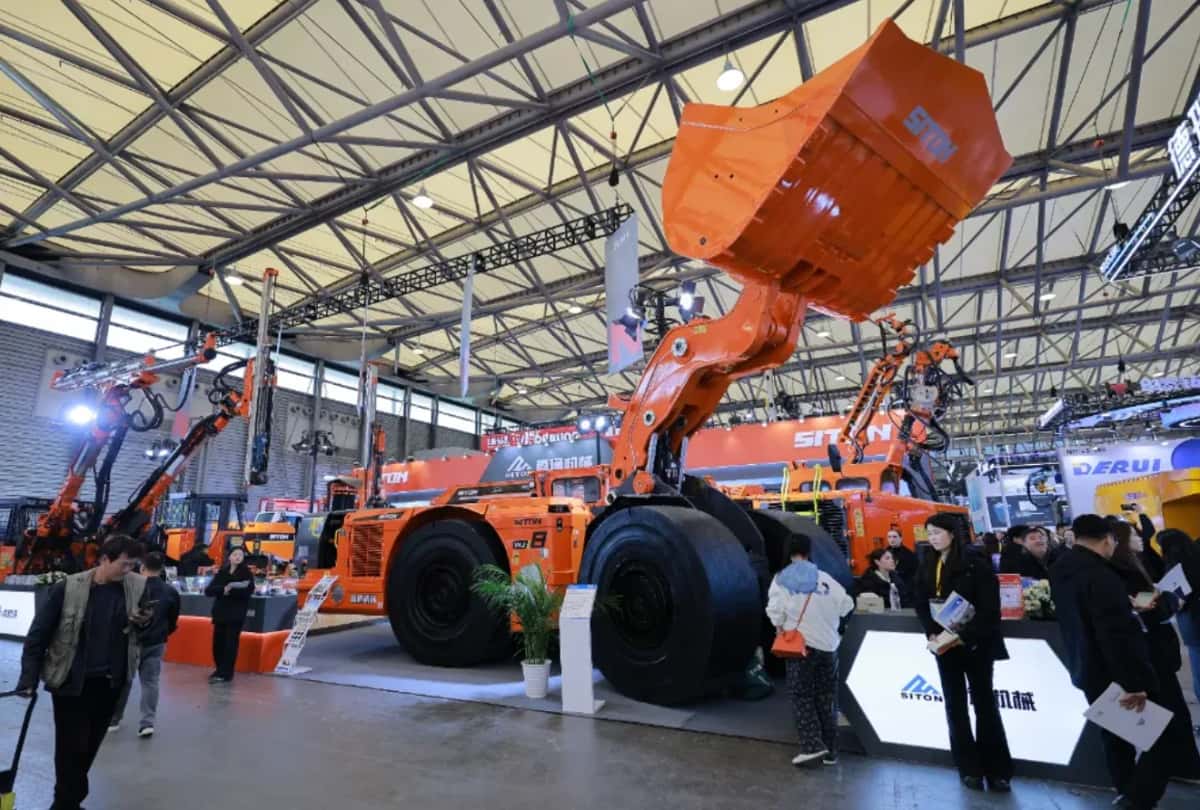
Jiangxi Siton displayed six machines at bauma China 2026, including its 45-tonne UK45 underground truck, alongside equipment for loading, tunnel development, production drilling, ground support and surface drilling. The Chinese manufacturer’s lineup spans several stages of mine work, with automated functions featured on multiple underground machines.
Siton has export references in Latin America and Central Asia and supplies Chinese mining companies including Jiangxi Copper, as well as mining contractors. The exhibit brought together equipment for both metal and industrial mines.
UK45 and WJ8 target haulage and loading
The UK45 is powered by a 450 kW Volvo Penta TAD1651VE engine. Siton associates the specification with operation on steep ramps under full load. The truck’s dump body has a 62-degree discharge angle, while its articulated chassis and hydraulic steering are designed for manoeuvring in confined underground spaces.
The cab is enclosed, air-conditioned and fitted with ROPS/FOPS protection structures. Ground-level access for daily maintenance and automatic central lubrication are also part of the equipment specification.
Siton presented the WJ8 loader as a match for the truck. Designed for large non-coal underground mines and tunnels, it has a standard 8 m³ bucket and a rated load of 18 tonnes. Its stated operating temperature range is -25 °C to +50 °C. The machine uses water-cooled Volvo Penta engines and exhaust after-treatment, with National IV or Euro Stage V emissions standards.
Automated drilling and bolting cover underground development
The double-boom DD42i development jumbo combines automated drilling and positioning with Siton’s control system. Its rock drills deliver 18 kW, and the company lists a drilling speed of 2 metres per minute. Remote control and autonomous drilling functions are available as options. Siton says automated control can reduce operator workload and limit overbreak and underbreak.
For long-hole production drilling, the DL52i automates positioning, drilling and rod handling. It is designed for large underground mines and can drill to more than 54 metres, using hole diameters of 90 to 115 mm. Its rock drill is rated at 33 kW. The machine also includes an anti-jamming system and modular design for maintenance access; an optional cold-weather package is specified for operation at -40 °C.
The DS4 bolter has a dedicated arm for installing rock bolts and a separate mesh-handling manipulator. The two can work in parallel. Its automated mesh system handles collection, positioning and installation, reducing manual handling and keeping the operator away from unsupported roof areas, according to Siton.
XT127 extends the display to surface drilling
The sixth machine, the XT127, is a top-hammer surface drill with a single straight boom. Siton says the boom is designed to provide rigidity and support for deep, large-diameter drilling. The machine combines intelligent controls with mechanisms intended to maintain hole trajectory and stabilise drilling as rock conditions change.
More in Frontier Mining
Japan’s 6,000-metre rare earth test moves from recovery to economics
The deposits sit inside Japan’s EEZ, but recovering sediment is only one link in a supply chain dominated by China.
Tarapacá’s AI pact puts mining in focus, but deployment details remain open
Iquique’s summit linked public agencies, business groups and technology providers around three regional industries.
Hera’s Dimorphos images reveal DART’s crater—and an unknown shaping deflection
NASA’s 2022 test changed Dimorphos’s orbit, but predicting another deflection depends on a property Hera is now investigating.