
Hera’s Dimorphos images reveal DART’s crater—and an unknown shaping deflection
NASA’s 2022 test changed Dimorphos’s orbit, but predicting another deflection depends on a property Hera is now investigating.
Why it matters: Dimorphos’s response to impact shows why future deflection plans need reliable measurements of an asteroid’s mass and internal structure.
576 kilograms — approximate mass of the DART spacecraft
6.1 kilometres per second — DART’s approximate impact speed
33 minutes — reduction in Dimorphos’s orbital period after the collision
11 hours, 55 minutes — Dimorphos’s orbital period before impact
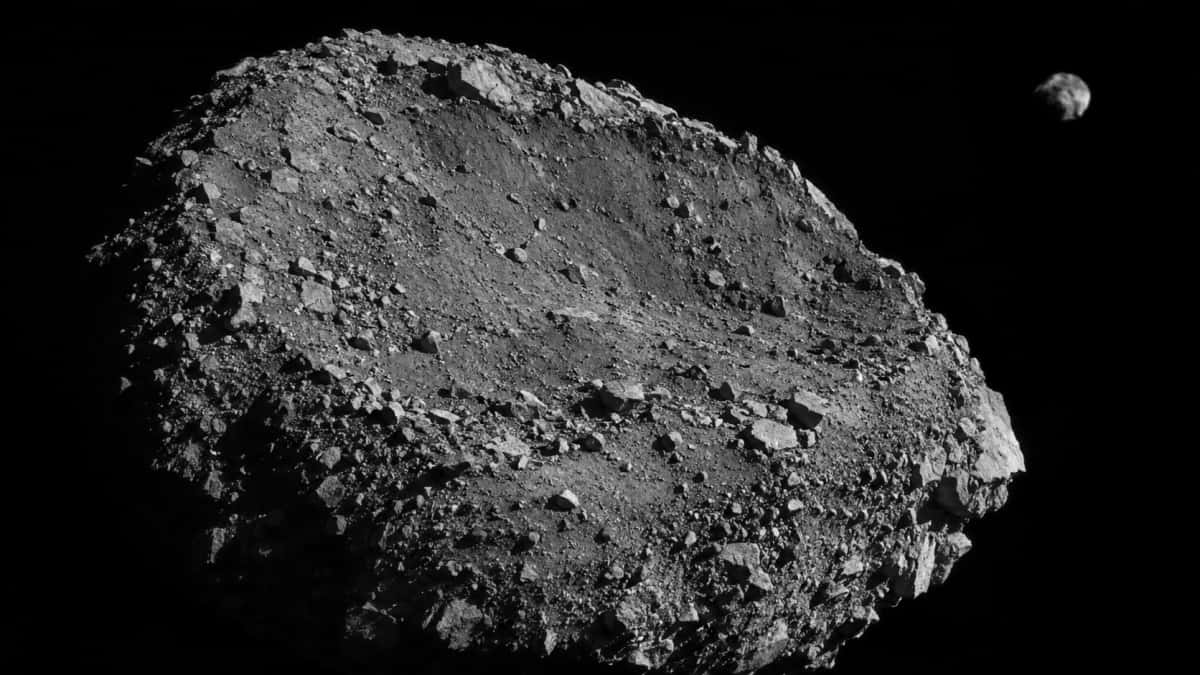
The European Space Agency’s Hera mission has captured detailed images of the changes caused by NASA’s 2022 DART impact on Dimorphos, including a large surface depression comparable in size to a sports stadium. The observations also show that the asteroid lost part of its rounded shape; Hera’s instruments will investigate further changes, including in its rotation.
ESA presented the images on November 25, 2026, four years after DART struck Dimorphos. The impact demonstrated that a spacecraft collision can alter an asteroid’s orbit. Hera is now examining the physical response behind that result, which could help scientists determine how to plan future deflection attempts.
DART changed Dimorphos’s orbit
DART, short for Double Asteroid Redirection Test, was designed to test whether a controlled collision could change an asteroid’s motion. The target was Dimorphos, which orbits the larger asteroid Didymos. Neither body posed a threat to Earth; they were selected so scientists could measure the effects without creating a planetary risk.
Before impact, Dimorphos took about 11 hours and 55 minutes to orbit Didymos. After the collision, its orbital period was reduced by approximately 33 minutes. DART approached at about 6.1 kilometres per second, transferring energy to the asteroid and ejecting material from its surface.
The orbital change was not determined solely by the force of the spacecraft’s impact. Material thrown into space also contributed to the momentum transferred to Dimorphos. Measuring the asteroid and reconstructing the collision’s effects will help refine estimates of how much each factor mattered.
The asteroid’s structure is central to the analysis
Hera’s images give scientists a closer view of the impact’s geological consequences. The scale of the depression points to the importance of Dimorphos’s internal structure, the distribution of its material and the mechanical strength of its surface.
Asteroids can be made up of fragments, dust and other material held together largely by weak gravitational forces, rather than forming a single, solid block of rock. In a compact body, impact energy may be concentrated in local fracturing. In a less cohesive structure, it may be redistributed more widely, producing a different physical response.
Hera is intended to turn DART’s test into a more detailed investigation. Its objectives include estimating Dimorphos’s mass, studying its interior, characterising its surface and reconstructing the impact’s effects. A mass estimate is particularly important for calculating the momentum transfer with greater precision.
Measurements may inform more than planetary defence
The same broad methods used to examine an asteroid remotely—including spectral instruments, radar and autonomous systems—also have applications in geological exploration on Earth. In both settings, researchers seek to infer composition and physical properties before they can directly examine large volumes of material.
Asteroid resource extraction remains subject to major technical and economic challenges. The immediate task for Hera is scientific: to reduce uncertainty about how Dimorphos responded to DART and improve the models used to assess possible interventions. The mission’s instruments will continue examining the asteroid’s mass, structure and the material ejected by the collision.
More in Frontier Mining
FCC Clears SpaceX for 1 Million AI Satellites, With Debris Reviews Ahead
Solar-powered computing could move data centres off Earth, but SpaceX will still have to demonstrate its cooling and transmission model at scale.
Epiroc digitises Pit Viper cameras, while SmartROC rollout follows a separate path
Remote operators need sharper views without added network load, but the upgrade leaves existing camera positions in place.
100 Minds takes AI safety assistant to Codelco’s Radomiro Tomic in limited rollout
Questions can surface during a night shift, far from a training room, when workers need to decide whether to proceed.