
Yukon Metals maps new copper-gold zones at AZ, but continuity remains unproven
At Viper, surface anomalies extend beyond the 2026 drill area, leaving their connection to mineralisation at depth to be tested.
Why it matters: The results expand AZ’s exploration targets, but surface samples and scattered drill intervals do not yet establish a continuous mineralised system.
10.41% copper — highest reported surface-rock sample, from Saddle.
2 kilometres — distance east of Viper’s 2026 drilling where surface anomalies were identified.
552 samples — soil and rock samples collected in the regional campaign.
1,948 metres — total drilled in three Viper holes during 2026.
Yukon Metals Corp. has identified copper, gold and molybdenum mineralisation in three areas of its 100%-owned AZ project in Yukon, Canada, with surface samples returning up to 10.41% copper and 6.27 grams per tonne (g/t) gold. The company said the regional exploration results, reported on November 19, 2026, also extend Viper’s geochemical anomalies beyond the area drilled this year.
AZ covers approximately 13,110 hectares about 36 kilometres south of Beaver Creek. Yukon Metals is investigating intrusive-related targets, including porphyry and skarn systems. The new results broaden the areas considered for follow-up work, but do not establish mineral resources or the economic viability of mining.
Saddle samples return the campaign’s highest grades
At Saddle, a skarn target, rock sample K140593 returned 10.41% copper and 2.21 g/t gold. Sample J653144 assayed 6.27 g/t gold and 0.73% copper. Other reported samples included 6.96% copper and 2.75 g/t gold, and 3.07% copper and 3.19 g/t gold.
The company describes these as selected rock samples; they are not representative grades for a deposit. Their significance will depend on whether mineralisation continues laterally and at depth, as well as on its volume and potential mining conditions.
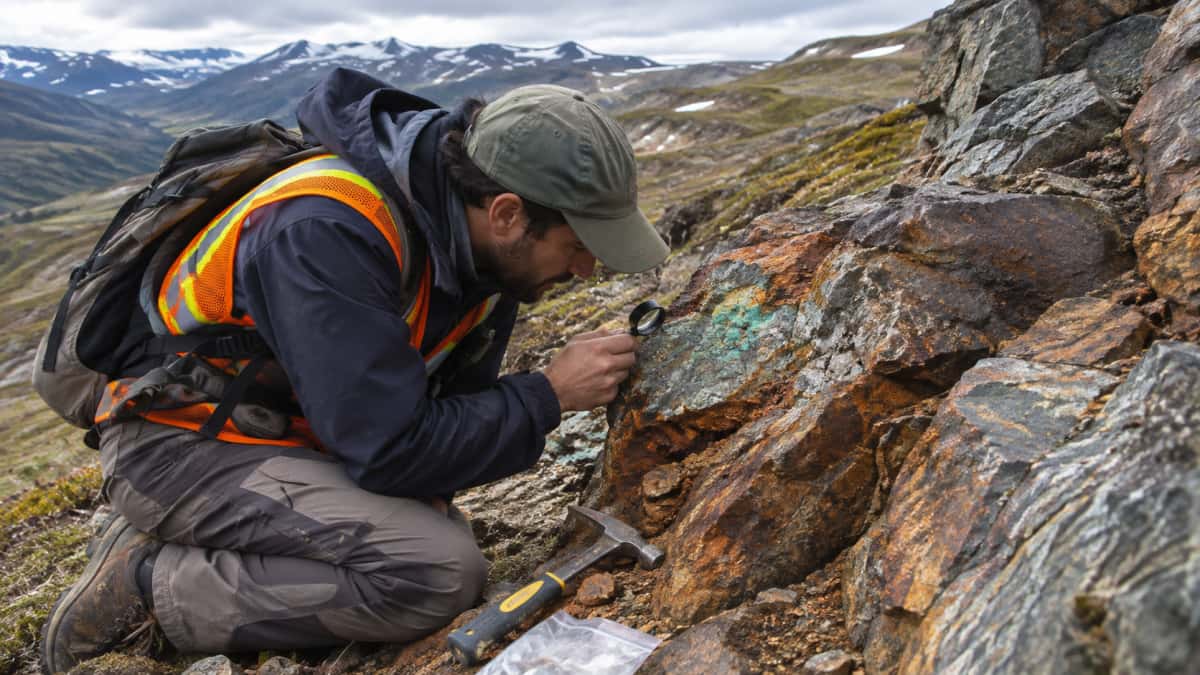
Saddle’s reported mineral associations include garnet, epidote, magnetite, chalcopyrite and pyrite, alongside secondary copper minerals malachite and azurite. Yukon Metals noted the setting at contacts between intrusive bodies and carbonate rocks, a geological configuration associated with skarn mineralisation.
Viper anomalies extend beyond this year’s drilling
At Viper, surface sampling identified copper and gold anomalies as far as two kilometres east of the 2026 drilling. Rock samples reached 2.81% copper, 1.74 g/t gold and 335 parts per million (ppm) molybdenum. Soil samples returned up to 1,895 ppm copper, 0.87 g/t gold and 209 ppm molybdenum.
The anomalies form a west-northwest to east-southeast geochemical corridor that roughly aligns with structures and intrusive bodies recognised in earlier drilling. In October 2026, the company described Viper’s geology as compatible with a copper-gold-molybdenum porphyry system. The surface results extend the area under consideration, but do not demonstrate that the anomalies connect to continuous mineralisation underground.
Three Viper holes drilled in 2026 totalled 1,948 metres. Additional results from diamond hole AZ26-007 included an 8.2-metre interval grading 0.11% copper and 0.10 g/t gold, with an approximately 0.9-metre section at 0.33% copper and 0.37 g/t gold. The reported interval is not described as a true width.
Wrangell adds another possible porphyry target
At Wrangell, mapping identified a granitic intrusive body with hydrothermal alteration. Surface samples returned up to 0.99% copper, 1.23 g/t gold and 658 ppm molybdenum. Reported minerals include chalcopyrite and molybdenite, with potassic and phyllic alteration that can occur in porphyry systems.
The company is considering whether Wrangell represents a mineralising centre distinct from Viper. Establishing how the areas relate will require further geological and geophysical work, as well as drilling.
The 2026 regional campaign collected 325 soil and 227 rock samples, excluding quality-control samples. Rock samples averaged 0.19% copper, 0.14 g/t gold, 1.7 g/t silver and 12 ppm molybdenum. Yukon Metals cautioned that these are arithmetic averages of collected samples, including selective sampling, and cannot be treated as representative property grades or used directly to estimate resources.
The next work will need to refine the extent and geometry of the anomalies, prioritise drill targets and test whether surface mineralisation continues at depth. Yukon Metals has not established a resource, commercial production capacity or development timetable for the newly identified areas.
More in Discoveries
Phoenix Metals' Lexington drilling tests an open-pit case beyond historic workings
Lexington's underground legacy is being tested against a potential bulk-tonnage model, but the new intercepts are still downhole lengths.

Rock Tech’s Ontario lithium trend reaches 16 km, but continuity is unproven
New Discovery lies about 10 km east of Bounty, but selective outcrop samples cannot establish the pegmatite’s average grade.
Prospectiva extends São Francisco copper zone, but continuity remains unproven
The step-out sits about 60 metres northeast of an earlier high-grade hit, while the folded sulphide target may thicken and thin along its structure.