
Phoenix Metals' Lexington drilling tests an open-pit case beyond historic workings
Lexington's underground legacy is being tested against a potential bulk-tonnage model, but the new intercepts are still downhole lengths.
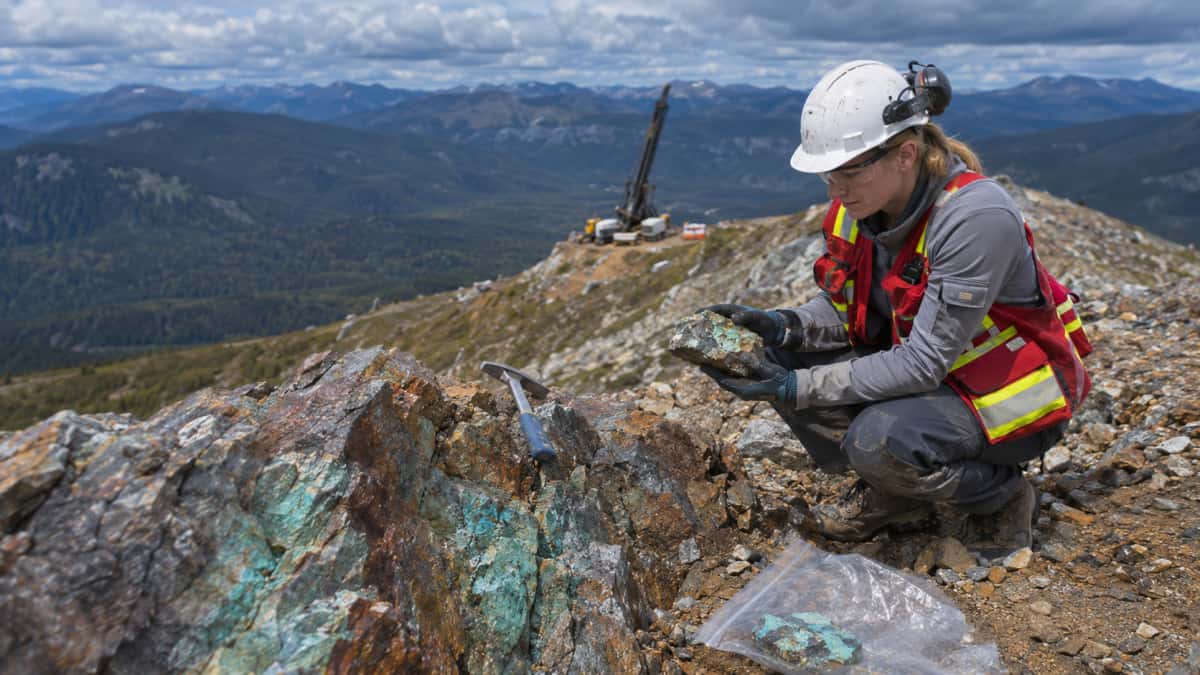
Why it matters: Lexington's broad copper-gold intervals could support a different exploration model from the site's historic high-grade underground mining, but their scale and geometry are not yet established.
169 m at 1.30% CuEq — the strongest reported interval, in hole LXDDH-26-001.
6,350 m across 20 holes — Phoenix Metals' completed 2026 Lexington campaign.
11 holes — assays still pending as of November 18, 2026.
427,500 tonnes — Measured and Indicated underground resources at 5.93 g/t gold and 0.99% copper.
Phoenix Metals Corp. reported a 169-metre copper-gold intercept at its Lexington target in the Greenwood mining district of southern British Columbia, as it tests whether mineralisation historically mined underground could also support evaluation of a larger, open-pit-style target. The interval in hole LXDDH-26-001 began at 41 metres and averaged 0.22% copper, 1.02 g/t gold and 3.79 g/t silver, equivalent to 1.30% CuEq.
The results, released November 18, cover the first nine diamond drill holes, totalling 3,063 metres. The full campaign comprised 20 holes and 6,350 metres; assays for 11 holes remained outstanding at the time of reporting.
High-grade sections sit within broader intervals
Three other reported holes returned long mineralised intervals: LXDDH-26-003 cut 181 metres at 0.38% CuEq; LXDDH-26-007 intersected 183 metres at 0.37% CuEq; and LXDDH-26-008 returned 233.5 metres at 0.41% CuEq. Within the latter, a 60.82-metre interval graded 0.87% CuEq, including three metres at 7.51% CuEq.
LXDDH-26-001 also contained four metres at 10.86% CuEq, a section the company associated mainly with elevated gold. The results show variation in both grade and the relative contribution of copper and precious metals across the holes.
All reported intervals are downhole lengths; true widths have not been determined. Further geological interpretation is required to establish the actual thickness and geometry of the mineralised zones.
A wider target remains to be tested
Phoenix interprets the mineralised horizon as potentially extending more than 1,500 metres along strike and about 300 metres across. That interpretation draws on 2026 work, surface mapping and records from more than 170 historical holes. New drilling identified mineralisation to about 225 metres vertical depth, and the system remains open to the northwest and southeast, as well as at depth.
The interpreted extent is an exploration target, not an open-pit mineral resource. Additional drilling, geological modelling and resource estimation would be needed to establish potential tonnage and grade. The company completed the campaign in two phases: 14 holes for 4,807 metres by September 30, followed by six holes for 1,543 metres in October. The work tested continuity north and south and extensions at depth and toward higher levels.
Existing resource is underground; CuEq depends on assumptions
Lexington's current resource estimate, effective December 31, 2025, comprises 427,500 tonnes of Measured and Indicated resources grading 5.93 g/t gold and 0.99% copper, plus 21,200 tonnes of Inferred resources at 3.41 g/t gold and 0.87% copper. Those figures relate to the underground resource and are distinct from the broader potential now being investigated.
The 1.30% CuEq headline grade is not the interval's copper grade: copper measured 0.22%. The equivalent calculation includes estimated contributions from gold and silver, using reference prices of US$6 per pound of copper, US$4,000 per ounce of gold and US$50 per ounce of silver, and assumed recoveries of 85%, 90% and 60%, respectively. These are calculation assumptions, not confirmed industrial recoveries or necessarily current market prices.
Lexington is part of Phoenix's Greenwood Precious Metals project, where the company outlined an initial district-wide program of about 55,000 metres across Lexington, Phoenix South and JD/Golden Crown. The company said further Lexington and Phoenix South assays were expected in December 2026, with some district results potentially extending into the first quarter of 2027.
More in Discoveries
Yukon Metals maps new copper-gold zones at AZ, but continuity remains unproven
At Viper, surface anomalies extend beyond the 2026 drill area, leaving their connection to mineralisation at depth to be tested.

Rock Tech’s Ontario lithium trend reaches 16 km, but continuity is unproven
New Discovery lies about 10 km east of Bounty, but selective outcrop samples cannot establish the pegmatite’s average grade.
Prospectiva extends São Francisco copper zone, but continuity remains unproven
The step-out sits about 60 metres northeast of an earlier high-grade hit, while the folded sulphide target may thicken and thin along its structure.