
Viridian’s Kraken drilling returns broad near-surface intervals, with 16 assays pending
Pending assays cover a 4.5-kilometre stretch of Kraken Main, leaving continuity across the system unresolved.
Why it matters: Whether near-surface copper, nickel and cobalt form a continuous, recoverable body will shape Kraken’s path from exploration target toward a formal resource.
21.2 metres at 0.62% CuEq — VKS25-026 extension, starting at 5.05 metres depth
43.05 metres at 0.16% CuEq — VKS26-052
33 completed; 16 assays pending — Viridian’s 2026 drilling campaign
C$5.77 million — raised in the first close of a private placement
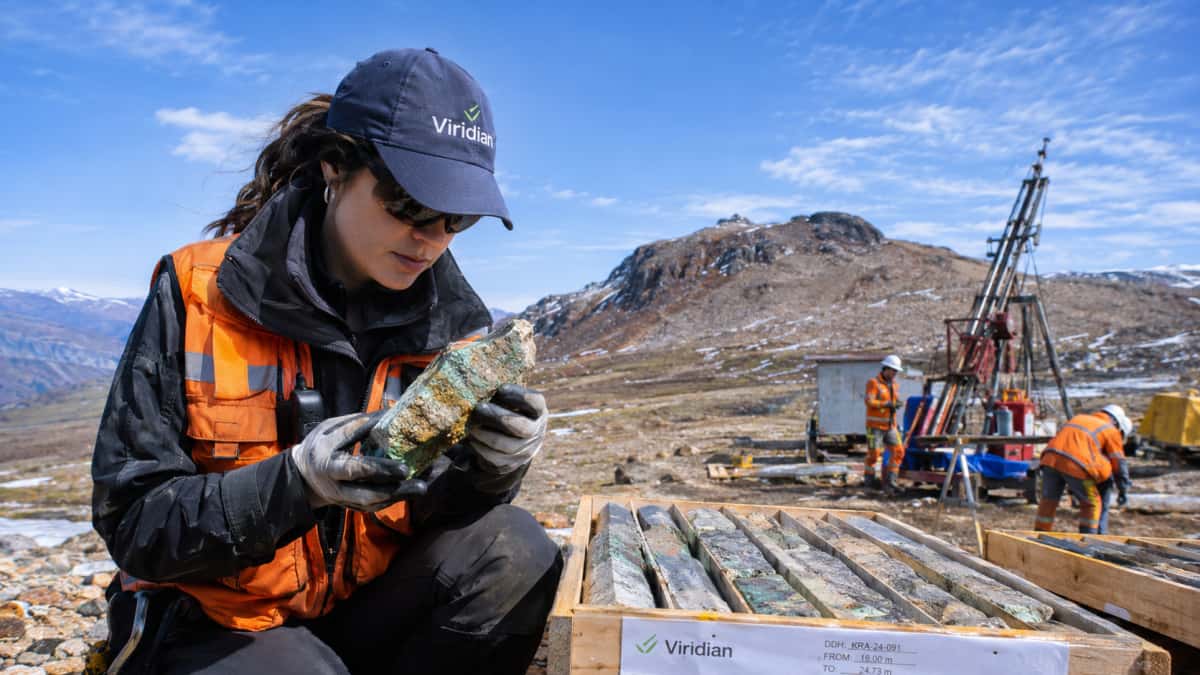
Viridian Metals reported new near-surface copper, nickel and cobalt results from its Kraken project in Labrador, Canada, including a 21.2-metre interval grading 0.62% copper equivalent (CuEq). The company completed 33 holes in its 2026 campaign and is awaiting assays from 16 more, which it says will help define the continuity and extent of the mineralized system.
The reported intervals are lengths down the drill holes; true thicknesses have not been determined. Viridian’s results support further exploration but do not establish an economically mineable deposit.
Assays show broad, lower-grade intervals
The VKS25-026 extension returned an average of 0.21% copper, 0.21% nickel and 0.03% cobalt across 21.2 metres, beginning 5.05 metres downhole. Other results include 43.05 metres at 0.16% CuEq in VKS26-052, 23.3 metres at 0.20% CuEq in VKS25-059 and a partial 24.45-metre interval at 0.18% CuEq in VKS25-057.
In VKS25-057, mineralization starts at 1.45 metres downhole, with a 5.9-metre sub-interval grading 0.28% CuEq. Assays for the final 21 metres of that hole remain pending; Viridian reported visually identified sulphides in the section.
The company’s exploration model considers the possibility of lower-grade mineralized halos around a more concentrated sulphide zone. Broad intervals could help test the size of the system, but assay results alone do not establish continuity, recoveries or commercial viability.
Exploration target remains conceptual
A September 2026 exploration target for Kraken Main outlined a conceptual range of 41 million to 61 million tonnes at 0.35% to 0.52% CuEq, based on an average mineralized thickness of 8.6 metres across an area of about 2 square kilometres. The target uses geological information and drilling completed before the current campaign; it is not a formal mineral resource or reserve, and its tonnage and grades remain conceptual.
Earlier drilling included 50.15 metres at 0.68% CuEq in VKS25-024, including 18.8 metres at 1.12% CuEq. Viridian plans to incorporate 2026 results into an exploration-target update expected in January 2027. Its CuEq calculations assume 80% recoveries for copper, nickel and cobalt, but project-specific metallurgical testing is still required. CuEq is not a measure of copper grade alone or a guarantee of revenue.
Funding supports a 2027 drilling programme
Viridian closed the first stage of a private placement on November 17, raising approximately C$5.77 million against an initial C$5 million target. The company said the proceeds will support exploration and preparations for its 2027 drilling programme. It is targeting a first mineral resource estimate in the fourth quarter of 2027.
The remaining 2026 assays include holes along about 4.5 kilometres of Kraken Main, including its southern extension. Some holes contain visually identified sulphide intervals of 41.8 and 47.3 metres that still require laboratory confirmation. The company’s next steps include completing those assays, advancing metallurgical studies and preparing the next drilling campaign; no mineral reserves or construction decision have been declared.
More in Discoveries
Yukon Metals pushes AZ copper-gold search beyond drilling, but scale remains unknown
At AZ, surface sampling reaches beyond the drilled footprint, but the company has yet to show whether the three target areas connect.
QGold reports 564 g/t gold at Mine Centre, but vein continuity remains untested
At South Foley, drilling intersected quartz beneath a surface sample, but the assay comparison is still pending.
Yukon Metals maps three copper-gold targets at AZ, including ground east of drilling
At Viper, a soil corridor follows the orientation of dikes and veins seen in 2026 holes, but the pattern still needs a subsurface test.