
QGold reports 564 g/t gold at Mine Centre, but vein continuity remains untested
At South Foley, drilling intersected quartz beneath a surface sample, but the assay comparison is still pending.
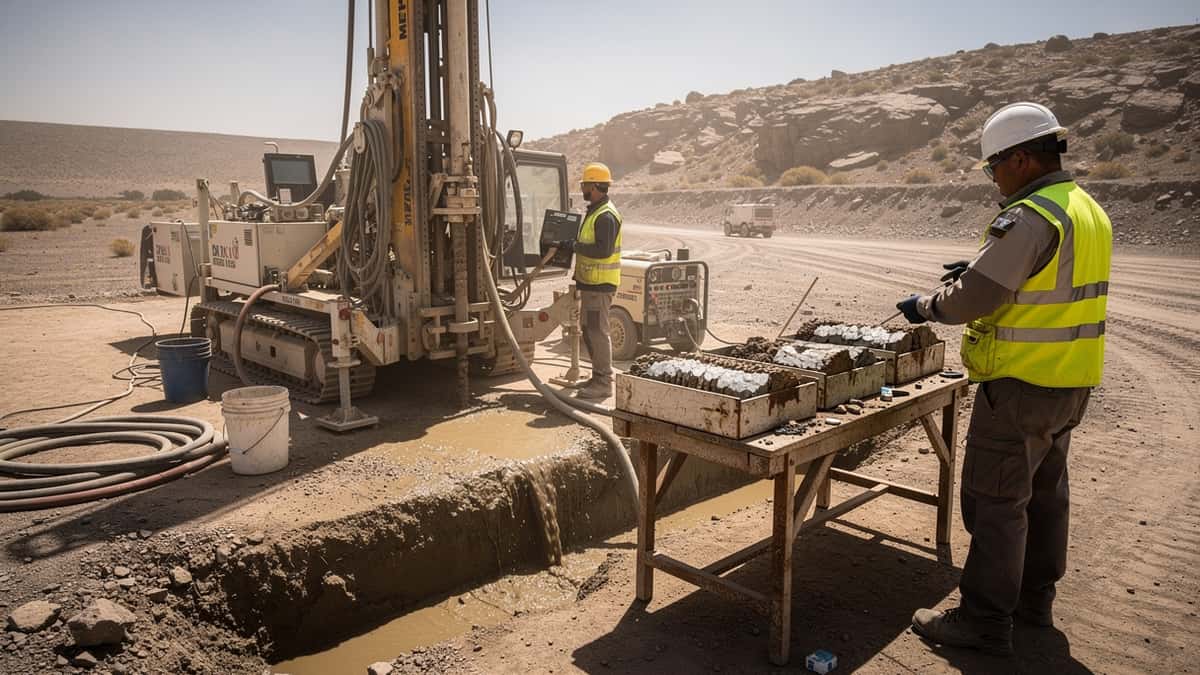
Why it matters: High-grade surface samples identify targets at Mine Centre, but neither the extent of the veins nor their grades at depth are established.
564 g/t gold over 0.25 metres — Government vein channel sample at Ferguson
95.5 g/t, 37.8 g/t and 15.5 g/t — Daisy vein samples across about 100 metres of strike
13.9 g/t over 0.40 metres — South Foley channel sample near drill hole Q26_40
126 channel samples — analysed for the program, excluding duplicates and quality-control samples
Q-Gold Resources reported a channel sample grading 564 g/t gold over 0.25 metres from the Government vein in the Ferguson area of its Mine Centre project in Ontario. The sample was collected during a surface-channel program in the summer of 2026. A separate interval at the same sampling point, identified as QG-CL-090, returned 9.06 g/t over 0.15 metres.
The company described the results as evidence of high-grade mineralization, but said the vein geometry and extent require further exploration. Channel sample lengths do not necessarily represent true vein widths, which remain unknown.
Daisy samples are spaced along about 100 metres of strike
At the Daisy vein, also in the Ferguson area, channel samples returned 95.5 g/t over 0.20 metres, 37.8 g/t over 0.20 metres and 15.5 g/t over 0.30 metres. The sample sites were spaced approximately 50 metres apart along about 100 metres of vein strike.
The results show gold at several sampled locations, but do not establish continuous mineralization or consistent grades between them, or at depth. Additional sampling and drilling are needed to test continuity. A selective rock sample from Big Vein, about 225 metres southwest of the former Ferguson mine, returned 29.3 g/t. Because it was a point sample rather than a channel across a continuous interval, it cannot establish the broader structure’s grade; QGold cautioned that selective samples may not represent the mineralized zone as a whole.
South Foley drill assays are still pending
At South Foley, a channel sample returned 13.9 g/t over 0.40 metres. The location was targeted by drill hole Q26_40, which intersected a quartz vein reported to be approximately 1.0 metre wide. That is a geological observation, not a gold assay: results for the drill intersection have not been reported, so its grade cannot yet be compared with the surface sample.
At North Foley, about 200 metres north of the Foley mine and along the known strike of the Vowel vein, a channel sample returned 6.11 g/t over 0.50 metres. As with the other surface results, it identifies a gold-bearing sample point but does not define mineralization along the vein.
Actlabs analysed 126 channel samples
The program included 126 channel samples, excluding duplicates and quality-control samples. Actlabs in Dryden, Ontario, analysed the material using a 50-gram fire assay with atomic absorption finish for gold. Trace elements were analysed using the UT-4M method, with four-acid digestion and ICP-OES/ICP-MS readings.
QGold said certified standards, blanks and coarse-crush duplicates were inserted in a rotating sequence after every 20 channel samples. The project geologist supervised field collection, logging and handling, and samples were transported to the laboratory under chain-of-custody procedures.
The technical information was reviewed and approved by Jason Arnold, P.Geo., president of DCX Geological Consulting and a qualified person under NI 43-101. Arnold is a QGold consultant and, according to the company, is not independent of it under that standard. The outstanding Q26_40 assays and further work to establish true widths and continuity remain key constraints on interpreting the surface results.
More in Discoveries
Yukon Metals pushes AZ copper-gold search beyond drilling, but scale remains unknown
At AZ, surface sampling reaches beyond the drilled footprint, but the company has yet to show whether the three target areas connect.
Yukon Metals maps three copper-gold targets at AZ, including ground east of drilling
At Viper, a soil corridor follows the orientation of dikes and veins seen in 2026 holes, but the pattern still needs a subsurface test.

Parbo intersects greenstone beneath Mount Padbury granite, forcing a gravity-model reset
GoldenEye has supplied a geological reference, while assays from pyrite-bearing Goldfinger breccias remain outstanding.