
Val-d’Or Mining’s Perestroika drilling adds high-grade gold, but continuity is unproven
A mineralized corridor extends about 1,100 metres, but the latest holes do not establish how its gold-bearing veins connect.
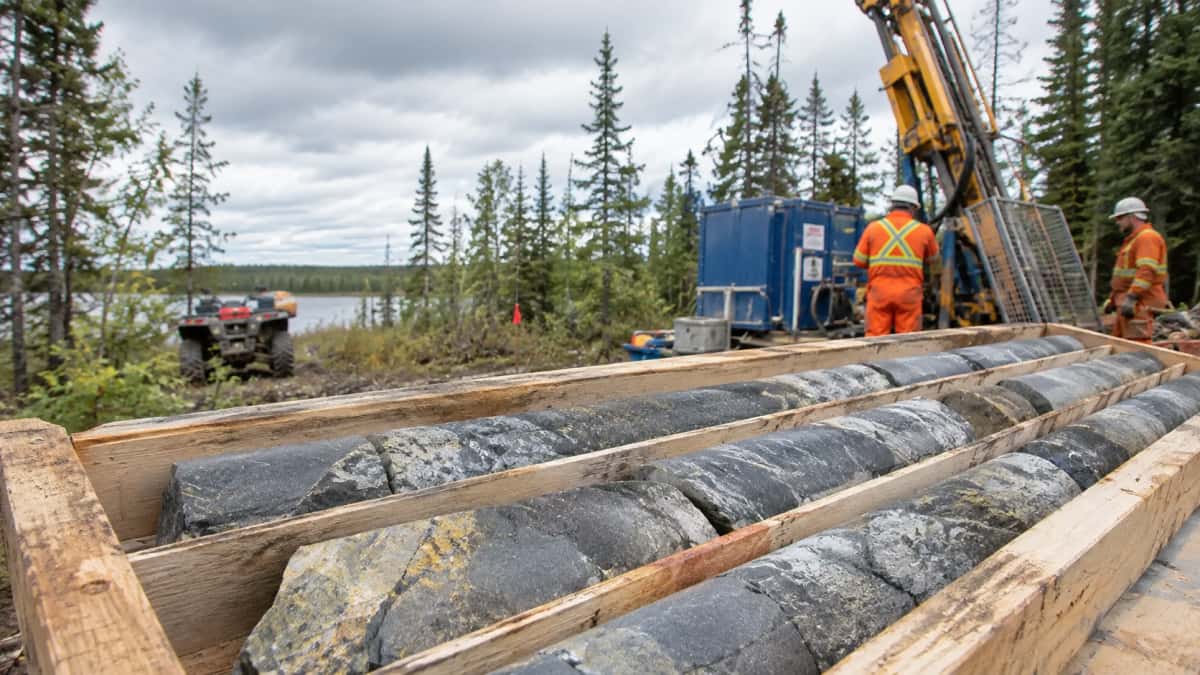
Why it matters: The latest assays add high-grade intervals to Perestroika’s geological picture, but the project’s value depends on proving that its gold-bearing structures continue between holes.
7.5 metres at 14.11 g/t gold — PE-26-044, including 0.6 metres at 150.41 g/t.
17 metres at 3.15 g/t gold — PE-26-045B, including 6.2 metres at 7.30 g/t.
21,951 metres drilled since 2024 — across 45 holes and two extensions.
70% / 30% — Val-d’Or Mining and Eldorado Gold’s respective interests.
Val-d’Or Mining reported new gold intercepts at its Perestroika prospect in Quebec, including 7.5 metres grading 14.11 grams per tonne (g/t) in hole PE-26-044. The interval, from 91.5 to 99 metres downhole, contains 0.6 metres at 150.41 g/t. The results add high-grade samples to a prospect where the continuity and true widths of the mineralized veins have yet to be established.
Eldorado Gold (Québec) operated the winter 2026 diamond-drilling campaign, which completed 25 holes for 12,477 metres. The prospect is about 40 kilometres northeast of Val-d’Or, in the Abitibi region.
Multiple intercepts, but downhole widths are not true widths
PE-26-044 also returned 1.7 metres at 58.77 g/t within the main interval. At greater depth, the hole intersected 1.1 metres at 14.73 g/t from 251.7 metres, including 0.6 metres at 22.75 g/t. Visible gold was reported in this deeper section.
Hole PE-26-045B cut 17 metres at 3.15 g/t from 113.5 metres, including 6.2 metres at 7.30 g/t and 0.5 metres at 51.31 g/t. It also returned 1.5 metres at 18.65 g/t near surface, including 0.5 metres at 45.86 g/t.
In PE-26-042, assays included 7.3 metres at 2.92 g/t from 70 metres and a separate 31.8-metre interval grading 1.21 g/t from 104.5 metres. That longer interval included 0.55 metres at 14.54 g/t. These are lengths measured along the drill holes; the company has not established the true thicknesses of the mineralized structures.
The mineralization is associated with quartz and ankerite veins, alteration and pyrite. In PE-26-044, the higher-grade zone occurs where veins cross the contact between a felsic dyke and strongly altered basalt. The results demonstrate gold at several depths, but individual high-grade intervals do not by themselves show that the veins form a continuous or economically mineable body.
Drilling tests a 1,100-metre structural corridor
The 2026 holes tested about 1,600 metres along a northwest-southeast-trending deformation corridor. The currently identified mineralized area extends about 1,100 metres, between two shear corridors separated by roughly 150 metres. The exploration model includes overlapping, relatively flat-lying vein sets, but their geometry and spatial continuity remain to be confirmed.
Perestroika lies in Courville township within the Abitibi greenstone belt, along the Uniacke deformation corridor, which the company describes as a possible southeast extension of the Destor-Porcupine deformation zone. Historical work at the prospect identified the Uniacke Shear and Glasnost showings. Golden Valley Mines and Royalties reported historical intercepts including 1.15 metres at 59.52 g/t and 3.5 metres at 18.08 g/t in 2009.
Across the 2024, 2025 and 2026 programs, the project has accumulated 21,951 metres of drilling. The 2026 campaign exceeded its original plan of about 8,000 metres in 20 holes; field work ended on April 6, 2026.
Ownership is set, while assays remain pending
Val-d’Or Mining holds a 70% interest in the properties covered by the option agreement originally signed in 2021, while Eldorado Gold retained 30% after the agreement expired. Eldorado operated the latest drilling, but the companies have not announced a new drilling budget or development schedule. No mineral resource estimate has been reported for Perestroika.
At the time of the November 19 update, 3,577 assay results from submitted samples were still pending. Those results will be incorporated into the interpretation of the 2026 holes; establishing vein geometry and continuity remains necessary before the prospect can be assessed as a potential resource.
More in Discoveries
Safi Silver drills deeper silver at Morocco's Addana, but continuity remains unproven
The campaign is also testing Antenna Hill, where visible sulphides have yet to be matched with assay results.
Lithium Africa finds pegmatites at South Africa’s Springbok, but continuity is unproven
Jackal Water lies 11 km from Norrabees, extending the search across a vast property as the company tests whether targets belong to one system.
Ni-Co Energy’s Kremer drilling finds deep sulphides, but continuity remains unproven
The Quebec programme paired shallow assays with deeper mafic and ultramafic rocks, setting up two different tests for the next phase.