
Noble Mineral Exploration finds 52.6% iron in Quebec, but processing is unproven
The surface chemistry may suit steelmaking, but the decisive question is whether processing can turn selected samples into a consistent product.
Why it matters: The results point to iron-bearing rocks with low phosphorus, but without drilling and recovery tests there is no evidence yet of a mineable deposit or saleable concentrate.
52.6% iron — highest grade reported from the surface samples.
15 of 25 samples — assayed above 40% iron.
Up to 0.001% phosphorus — reported in the seven highest-iron samples.
1,409 hectares — the property’s stated area across 26 claim units.
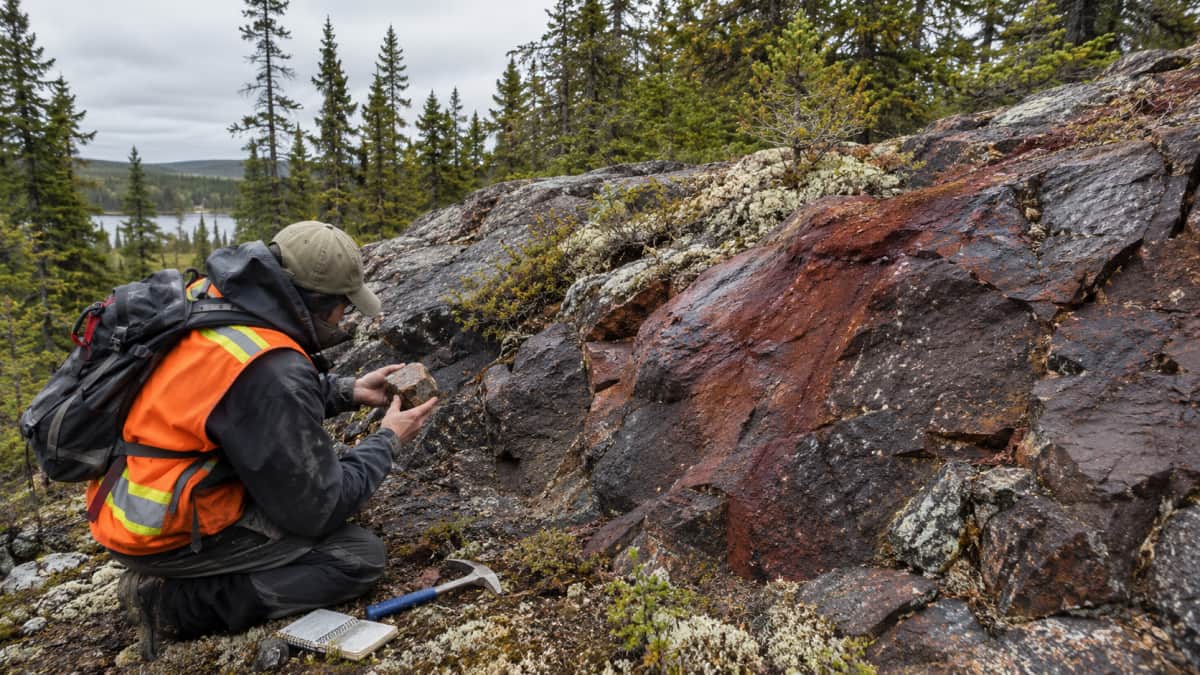
Noble Mineral Exploration reported surface rock samples grading up to 52.6% iron at its Havre-Saint-Pierre project in Quebec’s Côte-Nord region. The company said the November 25, 2026 results will help guide drilling and metallurgical tests; they do not establish a representative deposit grade or show that the material can be processed into a commercial product.
The 25 samples were collected across an area of about 1.1 kilometres by one kilometre, where an airborne survey had previously identified an electromagnetic anomaly. The median iron grade was 47%. Seven samples returned grades from 50.6% to 52.6%.
Surface samples point to multiple iron targets
The highest-grade sample, identified as 6622585, contained iron equivalent to 75.2% ferric oxide (Fe₂O₃). That chemical equivalence does not establish that all the iron occurs as hematite. Mineralogical work will be needed to identify the iron-bearing minerals and how they are distributed in the rock.
The spread of higher-grade results gives the company targets to investigate, but selective surface sampling can overstate the grade of a broader mineralized system. Havre-Saint-Pierre has no mineral resource estimate, and the results do not establish the size, continuity or average grade of any potential deposit.
Noble has expanded its Quebec property to about 1,409 hectares in 26 claim units. The larger land position could allow follow-up work on the geophysical anomalies and possible extensions of iron-rich geological units. Earlier exploration also identified vanadium, nickel, cobalt and chromium, although the available results do not establish whether any could be recovered as commercial by-products.
Processing tests will determine concentrate potential
The next phase is expected to include whole-rock X-ray fluorescence analysis, testing for total sulphur and phosphorus, and mineralogical studies using X-ray diffraction and microscopy. The company plans to identify minerals including magnetite, hematite, ilmenite, chromite and sulphides, followed by preliminary concentration tests.
Those tests will need to establish recovery rates and the behaviour of impurities, as well as whether the iron minerals can be separated efficiently. High iron grades in surface rock alone do not determine product quality: hardness, mineral grain size and liberation, energy requirements and separation performance can all affect processing costs. The company is targeting tests to assess whether concentrates grading between 62% and 67% iron are achievable; that range is not yet a demonstrated product specification.
The low phosphorus reported in the seven highest-grade samples could be favourable for steelmaking, where impurity levels influence processing and product properties. However, silica, alumina, sulphur and titanium also need to be characterized, and the results must be confirmed in material representative of the mineralized system.
Drilling remains necessary to test scale
Noble’s planned drilling will be needed to determine whether the surface grades continue laterally and at depth. The project’s location in Côte-Nord offers access to a region with iron and titanium mining experience and hydroelectric, rail and port infrastructure, but the project’s access requirements and infrastructure costs have not been established.
No resource estimate, production capacity, construction capital, operating cost or development schedule has been reported for Havre-Saint-Pierre. The next evaluation depends on drilling, geological modelling and metallurgical results that can test both the scale of the iron system and its ability to produce a competitive concentrate.
More in Discoveries
New Found Gold hits 110.47 g/t at Queensway as open-pit limits remain to be defined
Shallow Iceberg drilling is aimed at Queensway’s first mining phase, but grade-control data must still help define the limits of extraction.
Metalsource’s corrected Silver Hill assays lift grades, but true width is unknown
The revised hole lies south of a lower-grade intersection, while the geometry of Silver Hill’s mineralized structures remains unresolved.
Galloper Gold reports 22.28 metres at 3.14 g/t at Glover Island, but continuity remains untested
Pending assays from Kettle Pond South may show whether the gold-bearing zone extends beyond a single drill section.