
Marimaca drilling tests the reach of Pampa Medina’s copper sulphides
The central zone is being drilled on 150-metre spacing, while exploration also extends beyond the historically known oxide area.
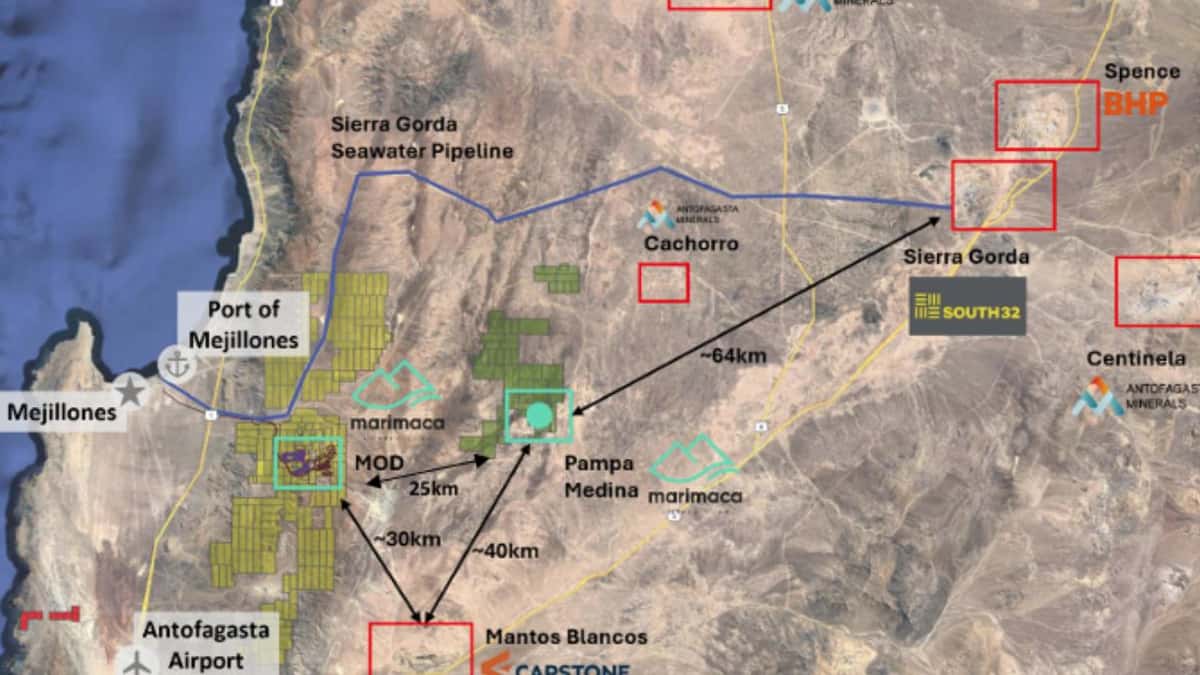
Why it matters: The drilling is building the geological picture needed to test whether Pampa Medina can support a first mineral resource estimate in 2027.
102 metres at 1.00% copper — SPRD-21, from 706 metres downhole, with 5.1 g/t silver.
8 metres at 3.21% copper — within SPRD-24, with 27.5 g/t silver.
84 metres at 0.62% copper — SPRD-26, about 300 metres west of the historically known oxide extent.
About 80% — the company’s estimate of true widths relative to reported downhole lengths.
Marimaca Copper reported new copper and silver intersections from drilling at the Pampa Medina deposit in Chile’s Antofagasta Region, including 102 metres at 1.00% copper and 5.1 g/t silver in hole SPRD-21. The results are part of exploration to assess the continuity and extent of mineralization at the deposit, which remains at the exploration stage.
Central holes intersect multiple mineralized horizons
SPRD-21 intersected the 102-metre interval from 706 metres downhole. Within it, the company reported 72 metres at 1.24% copper and 6.8 g/t silver, including 14 metres at 1.80% copper and 10.4 g/t silver. Marimaca said the results support its interpretation of multiple, superimposed mineralized horizons, primarily containing copper sulphides.
About 150 metres north, SPRD-18 returned 68 metres at 1.13% copper and 8.7 g/t silver from 634 metres, including 22 metres at 2.07% copper and 10.0 g/t silver. SPRD-24 intersected 18 metres at 1.69% copper and 13.3 g/t silver, including eight metres at 3.21% copper and 27.5 g/t silver.
Other central-area results included 34 metres at 1.36% copper and 6.6 g/t silver from 832 metres in SPRD-19, and 54 metres at 1.12% copper and 9.9 g/t silver from 320 metres in SPRD-25. The central drilling was conducted at 150-metre spacing and is intended to help define the distribution of grades and the sulphide system’s continuity at depth.
Western drilling tests oxide extension
Marimaca also reported results from near-surface oxide exploration. Hole SPRD-26, drilled about 300 metres west of the historically known oxide extent, returned 84 metres at 0.62% copper and 3.2 g/t silver. The interval included 46 metres at 1.06% copper and 6.0 g/t silver. The company said the hole adds information for evaluating the deposit’s western extent; it does not establish a resource.
Pampa Medina lies about 28 kilometres east of the Marimaca Oxide Deposit and is part of the Sierra de Medina properties, which cover approximately 14,500 hectares. The company is focusing work on an area of interest about three kilometres long and 1.5 kilometres wide, while also assessing potential extensions of copper and silver mineralization.
Resource estimate remains a 2027 target
Marimaca said central drilling is nearing completion and that subsequent work is expected to test continuity to the north and west, including at the Pampa Norte and Sierra Norte targets identified through geophysical work. Vice-president of exploration Sergio Rivera said the results support the company’s interpretation of the deposit’s geological continuity.
The company is targeting a first mineral resource estimate for Pampa Medina in 2027. The reported intervals are lengths measured along the drill holes, and Marimaca estimates true widths at approximately 80% of those lengths. The intercepts are exploratory results, not a mineral resource or reserve estimate.
More in Discoveries
Scottie Resources finds high-grade gold beyond planned mine limits
The Blueberry Contact holes could extend the underground layout, but their true widths and continuity remain unresolved.
NexMetals finds third copper-nickel zone at Selebi Main, but its scale is untested
The deep target lies below Selebi Main’s known Lower Zone, and its continuity will shape how the deposit is modelled.
Super Copper maps 600-metre Castilla target, but drilling must test it
The IP response overlaps historic workings and high-grade surface samples, yet neither shows whether copper and gold continue at depth.