
Super Copper maps 600-metre Castilla target, but drilling must test it
The IP response overlaps historic workings and high-grade surface samples, yet neither shows whether copper and gold continue at depth.
Super Copper identifica un nuevo objetivo de perforación de 600 metros en proyecto Castilla de Atacama
Why it matters: The target gives Super Copper a geophysical basis for selecting first holes at Castilla, but no drilling has tested the anomaly.
At least 600 metres — the target’s identified strike extent; it remains open along strike.
Four lines, 200 metres apart — each recorded a chargeability response associated with the Celeste target.
17.7% copper and 53.8 g/t gold — grades from a selected surface sample collected in 2025 near historic workings.
About 28 line-kilometres — the survey covered 14 lines, each approximately two kilometres long.
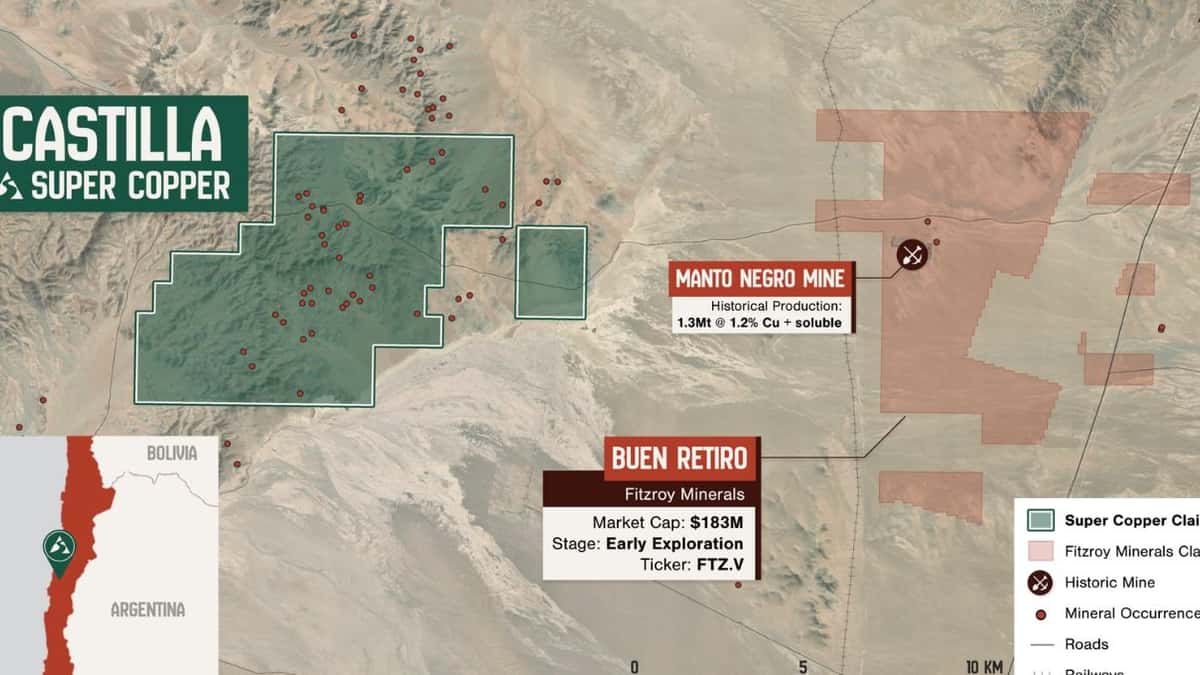
Super Copper has identified a priority drill target extending at least 600 metres at its Castilla project in Chile’s Atacama Region, using an induced-polarisation (IP) survey to define the Celeste anomaly. The company said the results will inform planning for the property’s first drilling campaign; no historical drilling has been reported at Castilla.
The chargeability response occurs on four consecutive survey lines in the Triveta area, spaced 200 metres apart. It remains open along strike, so its full extent has not been established. Super Copper reported the result on 17 November, adding it to surface sampling and magnetic modelling work disclosed during 2026.
Celeste overlaps historic workings and surface samples
The company said the anomaly spatially coincides with old artisanal workings. A selected surface sample collected there in 2025 returned 17.7% copper, 53.8 g/t gold and more than 50% iron. A second chargeability response on the same survey lines is associated with other historic workings, where a separate surface sample returned 15.9 g/t gold.
The IP survey comprised 14 lines of approximately two kilometres each. Super Copper integrated the results with drone-based magnetometry, geological mapping and rock sampling. The combined information is being used to refine areas for follow-up, with Celeste among the priorities for the next exploration stage.
These results do not establish mineralisation at depth. IP measures electrical responses that can be associated with sulphide minerals, but can also reflect material without economic value. The reported copper and gold grades come from selected surface samples, not representative averages; they cannot be used to estimate project-wide grades or mineral resources. Castilla remains an exploration-stage project with no resource estimate.
First Castilla drilling targeted for 2027
Super Copper is exploring Castilla for iron oxide-copper-gold (IOCG) deposits and uses geological, geochemical and geophysical data to select targets. The company expects to conduct its first drilling during the second quarter of 2027, subject to permits, access conditions and contractor availability.
Before drilling, it expects to report further sampling and mapping results, along with a classification of identified targets and planned metres for each. Those details are intended to guide the campaign; drilling will be needed to determine whether the Celeste chargeability response corresponds to copper-gold mineralisation.