
Caspin restarts Bygoo drilling to test Kelpie’s underexplored tin gap
The October resource update added indicated tonnes, but the connection between the two mineralised zones remains untested at depth.
ga.gov.au
Why it matters: Drilling could clarify whether Kelpie’s tin mineralisation continues between two zones and at depth, where the current resource is largely inferred.
6.5 million tonnes at 0.43% tin — Kelpie’s updated resource, containing 28,000 tonnes of tin.
200 metres — the gap between Dumbrell’s and Errol’s targeted in the first phase.
1.4 million tonnes at 0.47% tin — the indicated portion of the resource; the remaining 5.1 million tonnes are inferred.
84% tin recovery — achieved in preliminary metallurgical work using gravity separation and flotation.
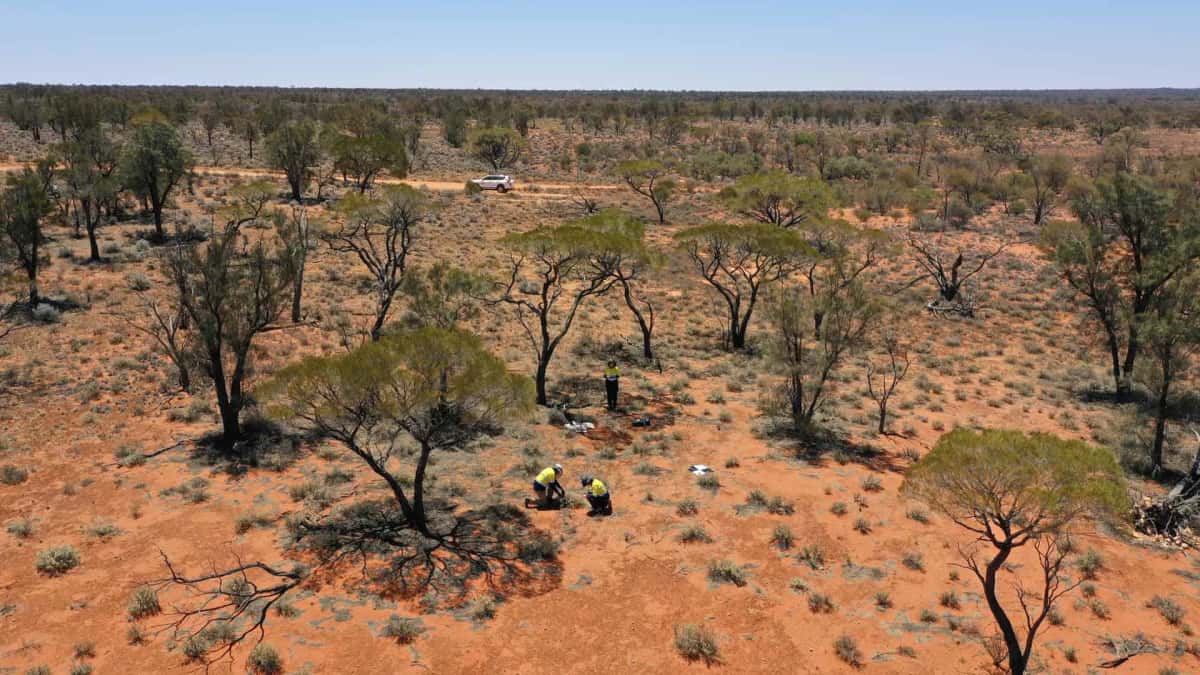
Caspin Resources has resumed reverse-circulation (RC) drilling at its Bygoo tin project in New South Wales, Australia, starting with a roughly 200-metre gap between the Dumbrell’s and Errol’s zones at the Kelpie deposit. The company is testing whether mineralisation continues at depth; effective drilling below about 100 metres of vertical depth is limited in the target area.
The work follows an October resource update that lifted Kelpie to 6.5 million tonnes grading 0.43% tin, or 28,000 tonnes of contained metal. Contained tin rose 45% from the estimate reported in September 2025. Caspin plans to follow the initial gap target with selective infill drilling at Errol’s.
Errol’s remains widely spaced
The updated estimate included an indicated resource at Kelpie for the first time: 1.4 million tonnes at 0.47% tin, accounting for about a quarter of the estimated contained metal. The other 5.1 million tonnes, grading 0.41% tin, are classified as inferred.
Errol’s has returned some of Kelpie’s higher-grade reported intervals, including 20 metres at 2.11% tin from 107 metres and 20 metres at 1.79% from 185 metres. The latter interval included 3 metres at 9.32% from 193 metres. These are reported drill intervals; the supplied information does not state true widths.
Drill spacing at Errol’s remains wide, and its resource is entirely inferred. Infill work is intended to better define continuity around the intercepts. New drilling data could support greater confidence in later estimates, but would not by itself constitute a resource update.
Diamond-hole assays are still pending
Caspin is also awaiting laboratory results from four diamond holes completed after the October update. The holes tested extensions at depth beneath Dumbrell’s and Stewart’s, and the company reported greisen-style alteration in all four based on geological observations. Alteration may indicate that the system continues, but assays are needed to establish whether the holes contain significant tin grades.
One hole followed the dip of the mineralised body for about 80 metres beyond the nearest previous drill point at Dumbrell’s. Caspin expected results from all four holes before the end of 2026. RC drilling is scheduled to resume during 2027 after a Christmas break, with further work planned at Errol’s and other extension targets.
Metallurgy supports further study, not a development decision
Earlier metallurgical work at Kelpie achieved tin recovery of about 84% through gravity separation and flotation, producing a concentrate grading 53.6% tin. Caspin has cited the results and the updated resource as inputs to assessing the potential for a standalone open-pit tin operation at Bygoo. They do not amount to a development decision or establish project viability.
Tin is used in electronics and manufacturing, with solder accounting for 51% of global tin consumption in 2023, according to the International Tin Association. The association forecasts a 2.2% decline in refined tin consumption in 2026, citing record prices and weakness in China’s solar market. For Kelpie, the immediate technical test remains whether the drilling can establish mineralisation through the poorly tested gap; pending assays will also determine whether the four diamond holes add evidence of tin at depth.
More in Discoveries
Kalgoorlie Gold finds volcanic rocks at Pinjin, but gold assays are pending
Lighthorse drilling targeted extensions beneath earlier high-grade hits, while Rebecca Sequence was tested for the first time beneath cover.
Argent Minerals finds gold beyond Trunkey Creek workings, but continuity is unproven
The first campaign has tested only the northern end of a 4.7-kilometre target, leaving the vein’s deeper geometry unresolved.
Brixton extends Catalyst at Thorn, while Sentinel’s porphyry footprint remains uncertain
Catalyst step-outs and a first test at a target 37 km from Camp Creek put two different exploration stages in the same campaign.