
Brixton extends Catalyst at Thorn, while Sentinel’s porphyry footprint remains uncertain
Catalyst step-outs and a first test at a target 37 km from Camp Creek put two different exploration stages in the same campaign.
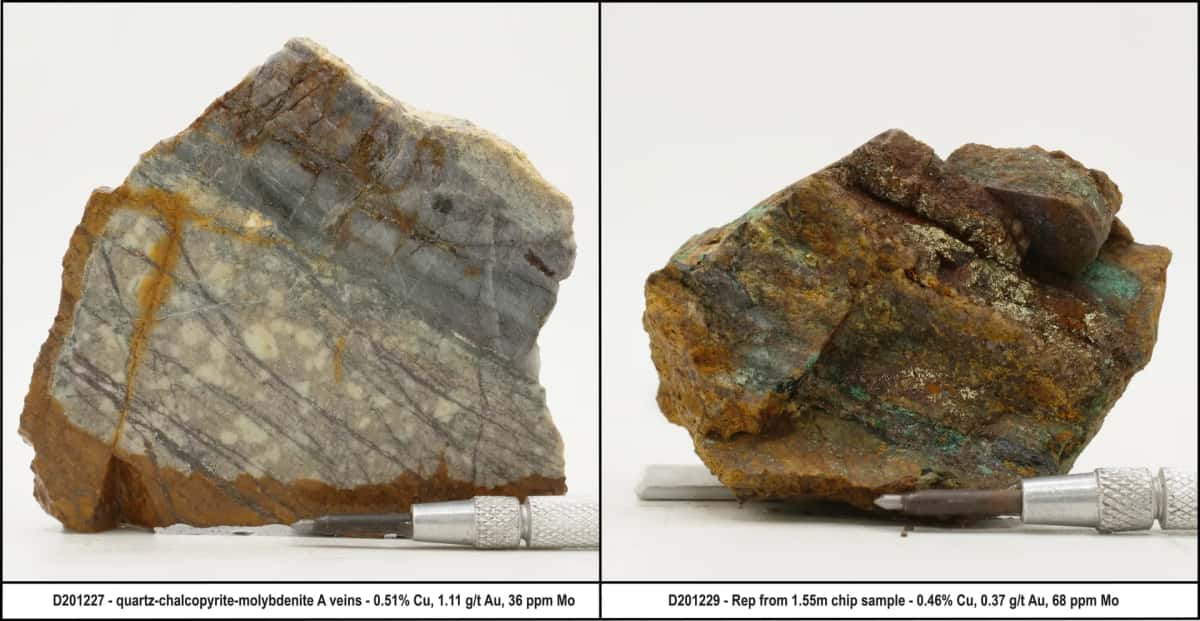
stocktitan.net
Why it matters: Catalyst’s open-ended mineralization and Sentinel’s unconfirmed porphyry interpretation leave two distinct exploration questions at Thorn.
2,070 m — drilled in four Catalyst holes
258.66 m at 0.29% CuEq — THN26-391’s main Catalyst interval from 30.89 m
1 km of strike and more than 500 m of depth — Brixton’s estimated Catalyst extent, incorporating 2025 drilling
10,000 m — the fully funded Thorn drilling programme launched in June 2026
Brixton Metals reported 2026 drill results from the Catalyst and Sentinel targets at its 100%-controlled Thorn project in northwestern British Columbia. Four holes at Catalyst extended copper-gold-molybdenum mineralization identified in 2025; Sentinel’s first drilling found near-surface copper, but results across the target were mixed and its overall extent remains undetermined.
Catalyst is about 7 km northeast of the Camp Creek system. Sentinel lies 37 km east-southeast. The work formed part of Brixton’s 10,000 m fully funded drilling programme at Thorn.
Catalyst drilling extends the 2025 discovery
At Catalyst, Brixton drilled four holes totalling 2,070 m from the 2025 discovery pad and nearby locations. THN26-391 returned 258.66 m at 0.29% copper equivalent (CuEq) from 30.89 m, including 72 m at 0.47% CuEq. Within that interval, 35.5 m graded 0.60% CuEq and contained 298 ppm molybdenum.
THN26-395 intersected 123 m at 0.22% CuEq from 73 m, followed by 330.34 m at 0.23% CuEq from 210 m. The reported interval ended at 540.34 m, and the hole finished at 549 m in mineralization, according to Brixton.
Two other holes tested continuity in different directions. THN26-392, about 140 m southwest of the discovery point, cut 21 m at 0.37% CuEq from 362 m, including 8 m at 0.55% CuEq. It also returned 47.89 m at 0.11% CuEq to the end of the hole. THN26-390, drilled to the southeast, intersected 80 m at 0.25% CuEq from 47 m. Brixton also reported 9.56 m at 0.73 g/t gold in THN26-391.
Combining the new results with 2025 drilling, the company estimates Catalyst mineralization extends for at least 1 km along strike and more than 500 m vertically. Brixton says it remains open to the northwest, northeast and southwest, as well as at depth. These are company estimates based on drilling, not a mineral resource estimate.
Sentinel’s first holes leave the target’s scale unresolved
At Sentinel, four holes were drilled from three pads. The first, THN26-386, returned 158 m at 0.25% CuEq from 9 m, including 36.7 m at 0.58% CuEq. Within that included interval, a 0.70 m sample graded 12.05% copper, 79.70 g/t silver and 0.75 g/t gold, for 14.10% CuEq. That narrow sample is part of a much broader interval and is not the average grade across it.
The same hole also returned 57 m at 210 ppm molybdenum from 179 m. THN26-387, about 650 m to the southeast, intersected 15.65 m at 9.62 g/t silver near surface and 50.70 m at 0.11% CuEq from 234.30 m, with molybdenum.
THN26-388 and THN26-389 did not return significant intervals. The first was abandoned at 112.8 m and redrilled from the same pad. In THN26-389, Brixton observed increasing copper and molybdenum toward the bottom of the hole, but reported no significant interval. The company interprets a zinc-lead-silver halo over copper-molybdenum mineralization as a possible indication that drilling tested upper and outer parts of a porphyry-style system. The interpretation remains provisional; the age of the intrusion associated with Sentinel’s mineralization has not been established, and its host rocks are mapped as Triassic and differ from those at Camp Creek, Catalyst and Tempest.
CuEq assumptions and unknown true widths constrain interpretation
Brixton calculated CuEq using reference prices of US$4.75 per pound of copper, US$3,500 per ounce of gold, US$50 per ounce of silver and US$20 per pound of molybdenum. The calculation assumes a conceptual 85% recovery for each metal; these are not metallurgical recoveries measured at Thorn.
The reported intervals are core lengths, and true widths are unknown. General composites use a 0.10% CuEq cut-off and allow up to 10 m of internal dilution; higher cut-offs apply to some included intervals. The reported lengths therefore do not establish the true dimensions of the mineralized bodies.
Brixton said core was split in half and samples were sent to ALS Minerals facilities in Yukon or British Columbia for analysis in North Vancouver. The company reported inserting blanks, duplicates and certified reference materials at a combined rate of up to 15%. Further drilling would be needed to define the geometry and extent of both targets, particularly Sentinel, where the porphyry interpretation and the age of the mineralizing intrusion remain unresolved.
More in Discoveries
Trident tests whether Contact Lake gold extends below Saskatchewan mine
Cameco mined Contact Lake from 1994 to 1998; Trident is now testing ground beneath the old workings.
Kalgoorlie Gold finds volcanic rocks at Pinjin, but gold assays are pending
Lighthorse drilling targeted extensions beneath earlier high-grade hits, while Rebecca Sequence was tested for the first time beneath cover.
Argent Minerals finds gold beyond Trunkey Creek workings, but continuity is unproven
The first campaign has tested only the northern end of a 4.7-kilometre target, leaving the vein’s deeper geometry unresolved.