
Vietnam's US$61 million rare earth plant puts separation technology to the test
At Hai Phong, the project is designed to turn mixed oxides into individual products, but its performance will depend on separating chemically similar elements.
Why it matters: Vietnam is seeking to add separation and refining capacity to a rare earth supply chain where processing remains concentrated in established centres.
US$61 million — approximate investment in the Hai Phong project
10,000 tonnes per year — planned capacity for products across five processing lines
More than 99% — target purity for individual rare earth oxides
Fourth quarter of 2028 — planned start of commercial operations
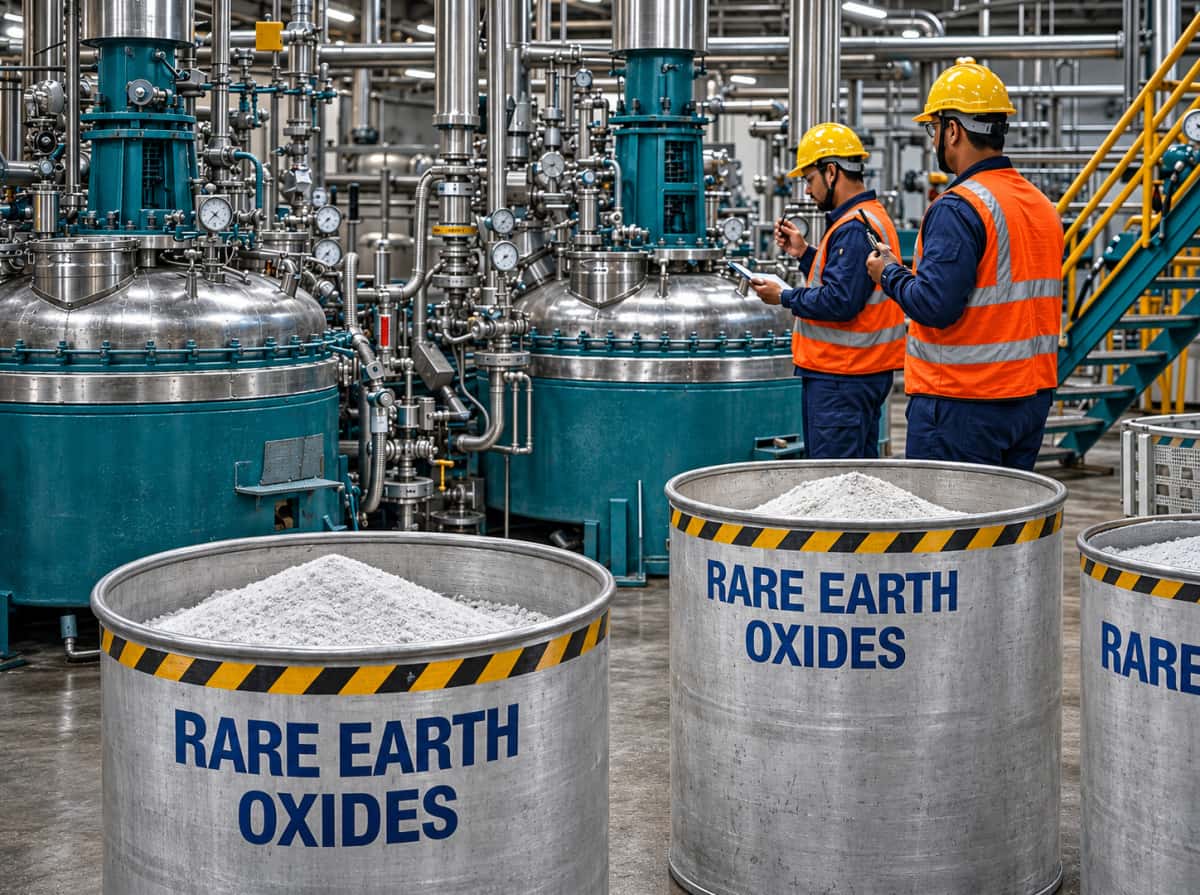
Khanh An Industry has begun construction of a rare earth processing plant in Hai Phong, northern Vietnam, aiming to produce up to 10,000 tonnes of materials annually once the facility reaches its planned commercial start in the fourth quarter of 2028. The project will use hydrometallurgy and solvent extraction to separate mixed rare earth oxides into individual products with purity above 99%.
The plant is being developed on about 14 hectares in the Xuan Cau industrial and free-trade zone, within the Dinh Vu-Cat Hai economic zone. Its five processing lines are intended to serve high-technology industries, but the announced capacity is a design target, not current production or a confirmed volume of any particular element.
Separation is the technical test
Rare earths comprise 17 elements that can occur together in deposits and have similar chemical behaviours. Turning mixed material into saleable individual oxides therefore requires multiple controlled separation stages. The Hai Phong facility is designed to use continuous counter-current solvent extraction, which transfers selected elements between liquid phases to increase concentration and purity. The project also plans to use automation and artificial-intelligence tools for process control.
Products could supply applications including permanent magnets, electronics, energy technologies, optics and catalysts. Neodymium, praseodymium, dysprosium and terbium are among the elements of commercial interest for some high-performance magnets. However, the project’s total planned capacity does not establish how much of each oxide it will produce, and it is not a target for finished magnets, which require further manufacturing steps.
Ben Den is among the planned feed sources
The company expects to source some raw material from the Ben Den mine in Lao Cai province, as well as from other legally authorised sources. Tests at Ben Den have used in-situ leaching on rare earth minerals associated with ion-adsorption deposits. The reported tests produced mixed rare earth oxides with contents above 95%; those mixtures could undergo additional purification and separation at Hai Phong.
The intended chain runs from mineral recovery to concentrates or mixed oxides, then chemical separation and products meeting industrial specifications. The difference between the tested input material and the plant’s target purity underscores the role of downstream processing in the project. The composition of feed, operating performance and product mix will determine what the facility can supply to customers.
Port access and environmental controls
Hai Phong’s port and industrial infrastructure could support the movement of chemical inputs, equipment and refined products. The project is located in an area also slated for port and logistics investment, although the source material provides no confirmed employment figure for the plant.
Processing will also require controls for reagent use, water consumption, industrial effluent and separation residues. In-situ leaching may reduce some physical disturbance compared with conventional mining, but it does not remove the need to monitor chemical solutions and groundwater. The plant remains under construction; its planned commercial start is the next major point at which its production, costs, product quality and ability to meet environmental requirements can be assessed.
More in Critical Minerals
Indonesia weighs a 70% state take from mining as nickel investment faces new risk
Foreign-funded nickel processing sits at the centre of a proposal whose treatment of existing contracts remains unresolved.
Legacy Minerals adds scandium to NiCo Young, but recovery remains unverified
The addition lifts the project's scale, while a pending licence and a key processing assumption shape what can be counted on.
Antofagasta court rejects Coyo challenge to Codelco-SQM lithium pact, for now
Coyo argued SQM was selected without a public tender, putting the structure of Chile’s state-led lithium strategy under scrutiny.