
China’s anode-free sodium battery takes on a cycle-life problem
Removing hard carbon from the cell leaves sodium vulnerable to irreversible losses during repeated charging and discharging.
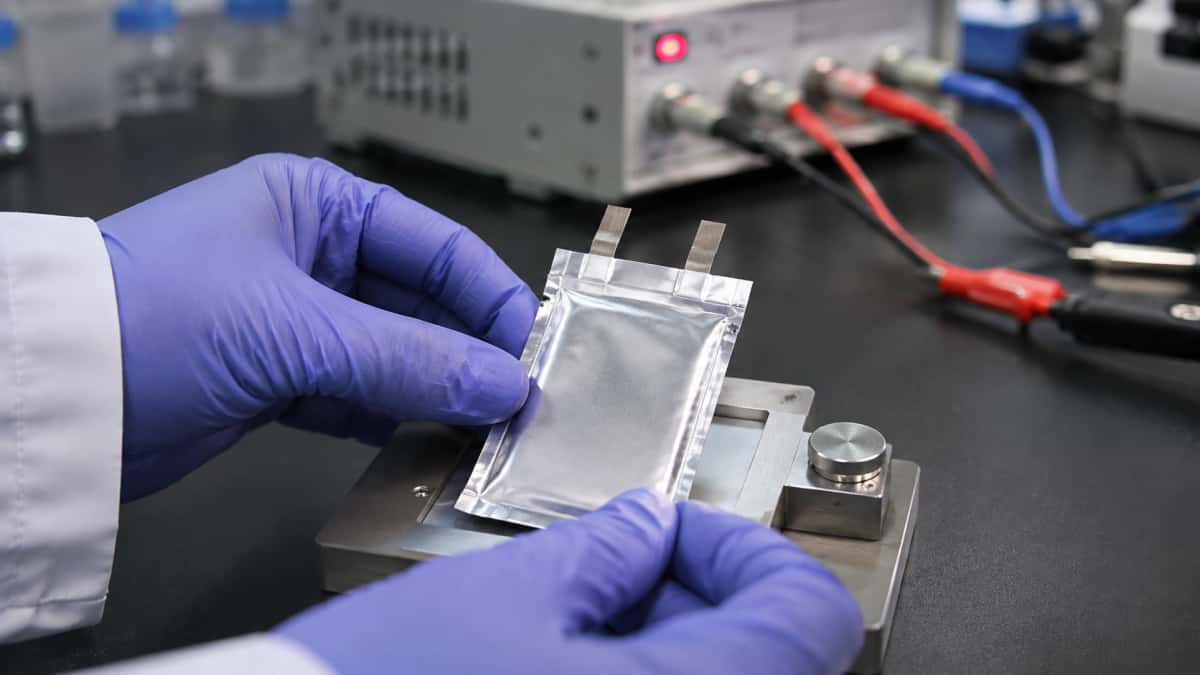
Why it matters: Longer-lasting sodium cells could broaden energy-storage options and diversify battery supply chains, though commercial competitiveness is not yet established.
1,400 cycles — the tested cells retained about 80% of initial capacity.
300 mAh — approximate capacity of the experimental pouch cells.
88% — capacity at −40 °C relative to the room-temperature result.
Up to 98% — round-trip energy efficiency under the reported test conditions.
A Chinese research team developed an anode-free sodium battery that retained approximately 80% of its initial capacity after 1,400 charge-discharge cycles, using an electrolyte based on 1,3-dioxane (DOX). The work involved researchers from Xi’an Jiaotong University, the Institute of Physics at the Chinese Academy of Sciences and other institutions, and was published on November 2, 2026.
The result addresses a central durability challenge for anode-free cells: sodium can be irreversibly consumed during cycling, steadily reducing capacity. The experiments were conducted on pouch cells of about 300 mAh, however, and do not establish commercial-scale performance or cost.
How the cell operates without active anode material
Conventional batteries use a cathode and an anode, with ions moving between them through an electrolyte. Many sodium-ion batteries use hard carbon as the active anode material. In the design studied by the Chinese team, that material is not included as an initial reserve during cell manufacture.
The negative electrode is still present: it is a metal current collector. During charging, sodium deposits on its surface; during discharge, it moves back towards the cathode. Removing the initial active anode material could reduce the materials used and may provide a route to higher energy density. But it also leaves less margin for sodium lost to unwanted reactions during repeated cycling.
The electrolyte targets sodium loss
The team used an electrolyte based on 1,3-dioxane, a cyclic ether. According to the research, the compound’s molecular structure supports reversible sodium deposition and a controlled oligomerisation process that forms a protective solid-electrolyte interphase on the metal surface.
That interphase is intended to limit parasitic reactions that consume sodium and degrade the cell. The researchers reported that the approach improved stability over repeated charge and discharge cycles. The tested cells had a cathode material loading of 20 milligrams per square centimetre and operated at rates of up to 3C. The team also reported 88% capacity at −40 °C compared with the room-temperature measurement, and round-trip energy efficiency of up to 98% under the conditions evaluated.
These are laboratory-cell results, not evidence of performance in a full battery system. The reported 300 mAh capacity is far below the capacities required for many vehicle and industrial storage applications, and the figures do not establish a commercial cost per kilowatt-hour.
Scale-up will determine the market relevance
Sodium is widely available, and some sodium battery chemistries can avoid nickel and cobalt, depending on the cathode materials used. Those attributes could help diversify supply chains and support applications where cost, operating life or low-temperature performance matter more than maximum energy storage in a limited space. Stationary storage for solar and wind power is one potential use; the research does not demonstrate that the battery is ready for that market.
For Chile, a major lithium and copper producer, sodium-based storage is one factor to watch as battery chemistries develop. It does not establish that sodium will displace lithium: lithium-ion batteries have a mature industrial base, and energy density remains important in many applications. The study also does not report a commercial cost comparison.
The next technical test is whether the reported stability can be maintained in larger cells and under practical operating conditions. The researchers’ results point to electrolyte design as a way to address sodium loss, but safety, manufacturing compatibility and performance in industrial formats remain to be demonstrated.
More in Critical Minerals
Vietnam's US$61 million rare earth plant puts separation technology to the test
At Hai Phong, the project is designed to turn mixed oxides into individual products, but its performance will depend on separating chemically similar elements.
Indonesia weighs a 70% state take from mining as nickel investment faces new risk
Foreign-funded nickel processing sits at the centre of a proposal whose treatment of existing contracts remains unresolved.
Legacy Minerals adds scandium to NiCo Young, but recovery remains unverified
The addition lifts the project's scale, while a pending licence and a key processing assumption shape what can be counted on.