
Chile and Japan deepen critical-minerals ties as El Teniente tests remote mining
Their Tokyo agenda links copper supply security to optical-network technology, while the project’s operational reach remains to be established.
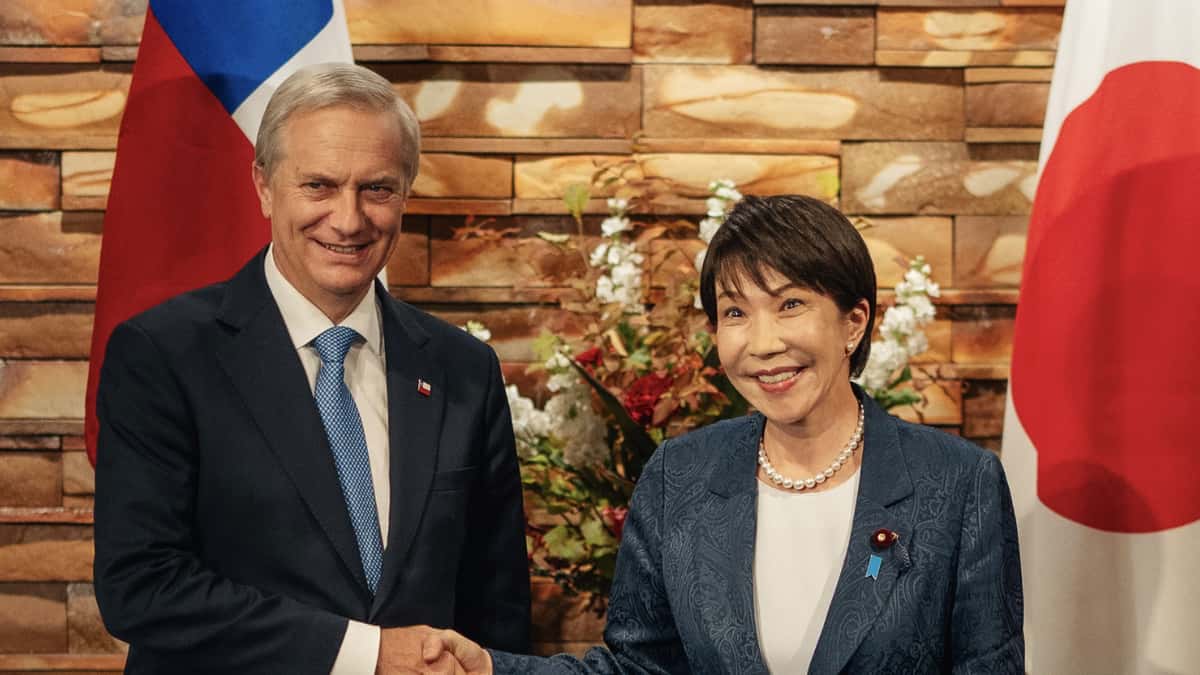
Why it matters: The talks connect Chile’s mineral supply role with Japan’s interest in secure materials and mining technology, but leave commercial supply commitments open.
2024 — Chile and Japan signed a mining and mineral resources cooperation memorandum.
August 2026 — Codelco and NTT Docomo Business announced the El Teniente technology trial.
Chile and Japan agreed to deepen cooperation on critical minerals, including copper, at a meeting in Tokyo on 20 November 2026 between President José Antonio Kast and Prime Minister Sanae Takaichi. Their joint statement also highlighted a Codelco–NTT Docomo Business project at El Teniente that is testing whether advanced communications technology can support remote operation of mining equipment.
The governments said their collaboration is intended to strengthen the stability of international supplies of materials used in industry and the energy transition. The statement did not set new copper or lithium supply volumes, identify specific mining investments or announce commercial contracts arising from the meeting.
El Teniente project remains a proof of concept
The trial, announced in August, is taking place at Codelco’s El Teniente division in the O’Higgins Region. It will assess the use of IOWN APN, an advanced optical communications network that transmits information using light and is designed to carry large volumes of data with reduced communication delays.
NTT Docomo Business said the project will connect facilities at El Teniente with an operations centre in Rancagua. The work includes assessing high-definition video monitoring and the technical feasibility of controlling equipment remotely. The stated aims include improving worker safety and operational efficiency by enabling heavy machinery to be managed from outside extraction areas.
The companies have described the work as a study and proof of concept, not an operational deployment. Its findings will determine whether a broader implementation is technically feasible; the joint government statement did not specify a rollout schedule or operating targets.
Existing agreements underpin the renewed agenda
The November commitment builds on a mining and mineral resources cooperation memorandum signed in June 2024 by Chile’s mining ministry and Japan’s Ministry of Economy, Trade and Industry. The governments also noted a new memorandum on information and communications technology, focused on secure digital infrastructure and technology solutions.
Japan views Chile as an important supplier of copper and lithium, according to State Minister for Foreign Affairs Iwao Horii, who raised opportunities for Japanese companies in mining, renewable energy and technology at a business meeting. The agenda also included Japanese support for the Choose Chile initiative, which promotes investment opportunities and business ties between the two countries.
For Chile, the diplomatic commitment sets a framework for cooperation, but the announcement itself contains no new investment or supply agreement. The next concrete test at El Teniente is whether the trial demonstrates that remote equipment control over the optical network is technically viable.
More in Critical Minerals
Kenya picks Bunker Hill consortium for Mrima Hill talks, but no licence yet
The proposal hinges on whether old NI 43-101 estimates can be verified and a culturally sensitive site can clear permitting.

Japan sets 6,000-metre rare-earth test, but seabed output is not refined supply
A short lift trial reached the surface, but Minamitorishima’s next campaign must test endurance, cost and environmental controls.

Chile maps 46 rare earth-rich tailings sites, but recovery remains unproven
Many deposits have only one surface sample, leaving their grade and continuity below ground untested.