
Argentina and Canada expand lithium plans, but each faces a different test
Cauchari-Olaroz is seeking a major capacity increase, while Canada's push extends from mine development to chemical conversion.
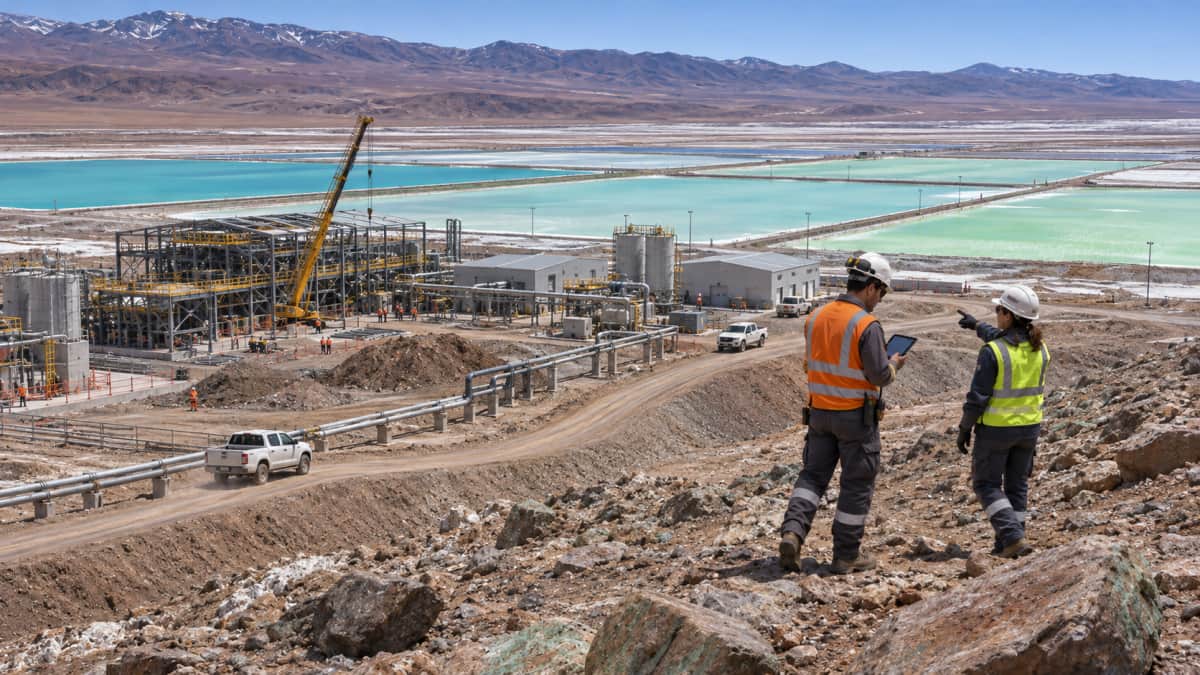
Why it matters: Argentina's proposed brine expansion and Canada's hard-rock projects show how competing supply strategies depend on more than resource size: both need to turn plans into operating capacity.
85,000 tonnes a year — Cauchari-Olaroz's potential nominal capacity after its proposed expansion
US$1.0 billion — approximate initial investment under consideration for the Cauchari-Olaroz expansion
83 million tonnes at 1.27% Li₂O — probable reserves at CV5 in Quebec
C$6.1 million — non-repayable funding secured by Frontier Lithium for PAK road and power-connection development
Argentina's proposed lithium expansions and Canada's mine and processing projects are advancing on different fronts, but both face hurdles before planned capacity becomes commercial supply. Lithium Argentina is assessing a second stage at Cauchari-Olaroz in Jujuy that could lift nominal capacity to about 85,000 tonnes a year of lithium carbonate equivalent (LCE); the company has not made a final construction decision. In Canada, technical studies and access infrastructure are progressing, while construction funding, permits and the viability of chemical conversion remain central to project delivery.
Cauchari-Olaroz expansion remains under evaluation
Cauchari-Olaroz produced 9,550 tonnes of lithium carbonate in the third quarter of 2026, up 3% from the previous quarter, Lithium Argentina reported. Production totalled 28,490 tonnes from January to September, and cash operating costs were US$5,801 per tonne sold in the third quarter.
The proposed second stage would add 45,000 tonnes a year of capacity. Lithium Argentina estimates an initial investment of about US$1 billion and is seeking to bring forward the first 10,000 tonnes of additional annual capacity, with production targeted to start in 2028. The expansion entered Argentina's Large Investment Incentive Regime (RIGI) in May 2026, but that status does not constitute approval to build. Technical, economic and financial evaluations are still required. The operation's projected life is 40 years if the expansion proceeds.
Rio Tinto is also advancing projects in the country. It inaugurated the Fénix 1B expansion and Sal de Vida in Catamarca after a combined investment of about US$1.4 billion. Its Rincón project in Salta carries an investment of US$2.5 billion and is designed for 60,000 tonnes a year of battery-grade lithium carbonate. Backed by US$1.175 billion in financing from four international financial institutions, the project is targeting first production in 2028, followed by an approximately three-year ramp-up. A further US$1 billion for Fénix II remains under evaluation, without a final investment decision.
Pozuelos-Pastos Grandes, a three-asset development in Salta controlled 67% by Ganfeng Lithium and 33% by Lithium Argentina, was formally established in October. Its staged plan starts at 50,000 tonnes a year of LCE and could reach 150,000 tonnes. The companies are assessing financing options, including long-term supply agreements and potential strategic partners. The design combines evaporation concentration with direct lithium extraction; shared infrastructure and processing are intended to serve the adjacent assets.
Canadian projects combine mine development with infrastructure
In Quebec, PMET Resources' updated feasibility study for the CV5 deposit at Shaakichiuwaanaan estimates probable reserves of 83 million tonnes grading 1.27% lithium oxide (Li₂O), with 148 parts per million tantalum pentoxide. The reserves contain about 2.61 million tonnes of LCE. The planned operation would produce 800,000 tonnes a year of spodumene concentrate grading 5.5% Li₂O. Tantalum could provide an additional product, while the project still requires permits and construction financing. It also received approximately C$1.2 million in federal funding for access infrastructure.
In northwestern Ontario, Frontier Lithium is progressing permitting and access work for PAK, a 92.5%-owned joint venture with Mitsubishi Corporation. The project includes a proposed 56-kilometre Junction Road, a spodumene concentrator and a future chemical conversion plant in Thunder Bay. The companies secured about C$6.1 million in non-repayable funding for road development and a power connection.
The Canadian conversion ambition faces a separate execution test: Rio Tinto slowed construction of its Nemaska lithium hydroxide plant in Bécancour in 2026 while reviewing project execution conditions. Meanwhile, Argentina's brine developments and Canada's spodumene projects have different water, energy, extraction and processing requirements. Their stated capacities also refer to different products—LCE and spodumene concentrate—and are not directly comparable. Cauchari-Olaroz's proposed expansion must still complete its technical, economic and financial evaluations.
More in Critical Minerals
AI data-centre growth puts Chile’s copper and critical-mineral supply chains to the test
Global data-centre power use is projected to nearly double by 2030, while some essential materials rely on concentrated processing chains.
Argentina's mining megaproject ranking spans billions, but the totals use different bases
The ten-project list mixes initial build capital, expansion costs and RIGI declarations, while developers remain at sharply different stages.
Argentina’s US$57bn mining expansion hinges on copper projects still awaiting decisions
The export forecast rests on a pipeline whose largest developments still need financing, permits and infrastructure.