
Uranium spot rises as explorers lag, but Forwood still backs early-stage juniors
Western Australia welcomes exploration, yet mine restrictions leave Oobagooma facing a hurdle beyond the uranium price.

forwoodsafety.com
Why it matters: The gap between uranium prices and explorer share performance tests whether a stronger market can translate into financing and development prospects for companies without production.
US$91.75/lb — spot uranium price, up 12% from the start of 2026.
US$98/lb — forward price, a multi-decade high, according to the account.
22.9% — Sprott Uranium Miners ETF’s year-to-date decline at the end of October 2026.
4.1% U3O8 — highest grade reported from surface rock samples at Orpheus Uranium’s Conways licence.
John Forwood, investment director of Lowell Resources Fund, says uranium explorers’ share prices have failed to keep pace with the commodity. The Sprott Uranium Miners ETF was down 22.9% for the year and 52% below its annual high at the end of October 2026, even as spot uranium reached US$91.75 per pound.
More than 90% of uranium trade takes place through long-term contracts, and the forward price stood at US$98 per pound. Forwood argues that spot prices nonetheless have a stronger influence on explorers’ valuations because these companies do not yet produce and depend on market expectations for their projects. He says a return of spot prices above US$100 could give explorers greater share-price upside than established producers such as Cameco and Kazatomprom. That is an investor’s expectation, not a guaranteed outcome.
Spot prices and the valuation gap
Uranium small caps reached their strongest valuations in early 2024, when spot prices moved above US$100 per pound. The price later returned to that level, but Forwood says explorers did not regain the ground they lost when uranium fell to the mid-US$60s per pound during 2024.
He contrasts the sector’s share-price weakness with the recent rise in uranium prices, arguing that the pressure on explorers in gold, silver, lithium and copper has been more readily explained by weaker commodity prices and higher interest rates. He also disputes the assumption that uranium projects should automatically face a greater development discount: he puts the average timeline for a large copper mine at 18 years and estimates 15 to 20 years for a uranium project. He acknowledges that far fewer uranium mines have entered operation.
Demand projections underpin the investment case but do not determine project schedules or share prices. The World Nuclear Association estimates that meeting government nuclear-power targets would require 548 GWe of additional capacity that is not yet planned or proposed by 2040. Benchmark has forecast that material uranium deficits could emerge from 2027.
Orpheus samples point to a distinct target
Forwood follows Orpheus Uranium, which is backed by Canadian developer IsoEnergy. The company holds projects in South Australia, including Radium Hill, Pirie Basin, Frome and Marree, and has completed its acquisition of Oobagooma in Western Australia’s Canning Basin, near Derby.
Its McArthur project in the Northern Territory has drawn attention after surface rock samples at the Conways licence returned grades of up to 4.1% U3O8, as well as copper. Forwood describes the target as vein-hosted mineralisation in basalt, unlike the sedimentary deposits Orpheus is pursuing in South Australia or the large unconformity-style deposits at Ranger and Jabiluka. The samples do not establish a deposit’s size or continuity. Orpheus shares had risen 58% year to date, but the company remains an explorer.
Oobagooma also faces a policy constraint: uranium mining in Western Australia is restricted, with exceptions for some mines that received environmental approval under an earlier conservative government. Forwood has pointed to the contrast between public support for exploration and limits on mine development.
Forwood also tracks Canadian and US projects
Geiger Energy is exploring in Canada’s Thelon Basin, a less-explored area than the uranium-producing Athabasca Basin. Its shares traded at C$0.12, about one-third of their early-2026 highs. Samples from its latest drilling campaign were still being analysed; Forwood cited visual indications and scintillometer readings, not confirmed laboratory results.
Manhattan Uranium holds projects in Saskatchewan and in Wyoming and Utah, both US states with a history of uranium production. Forwood describes Geiger, Manhattan and Orpheus as early-stage explorers that could be sensitive to a recovery in spot prices. Geiger’s pending laboratory assays remain a key technical qualification to the early indications from its drilling.
More in Resources

Cameco and Energy Fuels rally with Nvidia as uranium stocks track AI swings
A 57% slide in uranium miners had diverged from a rising long-term uranium price before Monday’s reversal.
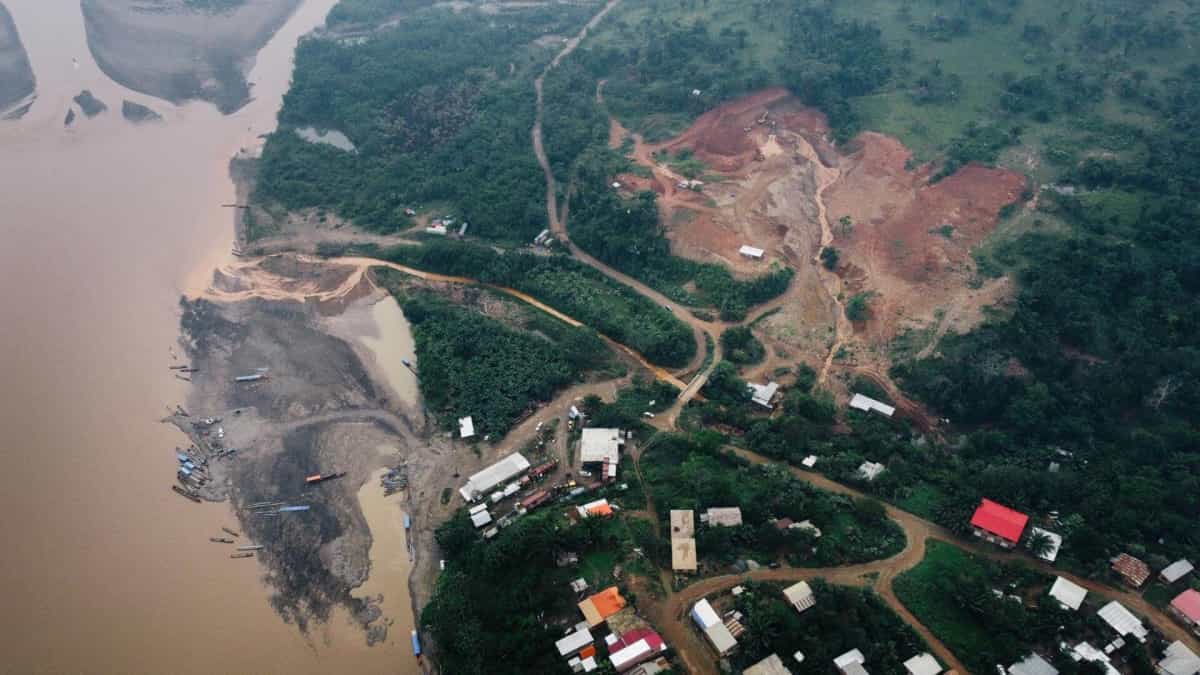
Bolivia gold mining shrinks Inti tanager habitat as researchers lose access
The newly described endemic depends on dry forest in a narrow valley where fieldwork relies on access to areas affected by extractive activity.
Newmont Ghana jobs span mine roles, but applicants face a recruitment scam warning
The official listings cover Ahafo’s operating sites, while outside offers also claim a route into Newmont hiring.