
Swiss glaciers lose 19.4% of their ice in five years as summer flows swell
A record stretch of freezing levels above 4,000 metres changed how far summer warmth reached into Alpine ice.
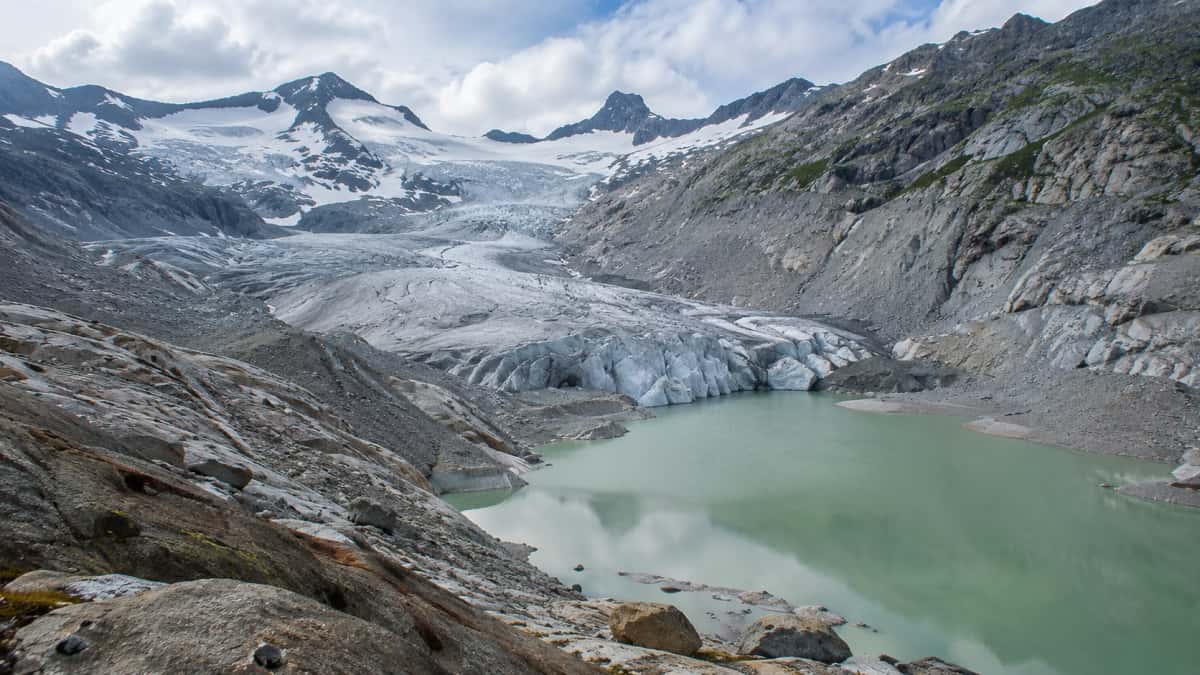
Why it matters: Accelerated ice loss is turning a long-term Alpine water reserve into short-term runoff, with implications for summer supply and hydropower planning.
19.4% — estimated loss of Switzerland’s total glacier ice volume from 2021 to 2026.
5.5% — the further loss recorded in 2026, the second-largest annual decline on record.
2.2 trillion litres — meltwater released by Swiss glaciers from July to September 2026.
Swiss glaciers lost approximately 19.4% of their total ice volume between 2021 and 2026, according to a glaciological balance published on Oct. 1, 2026. The country lost a further 5.5% in 2026, the second-largest annual decline recorded, as low winter snowfall and a hot, dry summer accelerated melting.
The pace of loss over the five-year period was more than double that recorded in any earlier five-year span in the monitoring series. The decline is also visible in the ice itself: some glaciers lost 2.5 to 4 metres of thickness during 2026, while some glacier tongues shrank by as much as 10 metres.
Thin snow cover left ice exposed
From November 2025 to April 2026, Switzerland had one of its ten lowest snow-accumulation seasons since records began. Dry conditions and successive heatwaves from May to September then removed the protective snow cover early, exposing more ice to melting.
The zero-degree isotherm remained above 4,000 metres for 76 days, more than twice the usual average and a Swiss record. By September, many glacier surfaces at 3,500 metres had lost the snow accumulated over the previous winter.
The glaciological balance found that the last five years brought an exceptional acceleration, not just a single season of heavy melt. Smaller ice bodies are particularly vulnerable: Bella Tola in Valais and Griessfirn in Glarus were considered to have disappeared as active glaciers in 2026. Larger glaciers, including Aletsch, Rhône, Clariden and Allalin, also experienced exceptional melting.
Meltwater boosts flows while depleting stored ice
Swiss glaciers released about 2.2 trillion litres of meltwater between July and September 2026, more than four times the annual drinking-water consumption of Swiss households. That surge can support river flows during a dry summer, but it represents the drawdown of ice accumulated over decades or centuries rather than a renewable seasonal increase in supply.
Glaciers store winter snowfall and release some of it gradually during warmer months. When melting persistently exceeds accumulation, that regulating capacity diminishes. Some basins may see temporarily higher runoff while ice continues to shrink; later, reduced remaining ice can mean less meltwater available in summer, particularly during drought.
That shift matters for reservoirs, hydropower, agriculture and community water supplies. Its effects will vary by catchment, so a national loss figure does not imply the same timing or scale of change in every river basin.
Retreat is reshaping Alpine terrain
As ice retreats, newly exposed ground and rock are altering glacier valleys and contributing to the formation of new lakes. Changes in ice and thawing permafrost can also affect the stability of some high-mountain slopes. These conditions warrant updated observation and risk planning, although glacier retreat does not mean every site will experience a landslide or flood.
The Swiss experience is relevant to other mountain regions, including the Andes, where glaciers help regulate water in some basins. It does not establish that Chilean glaciers are retreating at the same rate: local outcomes depend on altitude, temperature, precipitation, orientation and catchment conditions. For water users, including mines, the practical issue is to account for long-term climate scenarios in water-supply and infrastructure planning while recognising that impacts differ from basin to basin.
More in Resources
Antarctic ozone hole ranks seventh-largest in 48 years, but size is not the full measure
A persistent polar vortex drove the September expansion, but surface area alone does not show how deeply ozone was depleted.
Luca Mining rejects claims of criminal control at Campo Morado in Guerrero
Mexican reports cast doubt on who runs the mine, while Luca says coverage may have confused it with nearby operations.
Taprobane’s 17.6% THM grade is striking, but Sri Lanka’s sands have another test
Taprobane and nearby Mannar show why investors need to look beyond the total heavy-mineral percentage.