
Stanford’s 0.5 mm chips track reactions, but can they withstand mining conditions?
The sensors monitor heat inside test tubes, while mineral slurries and corrosive solutions present a different operating environment.
Why it matters: Continuous thermal data could help researchers study mineral-processing reactions in real time, but the sensors have not been tested in mining operations.
0.5 mm — chip size
0.5 seconds — interval between temperature readings
96 test tubes — the experimental setup used to calculate total data capacity
691,200 readings per hour — combined total at two readings per second in each tube
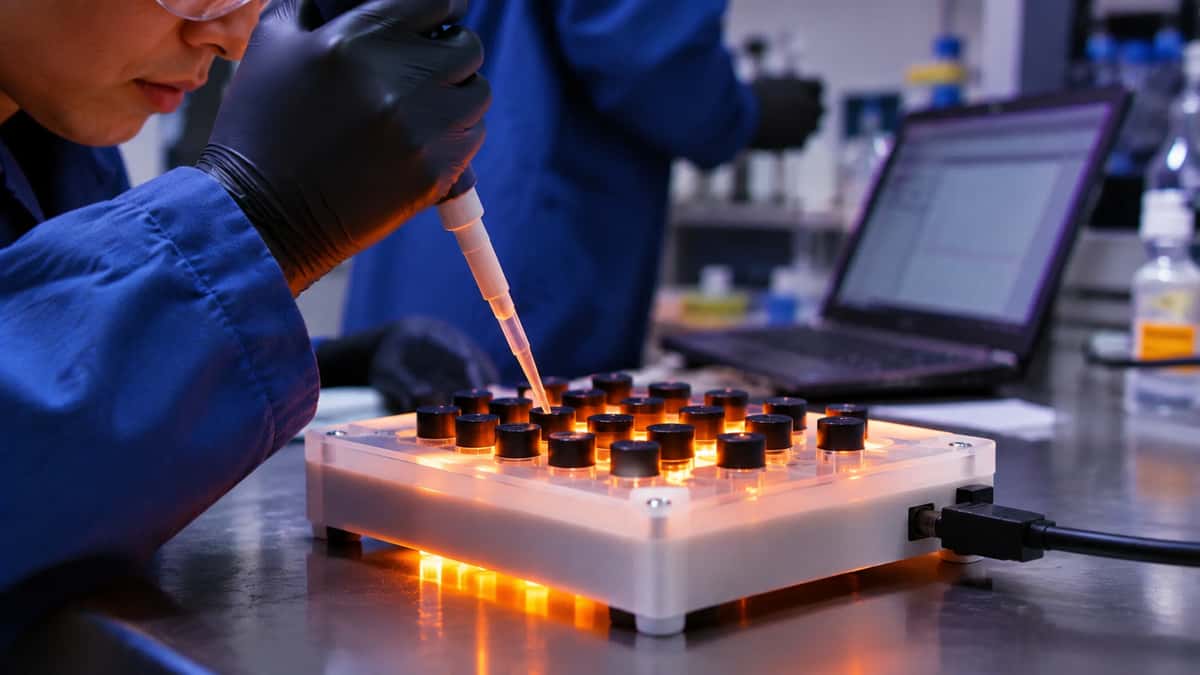
Stanford University researchers have developed 0.5-millimetre chips that monitor temperature changes inside chemical reactions and transmit data wirelessly. The technology could support research into mineral processing, but its performance has not been demonstrated in mines or industrial mineral-treatment facilities.
The system, called chemical reaction telemetry, was presented by Stanford on November 19, 2026. The research was led by chemist Song Lin with specialists from Cornell University and other US institutions, and published in Science.
Light-powered chips record reactions as they happen
The devices are designed to be placed directly inside small test tubes, where they measure thermal changes without requiring researchers to stop a reaction or remove samples for later analysis. Each chip takes a reading every half-second, providing a time series of heat changes during an experiment.
The chips use Optical Wireless Integrated Circuits (OWiC), which receive energy through light and transmit information optically. Made with silicon semiconductor materials and a protective coating, they require neither batteries nor wired electrical connections inside the vessel.
Temperature readings can provide clues about a reaction’s progress, rate or unexpected changes, but the sensors do not identify every substance in a mixture. They also do not replace chemical analyses needed to measure composition, metal concentration or recovery.
Testing catalysts and heat-generating reactions
In laboratory experiments, the researchers used the sensors to study reactions involving catalysts. These materials accelerate chemical reactions, but substances that interfere with their activity can cause catalytic poisoning. The team introduced potential inhibitors and used changes in the thermal signals to track effects on reaction behaviour.
The researchers also monitored reactions that release substantial heat. Continuous readings showed when heat generation increased and helped them examine changes to experimental conditions intended to reduce it. The results point to a possible role in detecting thermal changes early, although further validation would be needed before the approach could be used in industrial settings.
In a setup with 96 test tubes, two readings per second would yield 7,200 readings per tube in an hour, or 691,200 in total. Conventional workflows may involve analysing each sample after the experiment, a process that can take hours or days, depending on the technique. The larger dataset could also support analysis by software or artificial intelligence, but the chips themselves are measuring devices, not autonomous systems.
Mining applications remain a research possibility
The sensors could be explored in laboratory studies of hydrometallurgical copper processing, lithium treatment and other reactions used to separate or recover valuable materials. Temperature can inform researchers about reaction behaviour as they test changes in acidity, composition or operating conditions. The technology might also help compare experimental formulations without interrupting each reaction to collect a sample.
That possibility should not be confused with demonstrated mine-site use. The researchers have not reported tests in concentrators, leach facilities or Chilean mining operations. Mineral slurries, suspended particles, corrosive solutions and high temperatures would pose conditions beyond those described in the laboratory work. Researchers would also need to establish how reliably thermal measurements correspond to the chemical parameters operators need to control.
Stanford’s account identifies potential future measurements such as acidity and electrical conductivity, but these are not demonstrated capabilities of the current system. Further testing must establish sensor stability, material resistance and optical transmission in more demanding chemical environments.
More in Resources
China opens Baotou’s 195-km hydrogen pipeline as supply lags capacity
The route links renewable production with steel and chemical users, but its cost-cutting case depends on a much larger supply base.

Chile court keeps El Teniente copper-theft suspects in custody despite bail bids
The case reaches across alleged copper handling at Codelco’s mine and cable thefts from a regional power-transmission network.
Chile’s 14.7% mining decline hits GDP, but output weakness is not the whole story
Copper prices are forecast to stay high, yet geological and operational limits are keeping production from responding.