
Med Emre heads for Cartagena as Murcia seeks to block the refuge port
The overturned tanker carries about 7,000 tonnes of diesel as Murcia prepares an urgent court challenge to the planned port call.
shippingtelegraph.com
Why it matters: The decision on where to handle the overturned tanker will shape how its fuel is removed and how the risk of a spill is managed.
About 7,000 tonnes — diesel cargo aboard the Med Emre.
Around 140 nautical miles — the tow distance from the area near Ibiza to Cartagena.
35 metres — water depth at the Escombreras quay, according to the maritime authority’s assessment.
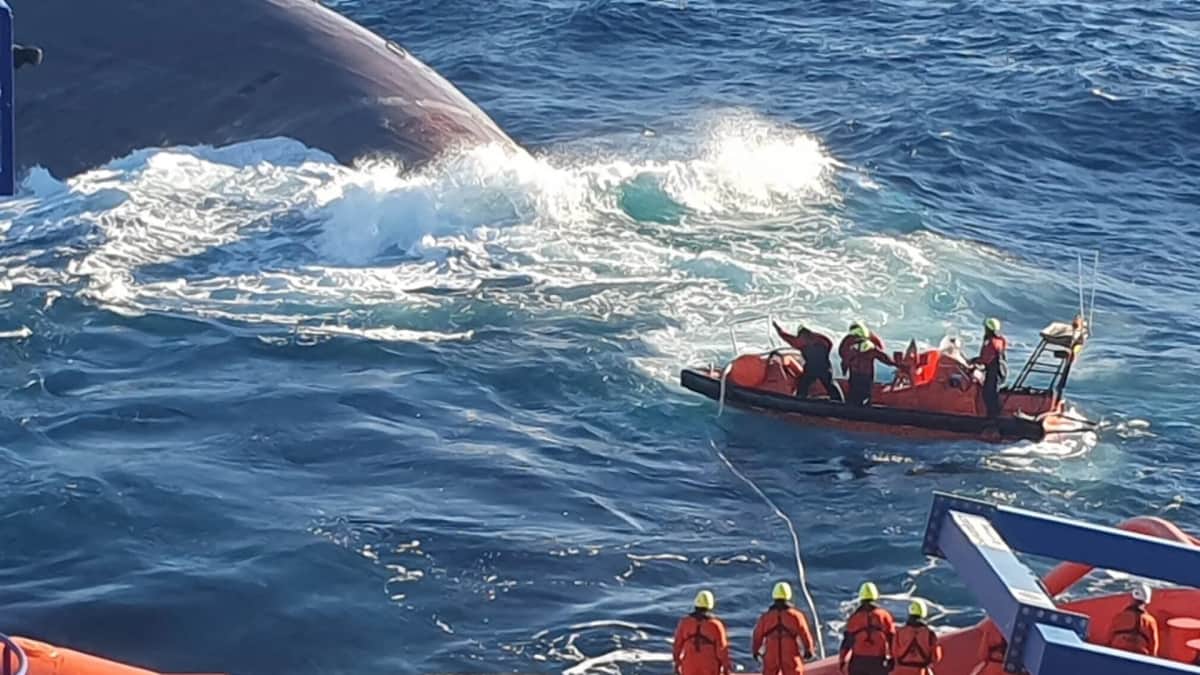
The overturned tanker Med Emre was being towed toward Cartagena on Saturday with about 7,000 tonnes of diesel aboard, after Spain’s Directorate-General of the Merchant Marine designated the port’s Escombreras dock as its refuge port. The regional government of Murcia said it would ask the High Court of Justice of Madrid for urgent measures to stop the vessel’s arrival.
The convoy is led by the Salvamento Marítimo vessel Clara Campoamor, with support from the private tug Boluda Fos. It must cover around 140 nautical miles at between 1 and 2 knots, a speed constrained by the tanker’s inverted position and the demands of the operation. Arrival was estimated for Monday, November 30, but remained dependent on how the tow progressed.
Escombreras selected for fuel removal and recovery
The maritime authority’s decision, issued on Friday, November 27, designates Escombreras as the location for removing the cargo and recovering the vessel. It said the work could not be carried out in open water or at an exposed anchorage vulnerable to adverse weather. Structural integrity and buoyancy checks allowed the tow to begin, but do not remove the risks of moving the tanker upside down or establish how it will behave during unloading.
The authority cited the dock’s depth, protected waters, room to manoeuvre and access to response resources. Its southwest breakwater reaches 35 metres of depth seven metres from the quay edge, a condition assessed as suitable for receiving the vessel in its current position. Cartagena also has maritime pollution-response capacity and industrial facilities that can receive and treat products brought ashore.
The planned sequence is to remove the commercial cargo and the ship’s own fuel before attempting to right and recover the tanker. The cargo is estimated at about 7,000 tonnes of diesel; the vessel also carried roughly 160 tonnes of operational fuel. The available information does not specify the distribution of fuel among the tanks or the extraction method. The full operation is expected to take several weeks, with no detailed stage-by-stage schedule disclosed.
Murcia’s challenge has not halted the convoy
Regional president Fernando López Miras said Murcia would seek urgent interim measures from the Madrid court to suspend the transfer. The stated aim is to prevent the tanker’s arrival, but the announcement does not mean the court has ordered the convoy to stop. The regional government argues that the operation presents a potential risk to the coast and its ecosystems and wants another option assessed.
The dispute follows objections elsewhere: the Balearic Islands had ruled out receiving the tanker, while the Valencian Community also voiced reservations about that possibility. The state authority’s order nevertheless put the tow in motion. Spain’s Royal Decree 210/2004 requires the maritime administration to weigh the anticipated harm of admitting a vessel against the consequences of other assistance measures, considering factors including seaworthiness, stability, cargo and fuel, distance, travel time and risks to people and the marine environment.
Monitoring continues during the tow
Authorities reported no additional pollution along the route as of Saturday. Separately, a patch near the accident site was described as weathered fuel, about five miles long and half a mile wide, and remained under observation. That report does not confirm a new release during the tow or rule out a later leak.
The accident killed the chief engineer and injured nine people. Seventeen crew members were aboard on November 27. The cause remains under investigation. Valencia’s maritime captain cited rough weather, with waves around four metres, and raised the possibility that open ballast-tank manholes allowed water ingress that contributed to the vessel’s capsize; this has not been established as the cause. The tow was under way as Murcia prepared its court application, with the projected arrival still subject to conditions during the operation.
More in Resources
Peru’s copper base expands as La Granja’s processing economics remain unresolved
La Granja’s scale is clear, but metallurgy, power and infrastructure must still support a viable operation.
China’s 600 MW compressed-air expander clears tests, but plant performance remains unproven
The machine is twice the scale of equipment at operating projects, but its power rating alone does not show how long it can discharge.
Nueva Centinela nears startup as Antofagasta’s copper recovery lags 2025
At the US$4.4 billion project, equipment trials are under way as the group advances separate water and infrastructure work elsewhere in Chile.