
China’s 600 MW compressed-air expander clears tests, but plant performance remains unproven
The machine is twice the scale of equipment at operating projects, but its power rating alone does not show how long it can discharge.
Why it matters: Scaling a key discharge component could reduce costs, but the system’s storage duration and efficiency depend on infrastructure and performance data that have not been disclosed.
600 MW — design class of the expander that completed tests.
300 MW — power capacity of China’s operating Yingcheng CAES plant.
Five hours — Yingcheng’s reported full-power discharge duration, equivalent to 1,500 MWh.
20%–30% — developers’ estimate for lower cost per unit of power from scaling equipment to 600 MW.
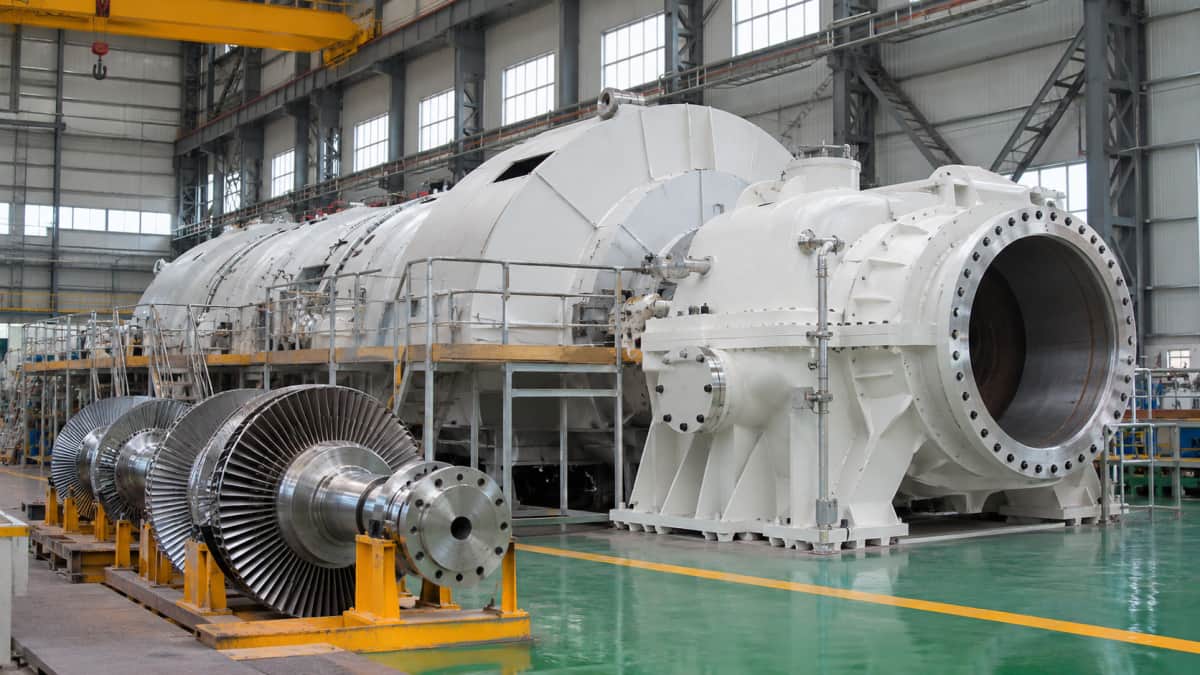
China’s Institute of Engineering Thermophysics at the Chinese Academy of Sciences and Beijing-based Zhongchu Guoneng have completed integration and mechanical tests on a 600 MW-class expander designed for compressed-air energy storage (CAES). The developers said the results met or exceeded design targets, but disclosed no measured performance parameters and did not report that the equipment had entered service at a grid-connected plant.
The milestone concerns a major component of the discharge stage, not a complete 600 MW storage facility. The rating describes power, not the quantity of energy stored or the duration for which the system could generate.
The expander is one link in a storage chain
CAES uses electricity to compress air, which is held in geological caverns or purpose-built vessels. When power is needed, the air is released through an expander that converts its energy into mechanical motion to drive a generator. Compressors, storage, heat exchangers, controls and generation equipment are also required, and energy is lost during conversion.
Heat management is a key part of system design. Capturing heat produced during compression and reusing it to warm air before expansion can improve round-trip efficiency. A February 2026 review in Nature Reviews Clean Technology gives a general efficiency range of 50% to 70% for large CAES facilities; that range is not a test result for the new expander.
The Chinese institute said development took nearly two years and involved high-power aerodynamic design, a long, multistage shaft, and dynamic regulation combining variable geometry and variable speed. The announcement did not provide operating pressures, test duration, efficiency figures, performance curves or results across different load conditions. Its statement that design targets were met or exceeded is therefore a developer-reported result, not independent commercial validation.
Yingcheng shows why megawatts do not tell the whole story
China’s Yingcheng CAES plant in Hubei province provides an operating comparison. It reached full-capacity grid connection in January 2025. A World Bank case study describes the facility as a 300 MW plant able to discharge at full power for five hours, or 1,500 MWh. It reuses caverns from a decommissioned salt mine, at depths of up to 600 metres, with a reported storage volume of about 700,000 cubic metres.
Those figures distinguish power from energy: megawatts measure output, while megawatt-hours express energy delivered over time. The new expander’s 600 MW class does not establish how much energy a system using it could store or how long it could sustain output. That depends on the complete plant, including storage volume and operating conditions.
The Chinese Academy of Sciences also cited projected reductions of 20%–30% in cost per unit of power and a 3%–5% increase in system efficiency from moving to 600 MW equipment. The announcement did not specify the comparison basis, costs included or whether the efficiency change means percentage points or a relative increase. The next test of the claims will be performance data from the expander integrated into a complete system and operated over time.
More in Resources
Peru’s copper base expands as La Granja’s processing economics remain unresolved
La Granja’s scale is clear, but metallurgy, power and infrastructure must still support a viable operation.
Nueva Centinela nears startup as Antofagasta’s copper recovery lags 2025
At the US$4.4 billion project, equipment trials are under way as the group advances separate water and infrastructure work elsewhere in Chile.
Vicuña’s US$18 billion plan tests how Chile and Argentina will run a cross-border mine
Its deposits straddle the Andes, while the operating model still has to fit two national regulatory systems.