
How Chile searches for hidden copper—and why a discovery is far from a mine
Geophysical signals can point to buried mineralisation, but they cannot establish whether a deposit can support an industrial operation.
Why it matters: Long development cycles mean future copper supply depends on exploration and project evaluation well before new metal is needed.
About 17 years — average time from discovery to production cited for a new copper mine.
More than 12 years — can pass before construction begins, according to the article’s indicative timeline.
200 metres at 0.8% copper — an illustrative intercept that would still need follow-up drilling to establish continuity.
Six million tonnes of copper — the contained-metal estimate in a hypothetical deposit of 1 billion tonnes grading 0.6% copper.
Chile’s copper search begins with geological mapping and indirect surveys, but a promising target must survive drilling, resource definition, technical studies, permitting and construction before it becomes a producing mine. Many deposits lie beneath sediments or volcanic rocks, making surface clues only one part of the exploration picture.
That long sequence helps explain why higher demand or prices cannot quickly translate into new mine supply. The cited industry average from discovery to production is about 17 years, while the timing for individual projects varies and the stages can overlap.
Geology narrows the search area
Exploration teams first identify regions with geological conditions favourable to metal deposits. They review geological maps, satellite imagery, tectonic structures and records from earlier exploration or mining.
In Chile, much of the search focuses on Andean porphyry copper systems. These deposits form when hydrothermal fluids associated with magma move and concentrate metals through large volumes of rock. At surface, clues can include hydrothermal alteration, quartz veinlets, iron oxides and copper minerals such as malachite, azurite and chrysocolla.
But sediments, volcanic rocks and other accumulated material can conceal those signs. Companies therefore use geochemical sampling and geophysical surveys to identify areas that merit closer investigation. Soil, rock and sediment samples can show anomalous copper or associated elements such as gold, molybdenum and silver. Magnetic, induced-polarisation, gravity and electromagnetic methods measure different physical properties of the subsurface.
Combined, the results help geologists build three-dimensional models and select drill targets. They indicate where to investigate; they do not prove a deposit is present or economically mineable.
Drilling tests the targets
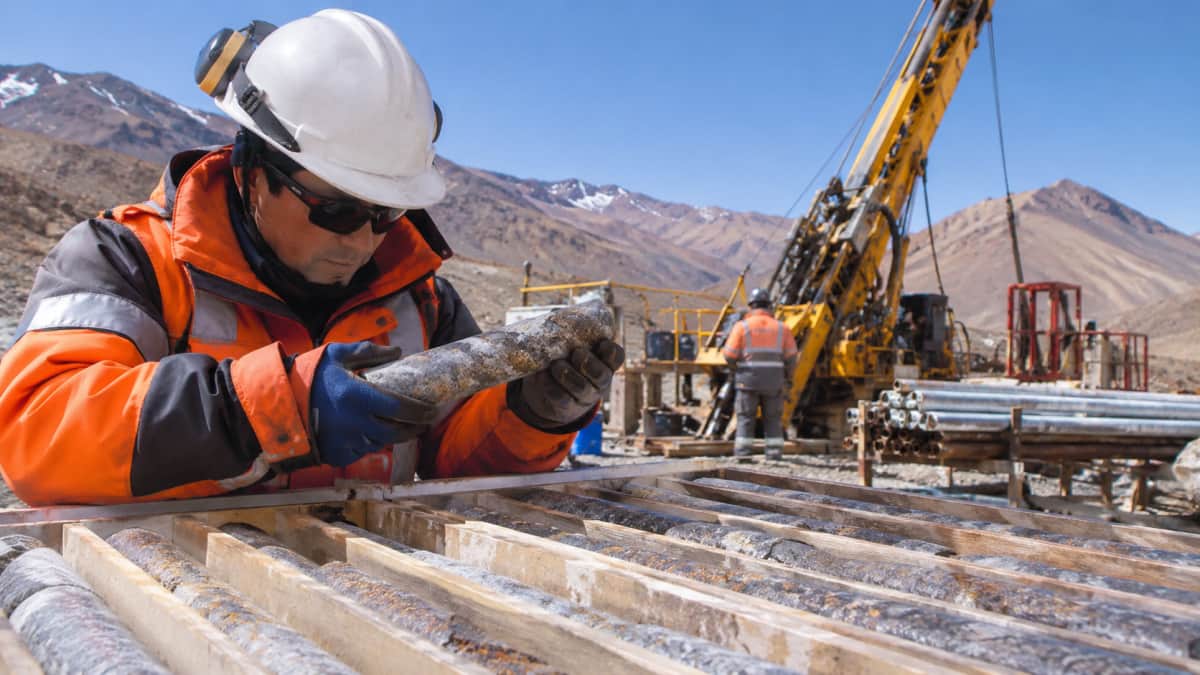
Diamond drilling recovers cylindrical rock core, while reverse-circulation drilling brings rock fragments to surface. Laboratories analyse samples for metal content and mineralogical characteristics. A hypothetical intersection of 200 metres grading 0.8% copper might be attractive as an exploration result, but one hole cannot establish a deposit’s size, geometry or continuity.
Further drilling is needed to test how mineralisation extends at depth and across the target. Large-scale projects may require tens or hundreds of thousands of metres of drilling before there is enough information to assess the deposit.
Drill data feed geological models and mineral resource estimates, which describe the volume and grade of mineralised material. A hypothetical 1 billion tonnes grading 0.6% copper contains about 6 million tonnes of copper. That is not the amount a mine would necessarily produce: metallurgical recovery, mining losses, dilution and economic constraints affect what can be extracted.
Resources and reserves are also distinct. Reserves are the economically mineable portion of measured and indicated resources after relevant technical, environmental, legal and economic factors have been considered.
Studies, permits and construction extend the timeline
Prefeasibility and feasibility studies assess mining methods, processing capacity, recovery, operating costs and capital requirements. Project teams also evaluate water and energy supply, transport, geotechnical conditions, tailings management and environmental impacts. In Chile, projects must obtain applicable environmental and sectoral approvals and meet closure requirements.
The indicative durations—from one to three years for initial exploration through three to five years for engineering and construction—are not a fixed schedule; stages can overlap, and projects differ. More than 12 years may pass before construction as exploration, engineering and approval processes proceed. Even a deposit with high copper grades may not advance if costs, metallurgy or infrastructure requirements prevent an adequate return.
Artificial intelligence and machine-learning tools can combine historical geology, geochemical results, geophysical measurements and satellite imagery to help rank targets and direct drilling budgets. They cannot replace drill confirmation, laboratory analysis or metallurgical testing. A deposit discovered in 2026 could begin production around 2043 if it followed the cited average development period, but the actual path depends on its technical, economic and regulatory assessments.
More in Resources
Andes copper deposits put Argentina’s pipeline against Chile’s mining lead
The two countries share a mineral-rich mountain belt, but turning Argentina’s undeveloped deposits into supply will depend on more than geology.
Andes copper race pits Chile’s mature industry against Argentina’s unbuilt projects
Chile already produces copper at scale, while projects across the border still depend on capital, infrastructure and approvals.
AI data centres could need 2.5 million tonnes of copper by 2040 as supply strains
The load extends beyond servers to power grids, while Chile’s investment pipeline still depends on projects clearing execution hurdles.