
Codelco faces dust charges at Ministro Hales as Talabre case hinges on compliance
The SMA’s parallel proceedings target a crusher and waste dump at one operation, and groundwater and tailings controls at another.
Why it matters: The cases put Codelco’s dust controls and tailings-water safeguards under separate regulatory tests, with the emissions proceedings still carrying potential sanctions.
Two serious charges — concern emissions controls at Ministro Hales.
Up to 5,000 UTA per charge — the maximum fine cited by the SMA.
22 new wells — planned to reinforce Talabre’s hydraulic barrier.
24 months — the execution period for the Talabre compliance programme.
Chile’s Superintendency of the Environment (SMA) has filed two serious charges against Codelco over particulate-emissions controls at its Ministro Hales operation in Calama, while separately approving the company’s revised compliance programme for the Talabre tailings facility. The Talabre proceeding is suspended while Codelco carries out the plan; that decision does not affect the emissions charges.
The SMA said the Ministro Hales case followed field inspections and seven public complaints received between 2021 and 2024. It initiated the sanctioning procedure on November 18, 2026. The charges are allegations under review, not sanctions already imposed.
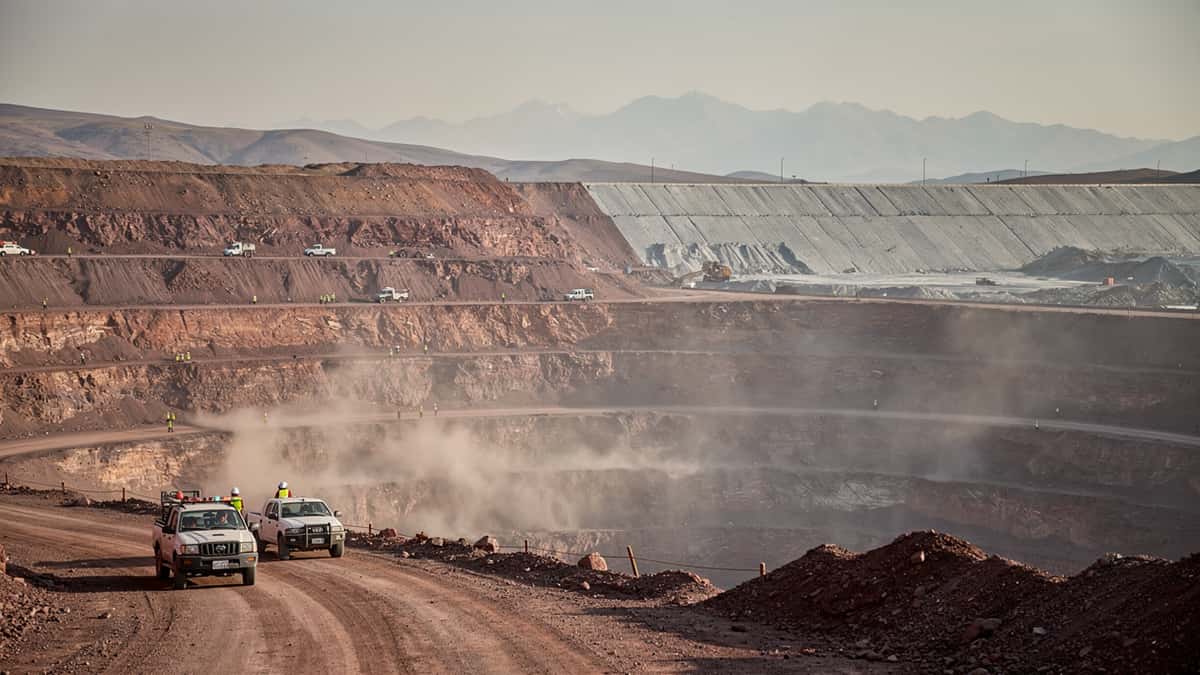
Crusher and waste dump cited in emissions case
One charge concerns the primary crusher, which the SMA alleges operated without the baghouse filter required by its environmental approval resolutions. From November 2023 to February 2024, its dust-abatement efficiency was below the committed level of 75%, according to the regulator.
The other charge concerns the waste-rock dump. The SMA alleges Codelco did not apply bischofite to inactive areas in 2023 and 2024, although the measure was intended to reduce wind erosion by 85%. The regulator also said it found no records showing the measure had been carried out between 2023 and 2025.
For each serious charge, Codelco faces possible revocation of its environmental approval, closure, or a fine of up to 5,000 Annual Tax Units (UTA). The SMA noted that Calama is designated a saturated zone for PM10 particulate matter. Superintendent Emanuel Ibarra said compliance with emissions-control measures is important to protecting public health.
Talabre plan covers groundwater and tailings solids
The separate Talabre case stems from charges issued in August 2024 over alleged failures to implement a contingency plan following changes in groundwater, and the deposit of tailings with less than the required 60% solids.
The approved programme contains eight actions, has a declared cost of $66,915,098,000 and is scheduled to run for 24 months. It includes installing 22 extraction wells to reinforce the tailings facility’s hydraulic barrier, which is monitored through 17 wells. The plan also includes implementing the PRECLA tailings pre-classification project to reach the required solids content, as well as conducting water-capture tests in the tailings basin.
With the programme approved, the Talabre sanctioning proceeding is suspended while the commitments are carried out. If Codelco fails to comply, the SMA may restart that process and impose up to twice the original fine. The suspension applies only to the tailings case; the Ministro Hales emissions proceedings continue separately.
More in Resources
US resumes Russian palladium imports as Sibanye-Stillwater challenges tariff ruling
A steep Commerce Department rate has not become an import order, leaving the legal dispute over Russian metal unresolved.
EU cold-rolled steel duties reach Vietnam, with Chinese inputs under scrutiny
The investigation tested whether Chinese hot-rolled steel inputs altered Vietnam’s market conditions alongside a review of five exporting economies.
Los Bronces water plan wins approval, but Vega Sur recovery hinges on flow separation
The design must keep contact water out of El Choclo while routing snowmelt toward a recovering high-altitude wetland.