
Chile clears Estepa II battery for grid services as monitoring duties remain
The system's fast-response tests are approved, but one-second performance records are still required for service verification.
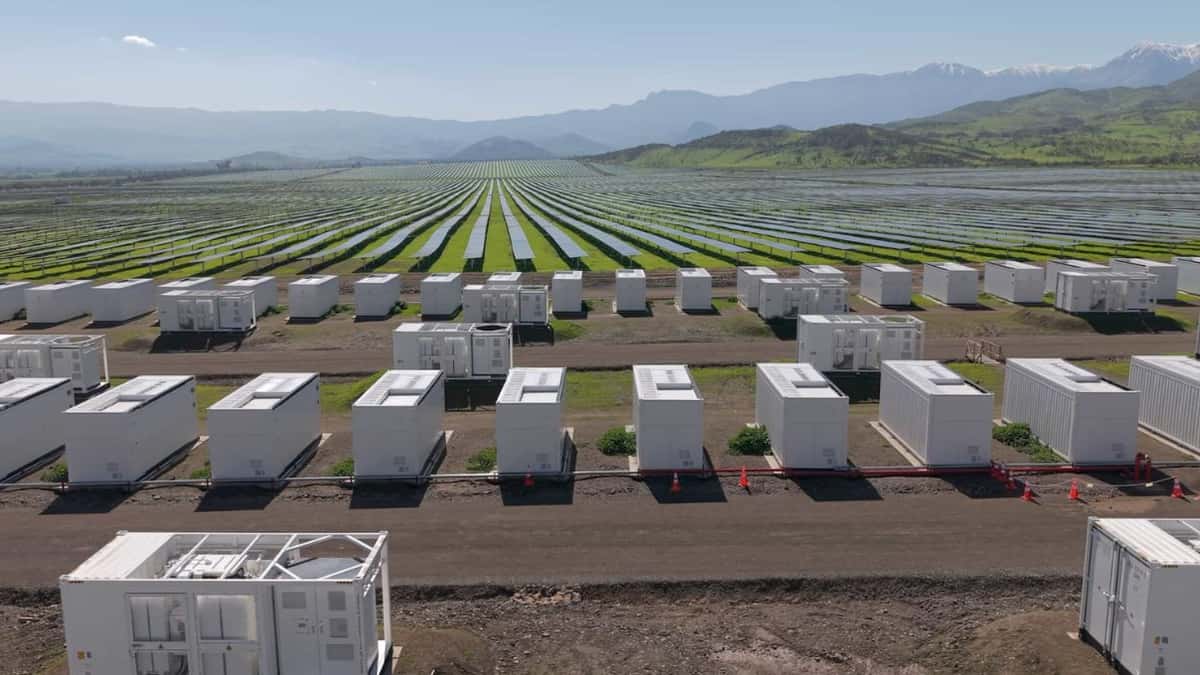
Why it matters: BESS Estepa II adds a fast-responding resource to Chile’s grid, where balancing variable renewable generation is an operational challenge.
230 MW — net power capacity of the installation
920 MWh — storage capacity, equivalent to four hours at nominal power
Less than one second — verified response time for primary frequency control
US$158 million — investment reported for the project by Chile’s Ministry of Energy
BESS Estepa II, an energy storage system linked to Atlas Renewable Energy in María Elena, Antofagasta Region, was authorized to provide frequency-control services to Chile’s National Electric System from 00:00 on November 19, 2026. The National Electric Coordinator approved the system for Primary Frequency Control (CPF) and Tertiary Frequency Control (CTF) after reviewing technical verification reports submitted by Estepa Solar SpA.
The authorization covers specific grid services; it is not a separate declaration that the entire energy complex has entered definitive commercial operation. The Coordinator issued its approval in letter DE 07588-26 on November 17.
Tests verified sub-second primary response
Verification tests found that the battery can activate primary frequency control in less than one second when frequency rises or falls.
In test scenarios involving a 0.2 Hz frequency change, the system provided close to 16 MW. At a 0.7 Hz deviation, measured contributions reached about 62 MW, depending on operating mode and the direction of the change. Those results describe specific test conditions; they do not mean the full 230 MW would be deployed for every frequency disturbance.
Tertiary service provides a larger adjustable range
The approval also covers tertiary frequency control, which allows power delivery or absorption to be adjusted in response to operating instructions. Verified tertiary regulation capacity is approximately 227.9 MW in discharge mode and 226.8 MW while charging. The system’s response time is under five minutes, with power variation rates near 40 MW per minute.
The technical report also recognizes 230 MW of cold tertiary reserve in discharge mode, achievable in less than 10 minutes from start-up. Actual use will depend on the Coordinator’s instructions and the batteries’ operating conditions and available energy.
The installation has 230 MW of net power and 920 MWh of storage, equivalent to about four hours of discharge at nominal power. It operates as a stand-alone storage facility and connects to the National Electric System through infrastructure associated with the 220 kV Estepa substation. The Ministry of Energy listed the lithium-ion battery project in its May 2026 project report with an investment of US$158 million; that figure is reported project investment, not confirmation of total expenditure incurred.
Monitoring and market-entry steps remain
Estepa Solar must install or enable power and frequency measurement with one-second resolution and submit the records required to assess primary-control performance. The letter sets a deadline of 30 calendar days from its November 17 issuance. Until the required signals are available, the Coordinator may instruct the service, but its performance will be classified as “Not Verifiable”; alternative assessment methods require prior approval.
The authorization does not automatically admit the project to ancillary-service tenders. Estepa Solar must complete the relevant platform registration and submit the documents required under the tender rules. Separately, the Coordinator can directly instruct the provision of the approved services. The next operational step is therefore completion of the monitoring requirements and the applicable participation process.
More in Resources
IEA copper outlook improves, but Chile faces a race to sustain mine output
New projects in the Democratic Republic of the Congo and Zambia have altered the supply outlook, while Chile's mature operations face a separate production test.
Aysén lawmakers press Chile energy ministry on isolated-grid law’s status
The proposed framework targets tariffs and supply continuity in communities beyond the national grid, where fuel logistics shape operating costs.
Chile reopens PAMMA aid for storm-hit miners, but damaged access still holds operations back
The second round targets producers in Huasco, Tierra Amarilla and Coquimbo after July storms disrupted routes into mine sites.