
Cabral Gold expands Cuiú Cuiú resource as inferred ounces dominate
Cuiú Cuiú’s first phase targets oxide ore, while much of the expanded inventory lies in primary rock requiring a different development route.
Why it matters: The resource growth broadens Cuiú Cuiú’s potential beyond its oxide-focused first phase, but most of the added geological inventory still needs further definition and economic evaluation.
3.51 million oz — total gold in measured, indicated and inferred resources across six deposits
998,800 oz — measured and indicated resources, up 49% from the prior estimate
2,512,900 oz — inferred resources, up 376% and about 72% of the total
149,835 m — drilling included in the updated estimate
Cabral Gold has increased the estimated gold resource at its Cuiú Cuiú project in Pará, Brazil, to 3.51 million ounces across six deposits. The updated estimate contains 998,800 ounces in measured and indicated categories and 2,512,900 ounces inferred. The company said measured and indicated resources rose 49% and inferred resources increased 376% from the previous estimate.
The estimate totals 42.5 million tonnes grading 0.73 grams of gold per tonne in the measured and indicated categories, and 82.1 million tonnes grading 0.95 g/t inferred. The inferred category has lower geological confidence and should not be treated as a reserve or as assured future production.
Primary rock holds most of the resource
Primary-rock deposits account for about 3.04 million ounces in indicated and inferred resources. That includes 733,200 indicated ounces in 20.8 million tonnes grading 1.09 g/t, and 2.302 million inferred ounces in 65.4 million tonnes at the same average grade. Compared with the previous estimate, indicated primary-rock resources increased 63% and inferred resources rose 406%.
The estimate also identifies higher-grade portions at a 1.00 g/t cut-off: 463,200 indicated ounces grading 2.32 g/t and 1,452,200 inferred ounces grading 2.37 g/t. Their potential contribution to a mine plan would depend on factors including depth, deposit geometry, recoveries and the investment required to process the material.
Oxide resources total 476,500 ounces: 265,600 measured and indicated ounces, up 21%, and 210,900 inferred ounces, up 190%. Oxide mineralisation is relevant to the initial heap-leach operation, but the resource figures do not establish how much material can be mined economically.
Initial operation targets oxide ore
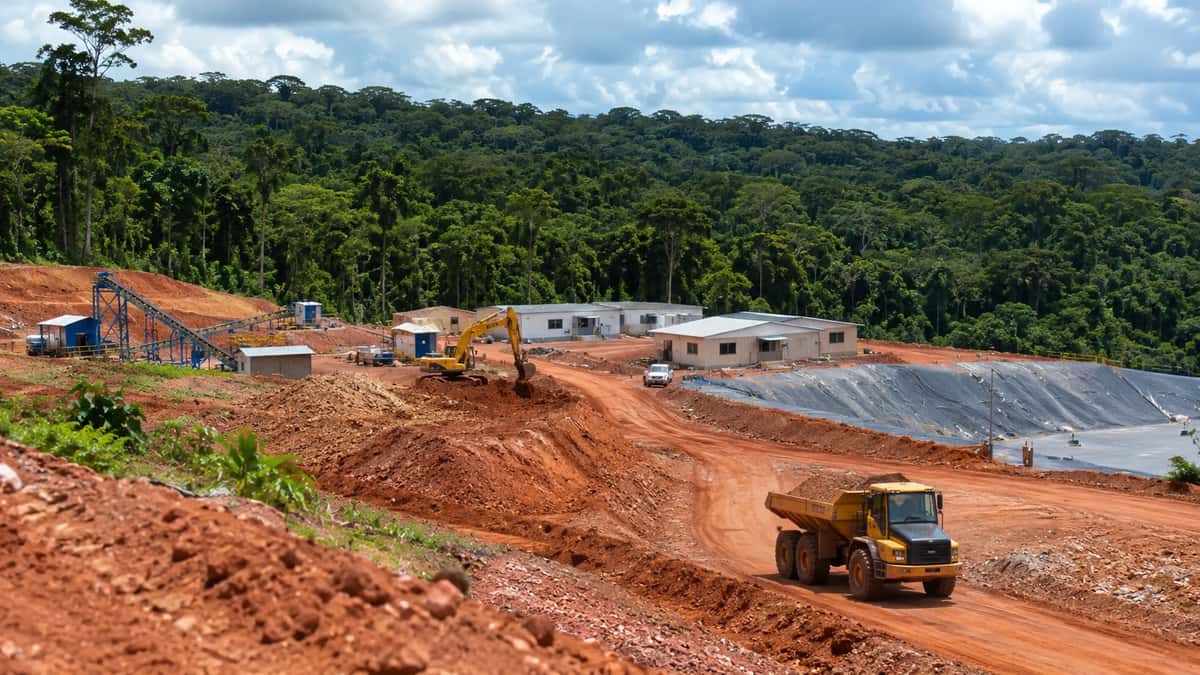
Cabral Gold’s first development phase is an open-pit operation designed to process about 3,000 tonnes of oxide ore per day, or roughly 1 million tonnes a year, through heap leaching. The company poured its first gold on September 10, 2026, and has said it aims to complete the transition to commercial production in the fourth quarter of 2026.
The resource estimate uses assumed recoveries of 85% for oxide material and 96% for primary rock, along with a long-term gold-price assumption of US$3,500 per ounce and open-pit mining parameters. These are estimation inputs, not guaranteed operating results. Developing primary rock would require separate technical and economic work, including assessment of mining methods and processing requirements.
Drilling and next steps
The estimate, effective November 11, 2026, was prepared under NI 43-101 and draws on 2,020 drill holes totalling 149,835 metres. Since the 2022 primary-rock estimate, Cabral completed another 604 holes for 46,118 metres. The six deposits included are Central, Moreira Gomes, Pau da Merenda, Machichie, Jerimum Baixo and Jerimum Cima.
All six deposits remain open at depth; Central, Pau da Merenda, Machichie and Jerimum Cima also have potential for lateral extensions. The company has identified more than 50 peripheral targets that are not yet sufficiently explored to be included in the current estimate.
Cabral plans to increase definition drilling in 2027 to improve the classification of some inferred resources and test extensions to known deposits. Further technical and economic studies will be needed before resource ounces can be converted into reserves or used to support an expanded mine plan.
More in Resources
Spartan Metals’ Victorio PEA sets US$683m initial cost, but estimates remain preliminary
A block-caving design underpins the New Mexico plan, while resource classification and metallurgy still need further testing.

Chile's peso comes under pressure as dollar reaches highest level since 2025
Miners may gain on peso-denominated costs, but the currency move coincides with weaker copper revenue.
Agnico Eagle targets 1 million ounces at Canadian Malartic; second shaft still under study
Odyssey’s first shaft is 73% complete, while the deeper expansion still needs a separate technical and permitting path.