
Volvo tests humanoid robots in Ghent as 2027 factory use hinges on validation
Workers are teaching AEON units to place components, but the first task is only a narrow test of factory readiness.
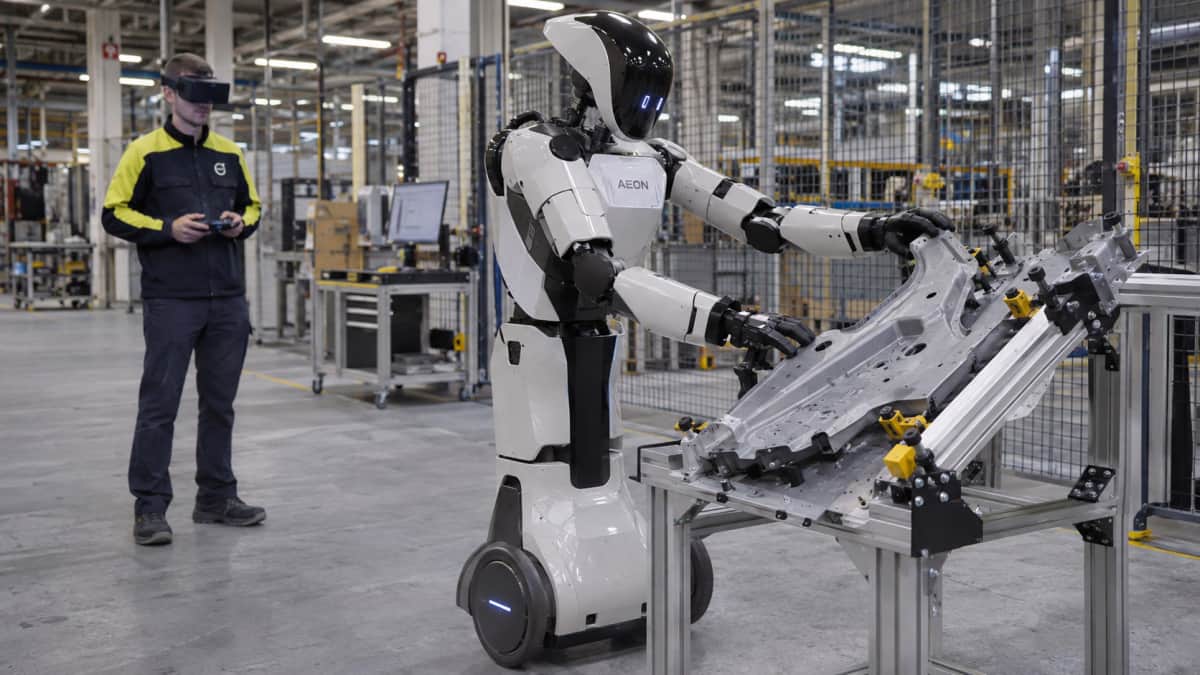
Why it matters: Volvo’s trial will test whether adaptable robots can work alongside people in existing industrial facilities, a capability that could also matter in mining workshops and plants.
1.65 metres — AEON’s height.
10 kilograms — stated payload capacity.
Up to four hours — operating time per charge, depending on conditions.
Mid-2027 — Volvo’s target for beginning use in manufacturing processes, subject to validation.
Volvo Cars has begun training Hexagon Robotics’ AEON humanoid robots at its Ghent vehicle plant in Belgium, with the company targeting their gradual introduction into manufacturing from mid-2027. The plan depends on whether the machines can meet production requirements for safety, reliability and quality.
The first task is placing components precisely in two holding fixtures. Volvo workers are teaching the robots through imitation learning, which uses recorded human movements to develop robotic skills. Engineers plan to increase task complexity after the initial operation is validated, including handling multiple parts and moving between workstations.
A human-shaped platform for existing facilities
AEON is designed to move through industrial sites built for people, potentially reducing the need to redesign infrastructure. Unlike conventional fixed robotic arms, the platform is intended to learn different tasks and move between stations. It has articulated arms, cameras, sensors and artificial-intelligence systems to interpret its surroundings and carry out precise movements.
The robots weigh 60 kilograms and travel on wheels rather than feet. Volvo’s published specifications give them a maximum speed of 2.4 metres per second and an automated battery-swapping system. The company has not disclosed how many units will take part in the project, its investment or expected operating savings.
The Ghent evaluation is due to expand in the first half of 2027, when additional AEON units are expected to join the pilot. Volvo has not described the initiative as a general replacement for workers or a plan to make the plant fully autonomous. The immediate test is whether humanoids can perform useful work without compromising manufacturing standards or worker safety.
The mining application remains a separate test
The trial could provide evidence relevant to mining and other industrial sectors, where some repetitive or physically demanding tasks still require people. Potential uses discussed for humanoid robots include handling tools and components, supporting maintenance, sorting parts and working in logistics areas. These are possible applications, not deployments announced by Volvo.
Conditions at mine sites would add technical hurdles beyond those at a vehicle factory. Dust, vibration, moisture, extreme temperatures, uneven ground and high-altitude operations can affect equipment performance. AEON’s wheeled design may also restrict its use in some open-pit and underground settings, making controlled areas such as workshops, warehouses and suitably prepared processing facilities more plausible early environments.
A wider rollout would also depend on operating speed, maintenance costs, uptime, precision and the ability to respond to unexpected conditions. The trial’s next stage is to bring additional units into Ghent and assess more complex operations; Volvo has not yet provided results from that validation or confirmed the scale of any deployment.
More in Frontier Mining

Lunar south-pole mining race puts scarce sites at the centre of a rules dispute
At the lunar south pole, water ice and sustained sunlight occur in scarce locations that future bases may need to share.

Narwhal tusk study probes how a spiral tooth grows straight
The Arctic canine’s layered mineral-and-fibre structure may offer a design clue for composites, but translating it into engineering remains untested.
MIT's SLIC AI targets analog chip design without data-centre-scale computing
Analog designers must balance signal gain against power draw; SLIC aims to automate trade-offs that typically require repeated simulations.