
Gulf of Mexico deep-sea species carry hidden genetic risks despite stable numbers
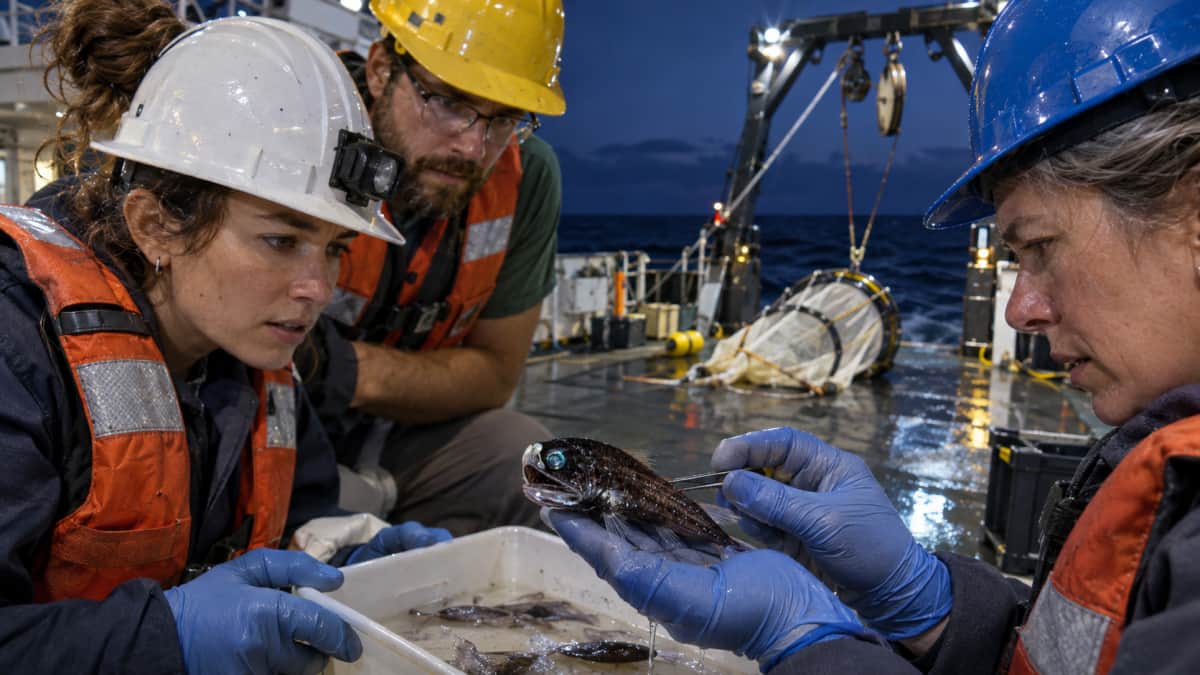
Scientists sampled mesopelagic fish and shrimp in a region facing climate pressure and renewed interest in seabed extraction.
Why it matters: Genetic monitoring may reveal vulnerability in deep-water populations before conventional surveys detect falling abundance.
486 specimens — sampled in the Gulf of Mexico from 2011 to 2023.
About 8% — decline in genetic diversity reported for Diaphus dumerilii over 12 years.
Up to 70% — potential loss of suitable habitat for four of the five species in the most adverse projections.
Researchers at Florida International University identified genetic indicators of vulnerability in five deep-sea species from the Gulf of Mexico, even where population numbers may appear stable. The study, published in Nature Communications on November 12, 2026, combined genetic analysis with climate and ecological projections; it did not formally classify the species as threatened or establish that they are close to extinction.
Genetic change can precede visible population declines
The team analysed three lanternfish species and two deep-water shrimp species from the mesopelagic zone, roughly 200 to 1,000 metres below the surface. One finding was an approximately 8% reduction in genetic diversity in the lanternfish Diaphus dumerilii over 12 years.
Genetic diversity can affect a population’s capacity to adapt to environmental change, withstand disease and recover from disturbances. Its decline may be difficult to detect through surveys focused mainly on animal counts and geographic distribution: a species can remain present in an ecosystem while losing some of the variation that could support future generations.
The researchers, led by Pedro A. Peres, also assessed effective population size—the number of individuals contributing genes to subsequent generations. All five species showed indicators of limitations in this measure. Effective population size can be much lower than the number of animals present, including when reproductive success varies among individuals.
Climate projections point to habitat pressure
Climate and ecological models examined conditions projected for 2050 and 2100. They indicated possible reductions in suitable habitat for four of the five species, reaching as much as 70% in the most adverse scenarios. The study links potential habitat changes to factors including ocean warming, dissolved oxygen and water circulation, which can affect the conditions and food supply available to deep-water organisms.
These projections do not mean that the species will lose that share of their populations. They indicate a potential contraction in environmental conditions considered suitable for them. Combined with limited genetic variation, such changes could constrain adaptation, although the study’s findings apply to five species in one region and cannot establish a broad genetic crisis across the world’s oceans.
Relevance to disturbance and seabed extraction
The researchers considered the Gulf’s history of industrial disturbance, including the 2010 Deepwater Horizon oil spill, which released millions of barrels of hydrocarbons from an installation about 1,500 metres deep. Earlier research documented declines among deep-water fish, crustaceans and other organisms after the accident. The new analysis did not establish a direct causal link between the spill and all the genetic changes it identified, or determine that the species’ vulnerabilities predated the disaster.
The findings also bear on environmental assessment as governments and companies examine potential seabed mineral extraction. Operations targeting polymetallic nodules, massive sulphides or metal-rich crusts could affect organisms beyond the seabed, depending on how sediment, noise and other disturbances travel through the water column. This study did not assess mining operations, but it shows why genetic sampling and long-term monitoring may add information that standard species inventories miss. Its conclusions remain limited to the five species and the Gulf of Mexico; wider sampling would be needed to determine how common these indicators are elsewhere.
More in Frontier Mining
Lunar south-pole mining race puts scarce sites at the centre of a rules dispute
At the lunar south pole, water ice and sustained sunlight occur in scarce locations that future bases may need to share.
Narwhal tusk study probes how a spiral tooth grows straight
The Arctic canine’s layered mineral-and-fibre structure may offer a design clue for composites, but translating it into engineering remains untested.

MIT's SLIC AI targets analog chip design without data-centre-scale computing
Analog designers must balance signal gain against power draw; SLIC aims to automate trade-offs that typically require repeated simulations.