
Taruga extends East Normanby gold search, but a 13,500 ppb anomaly lacks a source
Historical soil data trace a gold corridor beyond Weioko, while narrow quartz veins complicate how the targets should be interpreted.
Why it matters: The targets extend beyond Weioko, but soil results alone have yet to establish whether the strongest anomalies reflect mineralised bedrock.
4,194 samples — historical soil results reviewed across East Normanby
13,500 ppb gold — the highest historical soil result, south of Weioko
27 rock samples — collected by Taruga between the Weioko ridge and Wenasia
326.4 metres — total length of the first three Weioko diamond holes, with assays pending
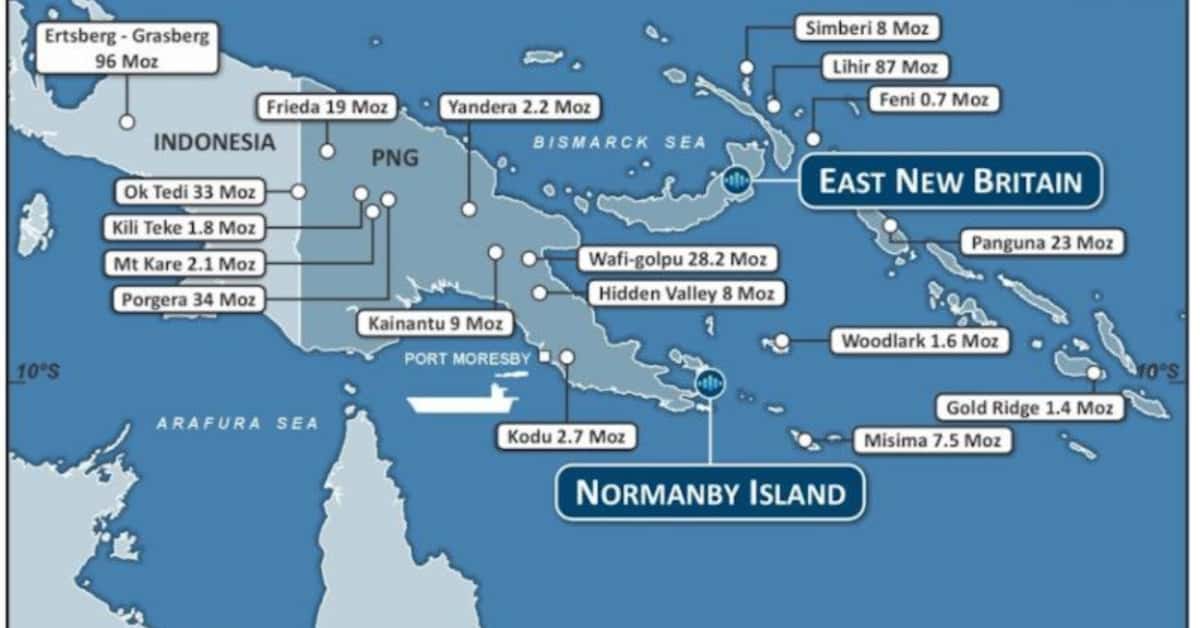
Taruga Minerals has identified additional gold targets at its East Normanby project on Normanby Island, Papua New Guinea, after reviewing 4,194 historical soil samples and collecting recent rock samples. Soil anomalies extend for about 6 kilometres of an approximately 8-kilometre corridor from Wenasia in the south to Sipupu in the northeast. Several targets lie beyond the Weioko deposit, where previous drilling left parts of the corridor untested.
The company has an option to acquire 100% of East Normanby and plans to trench priority targets to expose bedrock. The work is intended to test whether the soil anomalies have a mineralised source and to help define structures for possible drilling.
The strongest soil result has no identified bedrock source
The highest historical soil result in the district was 13,500 ppb gold, equivalent to 13.5 g/t, on a ridge about 800 metres south of current Weioko drilling. The point lies within a 1.4-kilometre untested stretch towards Wenasia. A rock sample collected about 12 metres from the high-grade soil point returned 0.011 g/t gold; the bedrock source of the soil result has not been identified.
Most of the historical soil sampling was completed in 1986 and 1987. From August to October, Taruga collected 27 selective rock samples along about 2.6 kilometres between the southern Weioko ridge and Wenasia. Two exposed quartz veins, about 75 metres apart and 300 metres south-southwest of the HG1 vein, returned 2.50 g/t gold and 35.6 g/t silver, and 2.26 g/t gold and 3.8 g/t silver.
The veins align north-northeast with HG1, where earlier outcrop sampling returned up to 33.1 g/t gold and 223 g/t silver. Taruga said mapping and trenching will help establish the structures’ orientation and extent. The selective rock results indicate mineralisation at individual outcrops, but do not establish continuity between them.
Sipupu soil anomaly remains untested
At Sipupu, about 1 kilometre south of historical drilling, an untested anomaly measures approximately 700 by 150 metres and includes soil results of 2,710 ppb and 1,140 ppb gold. Previous mapping in the area traced gold-bearing rock fragments upstream to exposed veins. Planned trenching is intended to test the bedrock beneath the anomaly and define structures that could guide later drilling.
Taruga compared soil data with assays from 104 rock samples, excluding samples collected at Weioko in January. The company reported that all six rock samples grading above 5 g/t gold came from locations with less than 50 ppb gold in soil. It interprets the contrast as evidence that narrow, mineralised veins may be poorly represented by soil sampling, and says its targeting will consider both broad anomalies and vein structures at their margins.
The next work will combine trenching with reprocessed geophysics and assays from Taruga’s first three diamond holes at Weioko. Those holes total 326.4 metres. The company said on 16 November 2026 that they intersected hydrothermal breccia in a unit hosting historical gold intercepts; samples were sent to ALS Brisbane, with initial assays expected during the December 2026 quarter.
More in Discoveries
Cadillac finds gold beyond Kerr-Addison pit, but 2026 resource omits it
The 2026 estimate is the reference point, but the company is still testing continuity before any resource revision.
Yukon Metals maps new copper-gold zones at AZ, but continuity remains unproven
At Viper, surface anomalies extend beyond the 2026 drill area, leaving their connection to mineralisation at depth to be tested.
Phoenix Metals' Lexington drilling tests an open-pit case beyond historic workings
Lexington's underground legacy is being tested against a potential bulk-tonnage model, but the new intercepts are still downhole lengths.