
Solis Minerals' first Cucho hole logs copper-molybdenum sulphides, with assays pending
The 496.7-metre hole points to possible extensions east and at depth, but visual logging cannot establish grade or economic continuity.
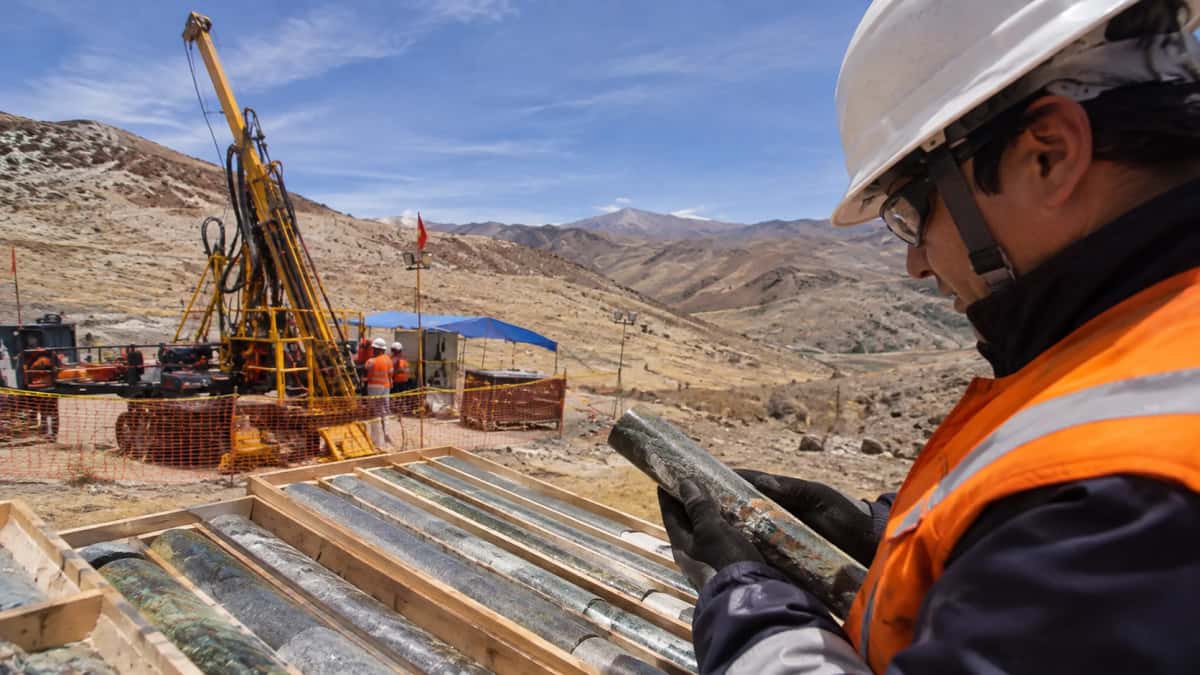
Why it matters: Assays from Cucho’s first hole will show whether the observed sulphides carry grades that warrant testing the project’s unprobed extensions.
496.7 metres — depth reached by first hole SLM26-01
About 5,000 metres — planned across eight diamond holes in the current campaign
105–338 metres — interval with more consistent chalcopyrite observations in SLM26-01
Solis Minerals logged copper and molybdenum sulphides in its first diamond hole at the Cucho project in Peru, but laboratory assays are still pending. Hole SLM26-01 reached 496.7 metres, with geological observations identifying chalcopyrite and molybdenite in veins and disseminations within altered granodiorite.
The company said the distribution of sulphides may indicate that the system identified in historical exploration extends eastward and to greater depth. The observations do not establish copper or molybdenum grades, however, and should not be treated as a continuous economic intersection.
Sulphides recorded through much of the hole
Geological logging identified sulphides from about 48 metres to near the end of the hole. Chalcopyrite was more consistently observed between 105 and 338 metres. Quartz veins containing chalcopyrite, pyrite and molybdenite were also recorded.
These minerals help inform the geological interpretation and the placement of follow-up drilling. But visual estimates of sulphide abundance cannot substitute for chemical assays: the laboratory results are needed to determine metal concentrations. The reported observations also do not define true widths or demonstrate that the full logged extent is mineralised continuously.
Historical drilling provides a comparison
Earlier drilling at Cucho returned copper, molybdenum and silver over broad intervals. Hole COP14-06 reported 175.4 metres at 0.28% copper, 0.012% molybdenum and 1.3 g/t silver; COP14-05 returned 96.7 metres at 0.28% copper, 0.018% molybdenum and 1.4 g/t silver. Higher-grade sections included 91.2 metres at 0.33% copper from surface in COP14-06 and 52.7 metres at 0.35% copper in COP14-05.
Solis’ current campaign is designed to address areas not tested by earlier drilling, including geochemical and geophysical anomalies. The company has outlined an exploration area about three kilometres long and 1.8 kilometres wide; those dimensions describe a target area, not a defined mineral resource. Surface samples have returned values of up to 0.49% copper and 0.63% molybdenum.
Eight-hole programme targets three areas
The approximately 5,000-metre diamond-drilling programme comprises eight holes across three priority areas. Target selection draws on geological mapping, geochemical sampling, geophysical surveys and historical drilling. The work is intended to test whether known mineralisation, surface anomalies and the new downhole observations belong to a larger connected system.
Cucho is in Peru’s Áncash department, about 183 kilometres north-northwest of Lima and at roughly 1,500 metres elevation. The project is about 40 kilometres from Element 29 Resources’ Elida project and 120 kilometres from the Antamina mine.
Molybdenite in the core adds a potential by-product to assess, but its abundance, mineralogical characteristics and recoverability have not yet been established. The next key step is laboratory analysis of SLM26-01, which will determine whether the logged sulphides are accompanied by copper and molybdenum grades that support further targeting.
More in Discoveries
ASX juniors target Nordic metals, but projects face sharply different hurdles
Finland's defined resources sit alongside targets whose next phase still depends on permits, partners or untested ground.
San Lorenzo Gold funds Salvadora expansion as Cerro Blanco assays remain pending
Two rigs are testing Cerro Blanco, where visible breccias still need chemical assays to establish their metal content.
Marimaca hits 102 metres at Pampa Medina as copper-silver continuity remains unproven
Near-surface oxides and deeper sulphides occur in the same exploration area, but their geometry and processing routes still need to be established.