
Saturn Metals finds high-grade gold east of Apollo Hill, but continuity remains untested
Some eastern structures lie beyond the current resource boundary; follow-up drilling will test whether they extend far enough to matter.
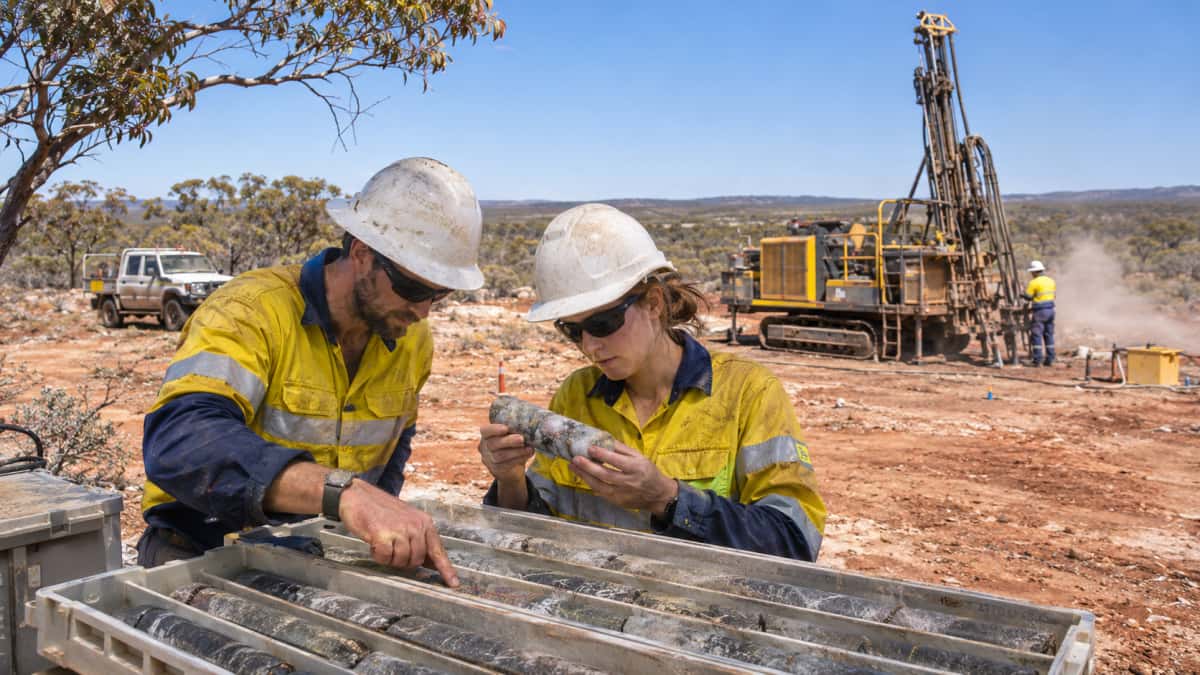
Why it matters: Whether the eastern high-grade zones form continuous mineralised structures will determine if they can support resource growth or influence Apollo Hill’s mine plan.
9 metres at 12.91 g/t gold — including 4 metres at 27.98 g/t in hole AHRC1765.
2.83 million ounces — Apollo Hill’s current mineral resource, at 0.51 g/t gold.
5,000 metres — planned additional reverse-circulation drilling to test the eastern structures.
2027 — the company’s target timing for a resource update.
Saturn Metals reported high-grade gold intercepts east of its Apollo Hill project near Leonora in Western Australia, including 9 metres at 12.91 grams per tonne (g/t) gold from 226 metres in hole AHRC1765. The interval includes 4 metres at 27.98 g/t from 227 metres. Some of the mineralised structures are outside the boundaries of the current resource, and the company plans further drilling to assess their extent and continuity.
The reported intervals are lengths down the drill holes, not necessarily true widths. Saturn, which owns 100% of Apollo Hill, said the additional 5,000 metres of reverse-circulation drilling will also tighten spacing between existing holes and improve its interpretation of the geology. The work is intended to support a resource update planned for 2027.
High-grade intercepts sit beyond parts of the resource
Other results include 12 metres at 4.93 g/t gold from 86 metres in AHRC1741, including 5 metres at 10.83 g/t; 8 metres at 9.16 g/t from 180 metres in AHRC1747, including 3 metres at 22.80 g/t; and 6 metres at 6.23 g/t from 74 metres in AHRC1757, including 2 metres at 16.14 g/t.
The company also reported 6 metres at 6.23 g/t from 220 metres in AHRC1749, 8 metres at 3.09 g/t from 353 metres in AHRC1746, and 8 metres at 2.00 g/t from 178 metres in AHRC1748. The eastern structures remain open laterally and at depth along their geological orientation, according to Saturn.
Apollo Hill’s current resource is 174 million tonnes grading 0.51 g/t gold, or 2.83 million ounces. In June 2026, Saturn added 590,000 ounces to the estimate, taking it from 2.24 million ounces after a drilling programme totalling about 63,000 metres. The company also identified gold-bearing structures extending up to one kilometre north of the existing resource in September.
Open-pit plan puts continuity and grade distribution in focus
Apollo Hill’s prefeasibility study outlines an open-pit operation with heap-leach processing capacity of 10 million tonnes of ore a year. The study projects average annual production of about 106,000 ounces of gold over the first 12 years. Higher-grade zones could affect the grade distribution and extraction sequence, but their potential contribution depends on continuity, geometry, metallurgy and economic mine design.
The project has a separate mineral reserve estimate of 104.6 million tonnes grading 0.47 g/t gold, equivalent to 1.586 million ounces, reported in December 2025. The new intercepts do not establish that the eastern zones can be included in either the resource or a future mine plan; the planned drilling is intended to test whether they represent continuous mineralisation rather than isolated concentrations.
Feasibility and approvals remain on the development path
Saturn revised its environmental and engineering schedule on 24 November 2026. The definitive feasibility study, previously expected in December, is now due in early 2027. A four-week public environmental review could move the final investment decision from late 2027 to early 2028. The company continues to target first gold production in 2029, subject to approvals, financing and construction.
Saturn raised A$100 million through an institutional placement and a further A$21 million through a share purchase plan in 2026. The planned drilling and 2027 resource update will help determine whether the eastern structures change Apollo Hill’s resource base as the company advances feasibility work and permitting.
More in Discoveries
QMines finds high-grade copper beneath Mt Chalmers, but old workings cloud continuity
A pontoon rig is testing ground between historic mine levels, with old plans needed to separate surviving mineralisation from mined-out areas.

Nimy nears final Mons gold hole, with soil anomalies still awaiting assays
More than 18,000 soil samples shaped the targets; the first drilling campaign is now moving from fieldwork to laboratory tests.
Challenger Gold finds Hualilán mineralisation, but waste blocks need reassessment
The 35,000-metre campaign is testing areas expected to feed Hualilán’s first heap-leach stage, while the status of other pit blocks remains open.