
QMines finds copper north of Mt Chalmers, but a 4 km corridor remains untested
The new targets sit in a lightly drilled stretch, leaving their connection to the existing resource unproven.
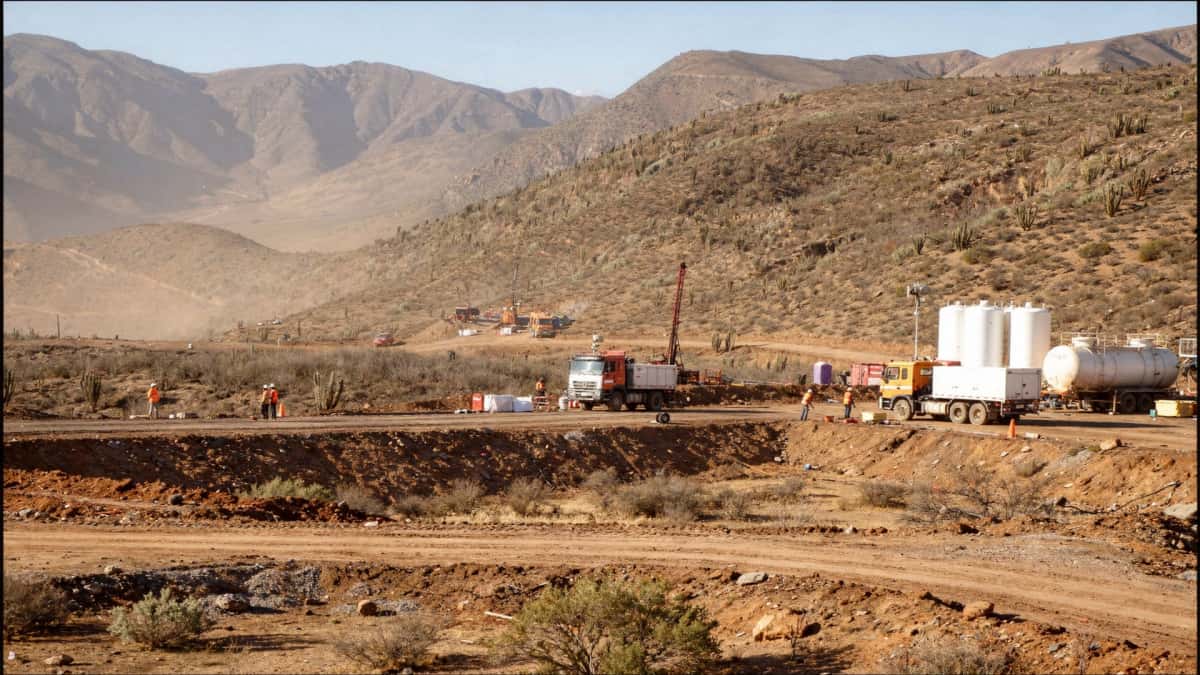
Why it matters: The intercepts extend exploration beyond Mt Chalmers’ known resource, but more drilling is needed to establish whether they belong to a continuous mineralised zone.
12 m at 2.83% copper — the higher-grade intercept began at 191 m in the first hole.
20 m at 0.45% copper — the second hole’s lower-grade interval began at 170 m.
About 4 km — the mostly undrilled strike QMines has identified between Mt Chalmers, Woods Shaft and Botos.
20,000 m — the company’s expanded district-wide drilling program.
QMines reported copper intercepts in two diamond drill holes about 180 m north-northeast of the Mt Chalmers resource in central Queensland. The results extend exploration beyond the known deposit, but do not establish continuity between the new intersections or with the existing mineralisation.
The first hole returned 12 m at 2.83% copper from 191 m, including 4 m at 5.30% and a 2 m interval at 7.05%. The reported results also include 2 m at 5.27% copper from 201 m. The company said laboratory assays confirmed copper sulphides observed in the core in October. True widths were not stated.
Two holes test ground north of the resource
A second diamond hole, drilled from the same platform in the opposite direction, returned 20 m at 0.45% copper from 170 m. A separate interval returned 5 m at 0.76% from 207 m, including 1 m at 2.43%. The intersection was at a similar elevation and about 180 m from the first.
The two holes encountered chalcopyrite and pyrite veinlets in silicified volcanic rocks. Similar host rocks and alteration are consistent with the intersections forming part of the same hydrothermal system, QMines said, but do not prove a connection. The company described the intervening area as largely untested; exploration manager Tom Bartschi said the higher-grade result came from a sector with limited historical drilling.
A district corridor links three mineralised centres
The drilling targets a structural corridor QMines identified in June, linking Mt Chalmers with Woods Shaft and Botos. The company’s interpretation points to about 4 km of mostly undrilled strike, but further work is required to determine how mineralisation is distributed along it.
Mt Chalmers has a resource of 11.3 million tonnes grading 0.75% copper and 0.42 g/t gold. Its proven and probable reserve is 9.6 million tonnes at 0.65% copper and 0.48 g/t gold. QMines is advancing a definitive feasibility study for a potential restart of the historic mine alongside a district exploration program.
The company expanded that program to 20,000 m from 10,000 m on September 29, 2026, adding exploration at Woods Shaft and Botos to the work at Mt Chalmers. The campaign is intended to test resource-growth targets as well as the wider district.
Follow-up assays and drilling remain outstanding
Four reverse-circulation holes have already been attempted in the northern corridor, with assays pending. QMines also said about 15 holes from its broader program were at the laboratory and that it expected further results before Christmas.
The company plans to drill between and beyond the two recent intersections, as well as toward the known deposit. Those holes will test whether the new results outline a broader mineralised zone or represent separate positions within the system; any resource addition would require further drilling and geological modelling.
More in Discoveries
Red Metal’s Pernatty PH1 test faces an access hurdle before 2027 drilling
A historic copper intercept lies near the target, but it does not test the buried-intrusion model Red Metal plans to investigate.
Barkly Rare Earths extends mineralisation, but resource update remains pending
New holes carry the footprint beyond the conceptual target, while assays are still due before the next estimate can be revised.
Mount Hope tests Mt Solitary gold below RC hits, but continuity is unproven
Earlier RC drilling ended in mineralisation, leaving the shape and link between the deeper gold zones unresolved.