
Kalgoorlie Gold finds volcanic rocks beneath mapped granite at Pinjin
The under-cover target lies 20 km along strike from Ramelius Resources’ Rebecca deposit, but the new sequence’s gold potential remains untested.
kalgoldmining.com.au
Why it matters: Identifying volcanic rocks under cover could change the geological model used to assess Pinjin’s gold targets, but the new sequence has not yet been assayed.
105 holes, 4,858 metres — aircore drilling at Rebecca Sequence.
20 holes, 4,860 metres — reverse-circulation drilling at Lighthorse.
76,400 ounces — gold resource reported at Pinjin.
20 kilometres — distance along strike from Rebecca Sequence to Ramelius Resources’ Rebecca project.
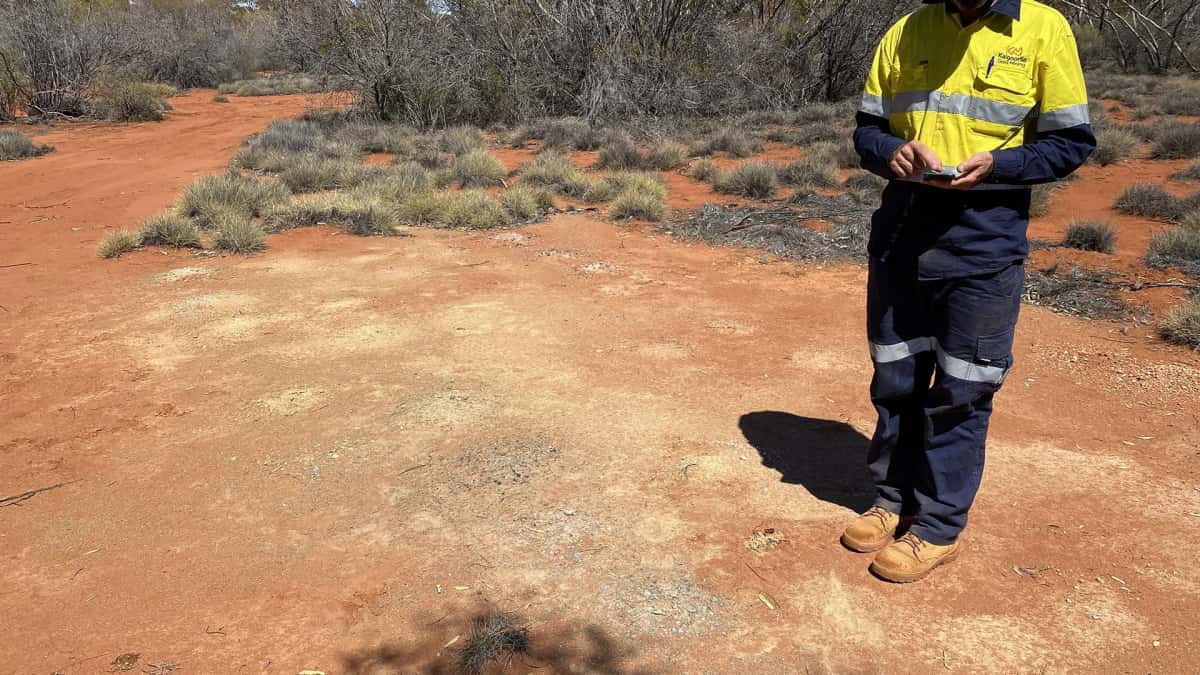
Kalgoorlie Gold Mining has identified a sequence of mafic and felsic volcanic rocks beneath cover at its Pinjin project in Western Australia, in an area where regional mapping had interpreted the underlying rocks as granite. The company said assays from the first-pass aircore campaign are pending, so the drilling has not confirmed gold mineralisation in the newly identified sequence.
Pinjin is about 140 kilometres northeast of Kalgoorlie and has a reported gold resource of 76,400 ounces. Kalgoorlie Gold completed nearly 10,000 metres of drilling across two programs: aircore work at Rebecca Sequence and reverse-circulation (RC) drilling at the Lighthorse discovery.
Aircore drilling challenges the regional interpretation
The Rebecca Sequence program comprised 105 holes for 4,858 metres. It intersected mafic and felsic volcanic rocks below cover in an area where government regional mapping had indicated granite, according to the company.
The target is about 20 kilometres north of Ramelius Resources’ Rebecca gold project, measured along geological strike. Rebecca has a reported resource of 1.4 million ounces. The proximity provides geological context for Kalgoorlie Gold’s target, but does not establish that the same mineralisation extends to Pinjin.
The distinction between volcanic rocks and granite matters to exploration in the Eastern Goldfields. Deformed greenstone belts commonly host major gold deposits in the region, while granites are generally considered less prospective. The new drilling therefore provides evidence about the rocks beneath the cover, not proof of an economic gold system. Samples have been sent to a laboratory, and the company has reported neither gold grades nor a resource estimate for Rebecca Sequence.
Lighthorse drilling tests depth continuity
Separately, Kalgoorlie Gold completed 20 RC holes for 4,860 metres at Lighthorse, targeting the continuation of mineralisation at depth. The new holes were drilled below areas where earlier campaigns reported intersections of 1 metre at 19.7 g/t gold and 3 metres at 9.01 g/t gold.
The company described intense alteration, veins, shears and sulphides in the geological logging of the new RC holes. Those are observations from the drill material and are not assay results. Samples from the Lighthorse program also remain under analysis.
Pinjin sits at the southern end of the Laverton Tectonic Zone, which is associated with a regional gold inventory of more than 30 million ounces. Kalgoorlie Gold reports more than 214,000 ounces of resources across its projects and a discovery cost below $4.60 per ounce. The largest share is at La Mascotte, within the Bulong Taurus project, where the company reports 138,000 ounces. The next concrete test at both Pinjin targets is the return of laboratory results.
More in Discoveries
QMines finds high-grade copper beneath Mt Chalmers, but old workings cloud continuity
A pontoon rig is testing ground between historic mine levels, with old plans needed to separate surviving mineralisation from mined-out areas.

Nimy nears final Mons gold hole, with soil anomalies still awaiting assays
More than 18,000 soil samples shaped the targets; the first drilling campaign is now moving from fieldwork to laboratory tests.
Challenger Gold finds Hualilán mineralisation, but waste blocks need reassessment
The 35,000-metre campaign is testing areas expected to feed Hualilán’s first heap-leach stage, while the status of other pit blocks remains open.