
Prairie Lithium brings Duperow brine to surface as Pad #1 awaits processing integration
The Saskatchewan site is prepared for winter, but the next stage depends on integrating a DLE unit with processing and support systems.
prairielithium.com
Why it matters: Brine recovery advances Prairie Lithium’s Saskatchewan project to further testing, but the planned processing circuit is not yet installed or operating.
C$6.3 million — Canadian government funding approved for Phase 1 processing equipment and auxiliary systems.
Four columns — the configuration of the DLE unit delivered to the project.
About 150 tonnes a year — planned Phase 1 production, measured as lithium carbonate equivalent.
Prairie Lithium recovered brine from a production well at its Saskatchewan project after re-entering the well, perforating productive zones in the Duperow formation and using swabbing to bring fluid to surface. The sample is intended for additional metallurgical testing. The company has not reported the volume recovered or laboratory results from this work.
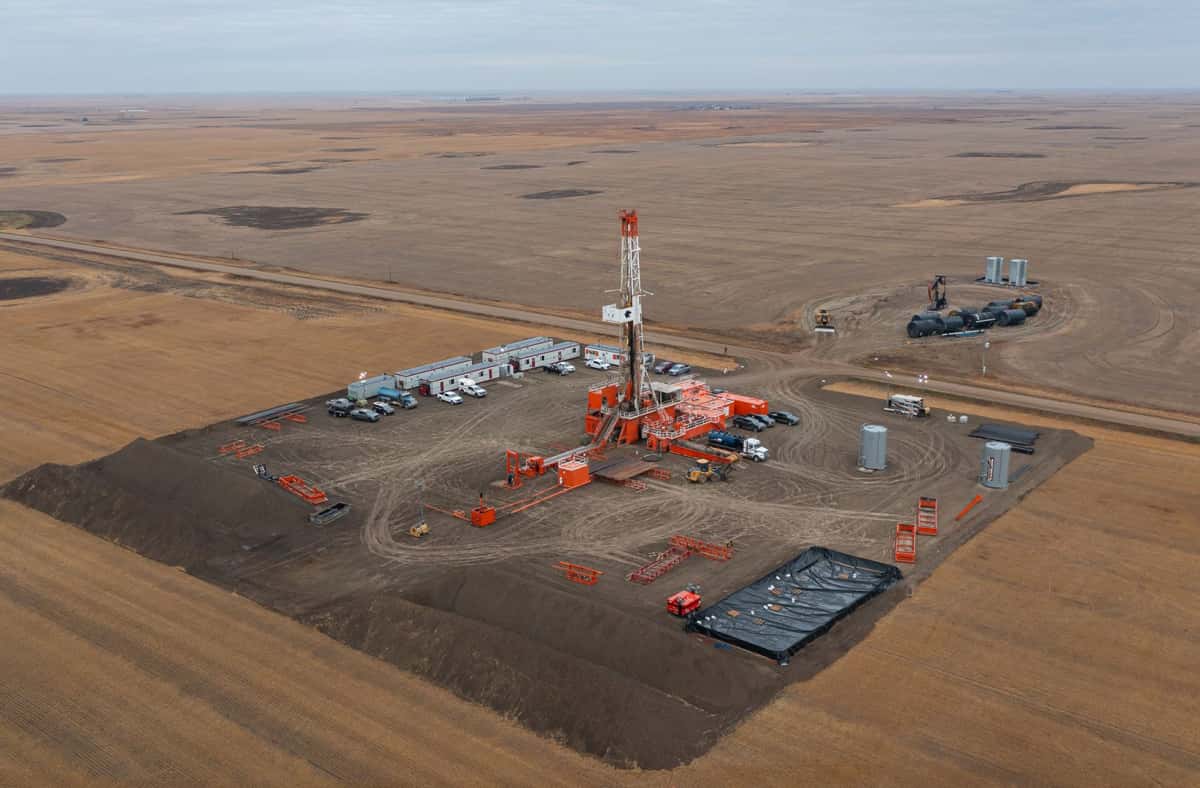
The recovery followed completion of site expansion and civil works, including grading and contouring to make room for additional infrastructure. Prairie said the work and well re-entry programme were completed before the Canadian winter. Pad #1 is being prepared for processing, but the recovery of brine does not mean the processing circuit is installed or operational.
Duperow brine will undergo further testing
A local services team completed the production-well work. After perforating the productive zones, the team used swabbing, a method to lift fluid from a well to the surface. Prairie plans to use the recovered brine in further metallurgical tests, which will inform development of the processing sequence.
The company has identified pre-treatment, direct lithium extraction (DLE) and lithium chloride concentration as components of the planned Phase 1 circuit. It has not disclosed a timetable for completing or commissioning those systems. Prairie said the pace and schedule of development will depend on financing availability, project requirements and lithium-market conditions.
Processing equipment is delivered, but integration remains
Pad #1 has completed production and disposal wells, electrical infrastructure and a facilities building. A four-column DLE unit, described by Prairie as commercial scale, has also arrived at the project. Further infrastructure, processing equipment and auxiliary systems still need to be installed and integrated.
In September, the Government of Canada approved C$6.3 million in funding through Economic Development Canada. Prairie expects to use the funding for Phase 1 processing equipment and auxiliary systems. The award does not establish that installation is complete or set a start-up date.
Planned output is covered by an offtake agreement
Prairie has a binding offtake agreement with Hydro Lithium for 100% of planned Phase 1 production, estimated at about 150 tonnes a year of lithium carbonate equivalent. That is a production target, not material already produced; the project still requires further metallurgical testing and integration of its processing equipment.
The International Energy Agency’s 2026 outlook estimates that lithium demand grew by an average of about 25% a year over the preceding two years, driven alongside other battery minerals by electric vehicles and energy storage. Under its stated-policies scenario, the agency projects demand to more than triple by 2040. Prairie, however, has said its development pace will also reflect current market conditions.
The next identified work includes additional tests on the recovered brine and planning and integration of the pre-treatment, DLE and lithium chloride concentration systems.
More in Critical Minerals
AVEVA puts mine data at the centre, but productivity gains remain unmeasured
Water, energy and mine-site systems can be joined, but their records must first become comparable across platforms.
CIPTEMIN and INACAP put Chile’s lithium value-add ambitions to the test
A SQM specialist pointed to cathode materials as one possible next step, putting local research and development at the centre of the discussion.
GBM tests electric haulage at Kearney as graphite restart nears
The trial is meant to inform fleet spending, but Kearney’s real haul cycles must first be reconciled with digital models.