
Tudor Gold’s 28-year Treaty Creek study depends on Goldstorm alone
Tudor is seeking a route to higher-grade underground material, but the access plan hinges on a permit not yet secured.
teuton.com
Why it matters: Goldstorm’s standalone economics set the baseline for Treaty Creek, while any contribution from other targets would require further drilling and a revised study.
28.25 years — projected operating life at a nominal rate of 10,000 tonnes per day.
US$1.54 billion — estimated pre-production capital, including contingencies.
US$2.3 billion — base-case after-tax net present value at a 5% discount rate.
20% — base-case after-tax internal rate of return.
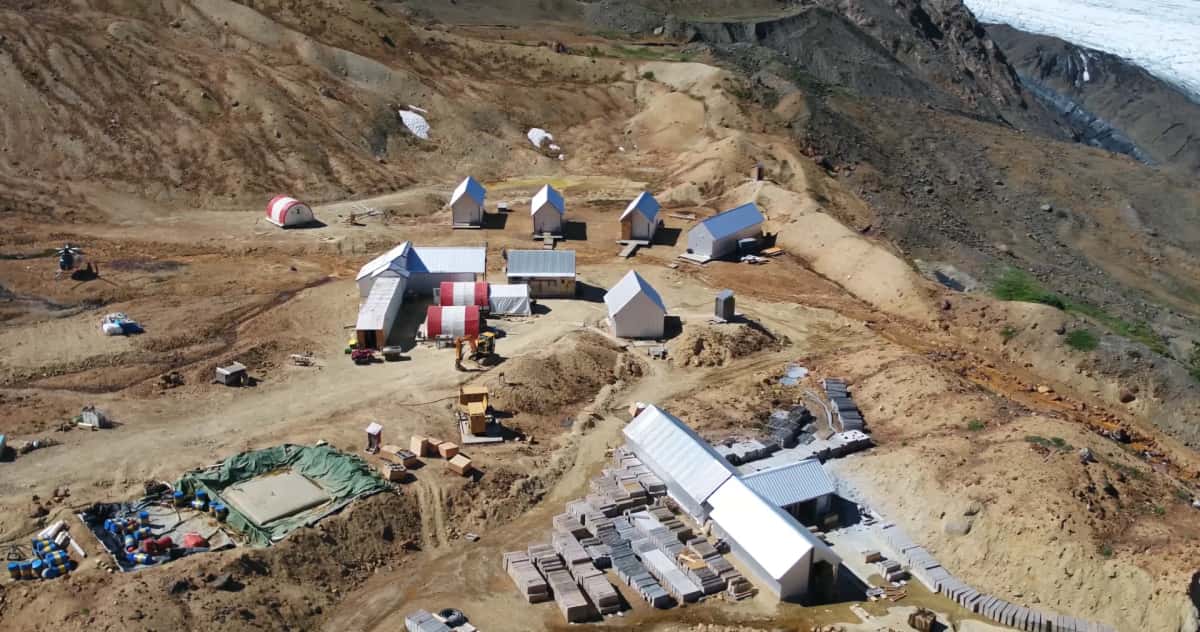
Tudor Gold’s preliminary economic assessment (PEA) estimates that the Goldstorm deposit could support a 28.25-year underground mine at its 80%-owned Treaty Creek project in British Columbia. The study projects production of gold, silver and copper at a nominal rate of 10,000 tonnes per day, but excludes mineralisation from every other zone on the property.
The PEA’s base case estimates US$17.8 billion in revenue and US$5.7 billion in after-tax cash flow over the mine life. Those are preliminary projections, not results from an operating mine.
Goldstorm sets the production and valuation case
Prepared by Vancouver-based Fuse Advisors, the study uses Goldstorm’s 2025 mineral resource estimate, effective November 30, 2025, and announced on January 22, 2026. Tudor said the work follows NI 43-101; Garth Kirkham of Kirkham Geosystems contributed to the resource estimate.
The model plans to extract 97.8 million tonnes of mineralised material and produce 4,677,902 ounces of gold, 22,142,780 ounces of silver and 209,862 tonnes of copper. Estimated average recoveries are 82.7% for gold, 85.0% for silver and 87.5% for copper.
After a two-year production ramp-up, the study forecasts average annual output from years three to 12 of 202,262 ounces of gold, 755,843 ounces of silver and 7,295 tonnes of copper. Across the full mine life, annual averages are estimated at 165,589 ounces of gold, 783,815 ounces of silver and 7,429 tonnes of copper.
The base case assumes prices of US$3,670 per ounce of gold, US$50 per ounce of silver and US$5 per pound of copper. It estimates a 3.7-year payback. In a higher-price case using US$4,500 gold, US$70 silver and US$6.50 copper, after-tax NPV rises to US$3.7 billion, the internal rate of return to 26.8%, and after-tax cash flow to US$8.6 billion. The study also includes a spot-price case based on market prices on November 23, 2026.
Underground design carries a substantial upfront cost
Pre-production capital is estimated at US$1.5408 billion, including US$272.5 million in contingency. Construction accounts for US$769.2 million, mining for US$206.4 million and other items for US$292.7 million. The model also includes US$438.7 million for mine development, US$355.9 million in sustaining capital and US$178 million for closure and rehabilitation.
The proposed mine uses long-hole stoping with paste backfill, divided into four mining zones. Two main ramps are planned: one to move mineralised material and another for vehicles and personnel. The sequence prioritises higher-grade zones early in the mine life; the study says paste backfill is intended to reduce dilution and improve mining recovery. Base-case all-in sustaining costs are estimated at US$1,358 per ounce of gold, net of silver and copper credits.
Other Treaty Creek targets remain outside the PEA
Goldstorm is the only Treaty Creek deposit with a mineral resource estimate, and the PEA assigns no economic contribution to other identified zones. Tudor plans underground exploration to better define higher-grade mineralisation and reduce dilution, but expects to obtain a permit to begin ramp excavation in 2027; that permit has not been confirmed.
The company has also identified a potential high-grade gold zone at Perfectstorm, about one kilometre west of Goldstorm. Tudor reported 10 holes that expanded the Perfectstorm porphyry in September 2026, followed on November 11 by an interval of 1.20 metres at 43.29 g/t gold. The zone is not included in the PEA. Tudor plans infill and expansion drilling in 2027 and says it could prepare an initial resource estimate before year-end if results support one. The company said it will file the PEA’s technical report on SEDAR+ within 45 days of the announcement; adding Perfectstorm to a future mine plan would depend on exploration results and a subsequent study update.
More in Resources

Agua Negra crossing delay puts Coquimbo’s summer tourism trade at risk
Snow and damage on Route 41-CH have stalled a seasonal link relied on by coastal businesses during the peak visitor period.

Chile’s peso slides as copper sell-off sends dollar to its highest since 2022
Copper’s decline weakened a key external support for the peso as traders reassessed US rate expectations and technology-sector risk.
Antofagasta export inspections reach plants, but specific risks remain undisclosed
Copper, molybdenum and lithium exports involve different processing and logistics stages before shipment.