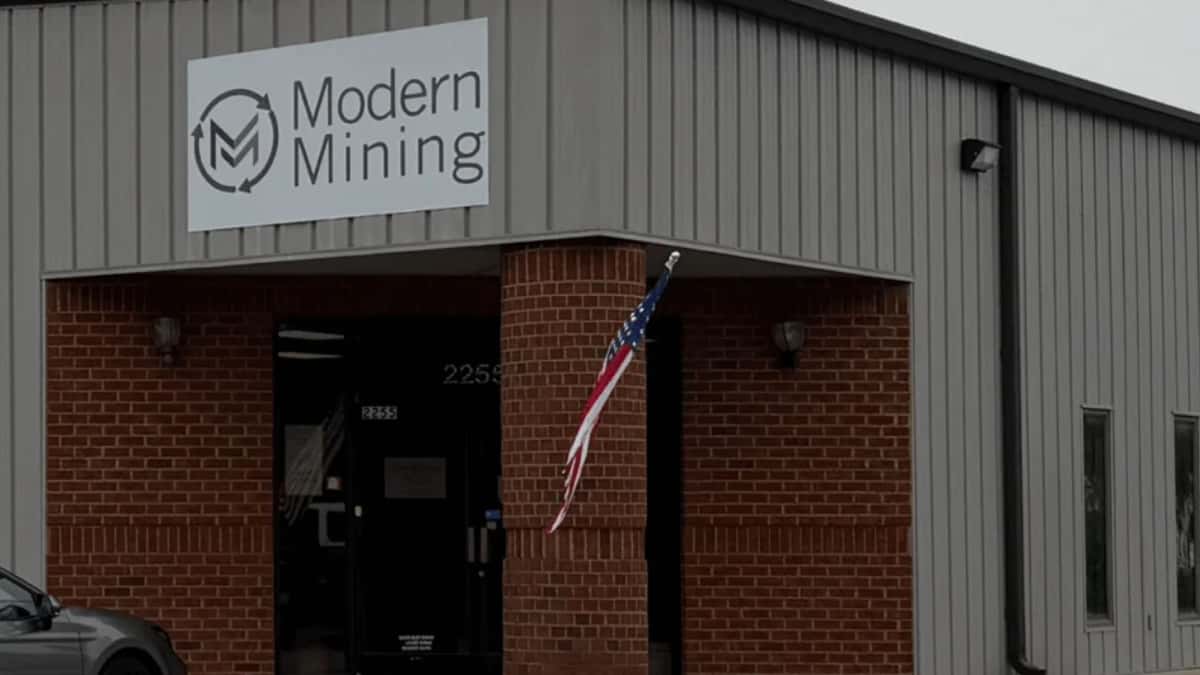
Modern Mining plans North Carolina e-waste plant, but commercial scale is untested
A US$40 million IPO backs the move beyond a Greenville pilot, but supply contracts and industrial economics still need to be established.
Why it matters: The project would add a US-based source of recovered metals, but its commercial case depends on securing electronic scrap and proving the process at industrial scale.
40,000 gold-equivalent ounces a year — the plant’s estimated design capacity.
Up to 1 tonne an hour — planned throughput for the first pre-concentration facility.
41 product batches — reported as commercialised from the Greenville experimental operation between December 2023 and June 2026.
62 million tonnes — global e-waste generated in 2022, with 22.3% documented as formally collected and recycled.
Modern Mining Technology Corp. plans to develop its first commercial e-waste metal recovery operation in North Carolina over 18 months, targeting design capacity of 40,000 gold-equivalent ounces a year. The company presented the plan on November 18, after completing an initial public offering that raised approximately US$40 million on November 12.
The proceeds are intended to fund infrastructure, equipment and operational preparation as Modern Mining moves from pilot work toward commercial production. The company’s target is a design estimate, not current production: its commercial facility has yet to be built and must still demonstrate that it can operate at scale.
A two-stage process for electronic scrap
The proposed process uses chemical treatment in aqueous solutions to separate metals in printed circuit boards and other electronic components. Modern Mining says it is designed to recover gold, silver, copper and palladium from discarded computers, communications equipment and other end-of-life devices.
The initial pre-concentration plant is designed to process up to one tonne of circuit boards per hour. It would concentrate higher-value material before sending it to a purification facility for further treatment. The company’s longer-term model is to connect regional pre-concentration plants to a central purification hub in North Carolina, which it estimates could receive concentrates from as many as five such plants.
Modern Mining has operated an experimental facility in Greenville since November 2023. It reported commercialising 41 batches of recovered metal products between December 2023 and June 2026. That operating history provides a basis for the next development stage, but the company has not yet shown that the proposed commercial configuration can sustain its planned throughput or economics.
Funding and execution remain central tests
The company’s 18-month schedule allocates the first six to nine months after the IPO to building the pre-concentration and purification facilities, securing e-waste supply contracts and training operating teams. Between months nine and 12, it expects to complete commissioning and move toward planned processing capacity. The final phase, from months 12 to 18, is intended to ramp commercial production and revenue.
Modern Mining also plans to seek R2 certification, a responsible electronics-recycling standard, and to develop supply agreements with recyclers, manufacturers and businesses that handle used technology. Those arrangements will be important to ensuring the plant has enough material to process; the company has not reported that all required supply contracts are in place.
Financial statements for the period ended September 30, 2026, showed no ordinary commercial revenue and identified uncertainty about the company’s ability to continue operating without additional financing. The statements pre-date the November IPO, but the capital raise does not remove the operational requirements to complete construction, obtain necessary authorisations and establish a reliable feedstock stream.
E-waste supply offers a large but underused pool
The project sits within urban mining, which seeks to recover materials from discarded products rather than relying solely on mined ore. The Global E-waste Monitor 2024, produced by the International Telecommunication Union and the United Nations Institute for Training and Research, estimated that the world generated 62 million tonnes of e-waste in 2022; only 22.3% was documented as formally collected and recycled. The report projects annual generation could reach 82 million tonnes by 2030.
That global volume does not establish how much suitable material Modern Mining can secure or process economically. The company’s next stated steps are construction, supply agreements, commissioning and the planned production ramp; the 18-month schedule and the facility’s commercial performance remain to be demonstrated.
More in Resources
Oil faces third weekly loss as Gulf supply recovers despite Hormuz strike
A tanker strike north of Oman puts shipping risk against a rapid return of Gulf exports.
Sonoro Gold advances Cerro Caliche engineering as heap-leach ground risks are tested
The proposed heap-leach pad is central to the Sonora project, but construction planning still depends on subsurface work and permitting.

Chile’s peso faces a copper-led test as the dollar breaks through $1,020
A sharp drop in copper coincided with renewed bets on U.S. rate hikes and doubts over the returns from data-centre investment.