Codelco faces two serious charges that put Ministro Hales’ permit at risk
The missing baghouse is one of two alleged failures; the case also tests how Codelco documented dust controls at the Calama operation.
Why it matters: The case puts operating conditions at a major Codelco copper mine under regulatory scrutiny, although no production halt or final sanction has been ordered.
10,000 UTA — maximum combined fine cited for the two serious charges.
75% — minimum emissions-abatement efficiency Codelco had committed to at the primary crusher.
85% — targeted reduction in wind erosion for designated areas of the waste-rock dump.
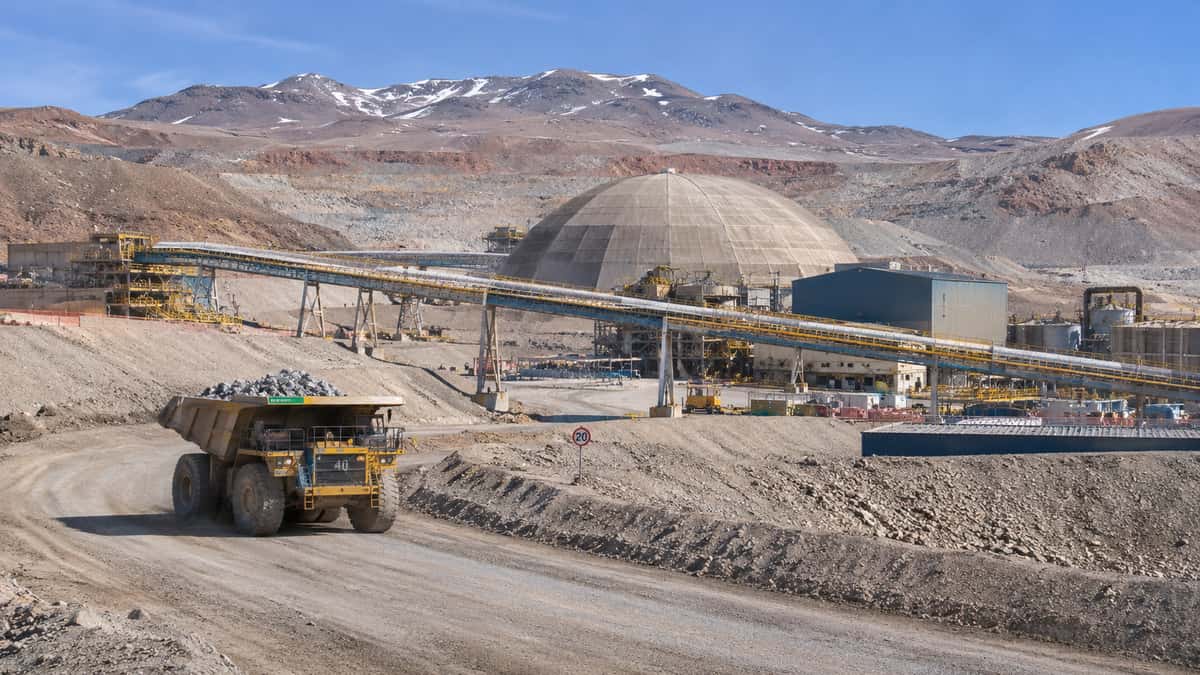
Codelco faces two serious environmental charges over dust controls at its Ministro Hales Division in Calama, northern Chile, in a case that could result in fines, closure or revocation of the operation’s environmental approval. The Superintendence of the Environment (SMA) opened the proceeding on November 18, 2026; the charges are allegations, not a final ruling, and the mine has not been ordered to stop operating.
The regulator’s case concerns the primary crusher and inactive areas of the waste-rock dump. It follows environmental inspections and information linked to seven citizen complaints filed between 2021 and 2024.
Primary crusher operated without the approved baghouse
The first serious charge concerns the primary crusher, which reduces mined material before further processing. Inspectors found it operating without the baghouse filter required by the operation’s environmental approvals. The system is intended to capture dust generated during crushing and material handling.
The SMA also alleges that emissions-abatement efficiency fell below the committed 75% threshold for four consecutive months: November and December 2023, and January and February 2024. The charge relates to conditions set out in environmental resolutions governing the mine.
Waste-rock dump treatment and records are also under review
The second charge concerns dust controls in inactive areas of the waste-rock dump. According to the SMA’s allegations, Codelco did not apply bischofite during 2023 and 2024 in areas where the treatment was required. The measure was intended to reduce wind erosion by 85% in the relevant zones.
The case also cites a lack of records demonstrating that the treatment was applied during 2023, 2024 and 2025. That means the regulator is examining both whether the dust-control measure was carried out and whether Codelco can document its implementation.
Calama has been declared a saturated zone for respirable particulate matter, or MP10. The SMA’s proceeding does not, by itself, quantify how much the alleged failures contributed to local air concentrations. Compliance with a required mitigation measure and the measured effect of a source on ambient air quality are related but distinct questions.
Maximum penalties are not a final outcome
For each serious infringement, the potential penalties cited include a fine of up to 5,000 UTA, closure or revocation of the relevant environmental approval, known in Chile as an RCA. The two charges could therefore carry a combined maximum fine of 10,000 UTA. That is a theoretical ceiling, not a penalty imposed by the regulator.
The SMA has not issued a decision ordering closure or revoking Ministro Hales’ RCA, and no production loss has been confirmed as a result of the charges. Any such consequence would depend on the administrative process and the authority’s eventual decision.
The proceeding, identified as file D-266-2026, remains open. Codelco will need to address the alleged failures involving the crusher and waste-rock dump as the case advances. Separately, the SMA has approved a compliance programme for a different Codelco proceeding concerning seepage at the Talabre tailings storage facility; that programme does not resolve the new charges at Ministro Hales.
More in Resources
Copper falls to US$5.70 as eight-session slide tests 2026 outlook
Physical supply constraints remain a counterweight, but concerns over China’s industrial demand and a stronger US dollar are weighing on the market.
Chile’s US$111.149bn mining pipeline sets a record, but permits remain a test
Two major lithium projects remain in environmental review, putting the delivery of a large share of the pipeline’s growth to the test.

Mercuria flags recession-like copper demand as Chinese stocks tighten
Copper’s AI-linked rally is losing conviction as China faces a squeeze on immediately available metal.