
Chile's copper industry faces a high-grade test after learning to mine lower grades
Lower grades have pushed up energy use and processing demands; any future discovery would enter a sector shaped by water and power constraints.
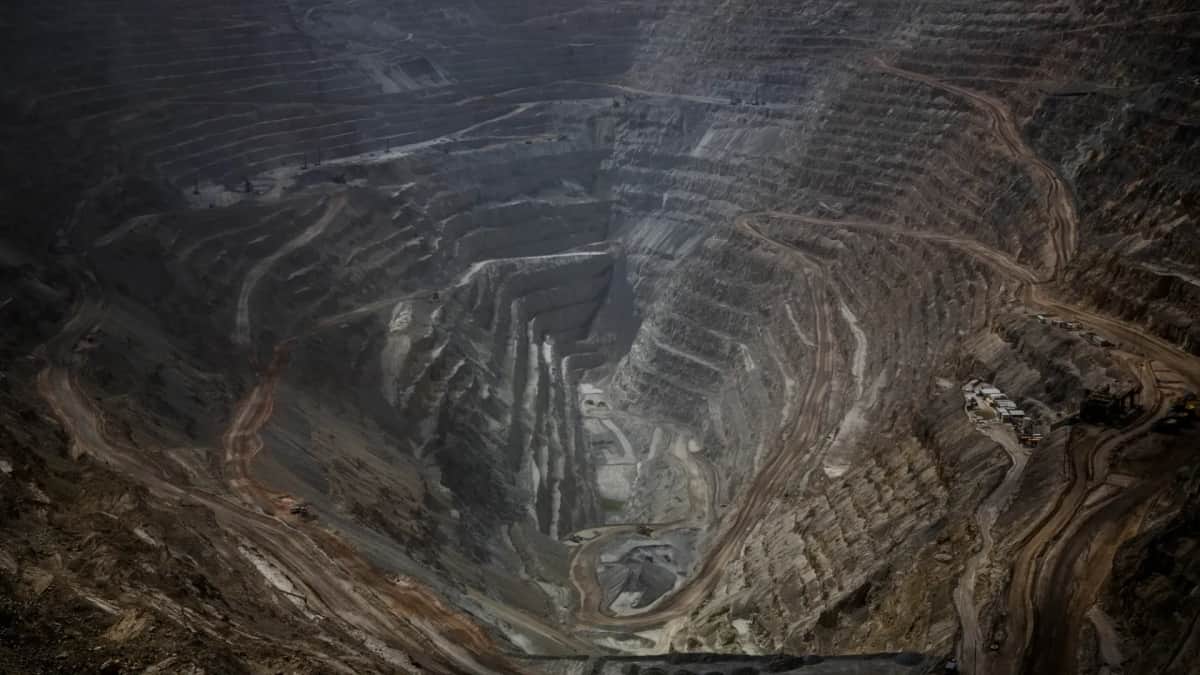
bloomberg.com
Why it matters: Chile's ability to apply its water, energy and processing expertise to any future high-grade deposits could influence how much copper existing infrastructure can produce.
5.77 million tonnes in 2015 and 5.39 million tonnes in 2025 — national copper output
165.5 PJ to 210.6 PJ — total mining energy use over the same period
72.5% — share of mining water use supplied by reused water in 2025
US$874.7 million — Chile's 2025 exploration budget, including US$669.6 million for copper
Chile has spent decades adapting its copper industry to lower grades, deeper mining and tighter water and energy constraints. That experience could improve the economics of future high-grade deposits, but the scenarios presented are hypothetical: they do not report a new discovery.
Cochilco figures show the pressure on the sector. From 2015 to 2025, copper production fell from 5.77 million tonnes to 5.39 million tonnes, while total energy consumption rose from 165.5 petajoules to 210.6 petajoules. Energy use per tonne of copper increased from 28.7 to 39.1 gigajoules. The figures reflect harder operating conditions as well as the industry’s efforts to manage them.
Water and power are shaping the operating model
Water scarcity has driven investment in desalination, seawater pumping, recovery from tailings and process-water recirculation. In 2025, reused and recirculated water reached 58.17 cubic metres per second, equal to 72.5% of total mining water use, according to Cochilco. The agency’s outlook projects seawater will account for 67.6% of external water supply to copper mining by 2034 under its scenario.
Energy demand remains another constraint. Cochilco projects electricity consumption will rise from 27.6 terawatt-hours in 2025 to 33.2 TWh in 2034, a 20.2% increase, while copper output is expected to grow 8.3%. The company-level and industry tools described in the analysis include more efficient grinding, automation, predictive maintenance and renewable power. Their effectiveness will depend on each mine’s geology and operating conditions.
Higher grades could change the processing equation
A hypothetical concentrator processing 10 million tonnes of ore annually at 90% metallurgical recovery would produce 54,000 tonnes of copper at a 0.6% grade. At 1.2% grade, the same throughput and recovery would yield 108,000 tonnes. This comparison illustrates the potential effect of grade; it is not a production forecast and does not assume unchanged water or energy use in every operation.
The material also models the ore required to produce 100,000 tonnes of copper annually. At 0.6% grade and 90% recovery, the calculation requires 18.52 million tonnes of ore; at 2.5% grade, it requires 4.44 million tonnes, 76% less. Lower throughput could reduce requirements for grinding, process water, reagents and tailings capacity, though actual outcomes would depend on mineralogy, rock hardness and process design.
A smaller discovery near existing infrastructure could also matter. In a separate illustrative case, blending 10% of 2.5%-grade ore into a 0.6%-grade feed would lift the blended grade to 0.790%, with a theoretical 31.7% production increase at constant throughput. The calculation assumes metallurgical compatibility and equivalent recovery.
Exploration remains the missing link
The Central Bank of Chile identified that about 80% of the 2025–2034 mining investment portfolio was directed to maintaining or expanding existing operations. Cochilco recorded a 2025 exploration budget of US$874.7 million, of which US$669.6 million was allocated to copper. The challenge is converting exploration spending into commercially viable discoveries and connecting deposits to infrastructure.
The analysis points to advanced geophysics, deeper drilling, artificial intelligence and historical geological data as tools that may support exploration. Any new project would still need to meet its own geological, water, energy, environmental and investment requirements. The productivity comparisons depend on their stated assumptions, and the next step is whether exploration identifies deposits that can be developed under those conditions.
More in Resources
Chile's mining investment leans on brownfields as falling grades test future output
Mature operations must process more material to sustain copper output, while new exploration still has to establish what lies beneath untested ground.
Argentina targets new copper mines as Chile spends to sustain mature operations
Seven advanced Argentine projects face a different test from Chile’s brownfield pipeline: turning proposed capacity into operating mines.
Chile's copper output gap could exceed US$11 billion, but not all is exploration
Cochilco's 2026 forecast sits below Chile's 2015 output, while ageing mines and operational disruptions complicate the cause.