
Chile’s 39% copper-growth scenario hinges on finding lost high grades
Escondida, Chuquicamata and El Teniente began with richer ore, while today’s national mill feed averages far less.
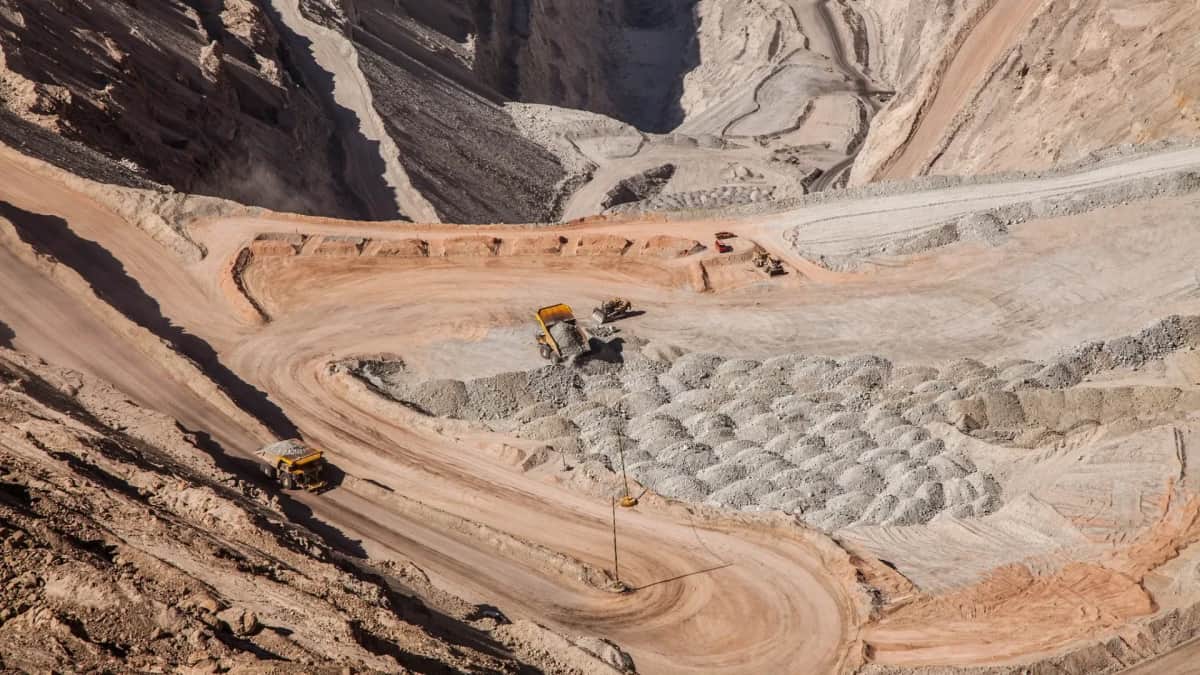
redimin.cl
Why it matters: Higher-grade discoveries could increase Chile’s copper output without requiring the same scale of ore processing as lower-grade mines.
0.58% — Chile’s average copper grade treated in 2025.
2.13 million tonnes — annual output in the three-mine hypothetical scenario.
39.5% — the modeled increase over Chile’s 2025 production.
US$874.7 million — Chile’s total exploration budget in 2025, according to Cochilco.
A hypothetical trio of new Chilean copper mines matching the early grades of Escondida, Chuquicamata and El Teniente could add about 2.13 million tonnes of copper a year, lifting national production from 5.388 million tonnes in 2025 to 7.514 million tonnes. The scenario assumes each mine processes 100,000 tonnes of ore a day for 350 days a year, with 90% metallurgical recovery; it is not a production forecast or evidence that such deposits have been found.
The historic grades are far above today’s average
Cochilco statistics compiled by the Consejo Minero put Chile’s average copper grade treated in 2025 at 0.58%. The early operating sectors of Escondida processed ore at roughly 2.5% to 2.9%, while the initial sectors of El Teniente recorded grades of 2% to 3%. Chuquicamata’s early grade was about 1.75%.
Those figures are not directly comparable. Historical grades refer to ore mined in particular periods or sectors, while the more recent figures cited for Chuquicamata and El Teniente are grades in mineral reserves at the end of 2025. Escondida’s 0.90% figure refers to concentrator feed in fiscal 2026.
Escondida’s own production history illustrates the change: its processed grade reached about 2.9% in 1993-94, compared with 0.90% in fiscal 2026. The mine has expanded concentrator capacity and used leaching and operational improvements to support production as grades declined, but the modeled comparison highlights how much metal content can vary per tonne of ore.
Three mines could add 2.13 million tonnes
The hypothetical uses grades of 2.5% for a new Escondida and a new El Teniente, and 1.75% for a new Chuquicamata. At the stated processing rate and recovery, the modeled annual outputs are 787,500 tonnes, 551,250 tonnes and 787,500 tonnes, respectively.
At a constant 90% recovery, a 2.5% grade deposit would require about 44 tonnes of ore to recover one tonne of copper, compared with about 192 tonnes at 0.58%. That difference could ease requirements for grinding, electricity, industrial water and tailings handling per tonne of copper. It would not guarantee equivalent reductions in total costs: depth, rock hardness, mineralogy, mining method and haulage distances would also matter.
The source analysis also models blending high-grade ore into existing plants. At a fixed processing capacity, replacing 10% of a 0.58% feed with compatible ore grading 2.5% would raise the blended grade to 0.772% and theoretical copper output by 33.1%. That case depends on a suitable deposit being close enough to infrastructure, on metallurgical compatibility and on the mine and plant being able to handle the blend.
Exploration spending does not ensure new discoveries
Cochilco put Chile’s 2025 mineral exploration budget at US$874.7 million, including US$669.6 million for copper. The spending includes work around known operations as well as exploration for new deposits. Separately, the Central Bank of Chile identified in 2026 that about 80% of the 2025-34 mining investment portfolio was directed at maintaining or expanding existing operations.
The scenario values the additional copper at more than US$23.4 billion a year at US$5 per pound, but that is gross production value, not profit, tax revenue or a direct contribution to GDP. Costs, capital requirements and other economic factors are excluded. Any deposit would also need to pass exploration, study, permitting, financing and construction stages; developing a discovery into a commercial mine can take more than a decade.
More in Resources
Chile's mining investment leans on brownfields as falling grades test future output
Mature operations must process more material to sustain copper output, while new exploration still has to establish what lies beneath untested ground.
Argentina targets new copper mines as Chile spends to sustain mature operations
Seven advanced Argentine projects face a different test from Chile’s brownfield pipeline: turning proposed capacity into operating mines.
Chile's copper output gap could exceed US$11 billion, but not all is exploration
Cochilco's 2026 forecast sits below Chile's 2015 output, while ageing mines and operational disruptions complicate the cause.